
Meta’s Andromeda Update, Explained: Why Your Facebook Ads Changed
If your Facebook ads got harder sometime in 2025 — CPMs climbing, old winners dying, campaigns that used to print money suddenly burning cash — there’s a good chance Andromeda is why. Here’s what Meta’s new AI retrieval engine actually is, why it changed everything, and the creative-first playbook that works with it.
Andromeda is Meta’s AI-powered ad retrieval engine — the first stage of delivery that narrows tens of millions of eligible ads down to a few thousand candidates for each impression, before ranking and the auction. It runs on custom hardware with models roughly 10,000× larger than the old system, and rolled out across Facebook and Instagram in 2024–2025. The practical upshot: delivery shifted from audience-first targeting to creative-first matching — your creative is now the main signal that decides who sees your ad.
What is Meta's Andromeda update?
Andromeda is Meta's next-generation ad retrieval engine — the part of the system that decides which ads are even eligible to be shown to you before any bidding happens. Meta introduced it in a December 2024 engineering post, describing a system co-designed across machine learning, software and custom hardware (Meta's MTIA chips plus the NVIDIA Grace Hopper Superchip) that enables roughly a 10,000× increase in model complexity at the retrieval stage.
In plain terms: every time someone opens Facebook or Instagram, the system has to pick a handful of ads to show from a pool of tens of millions. Andromeda is the engine that scans that enormous pool in milliseconds and shortlists the few thousand most relevant candidates. It doesn't pick the final winner — it decides who gets into the room.
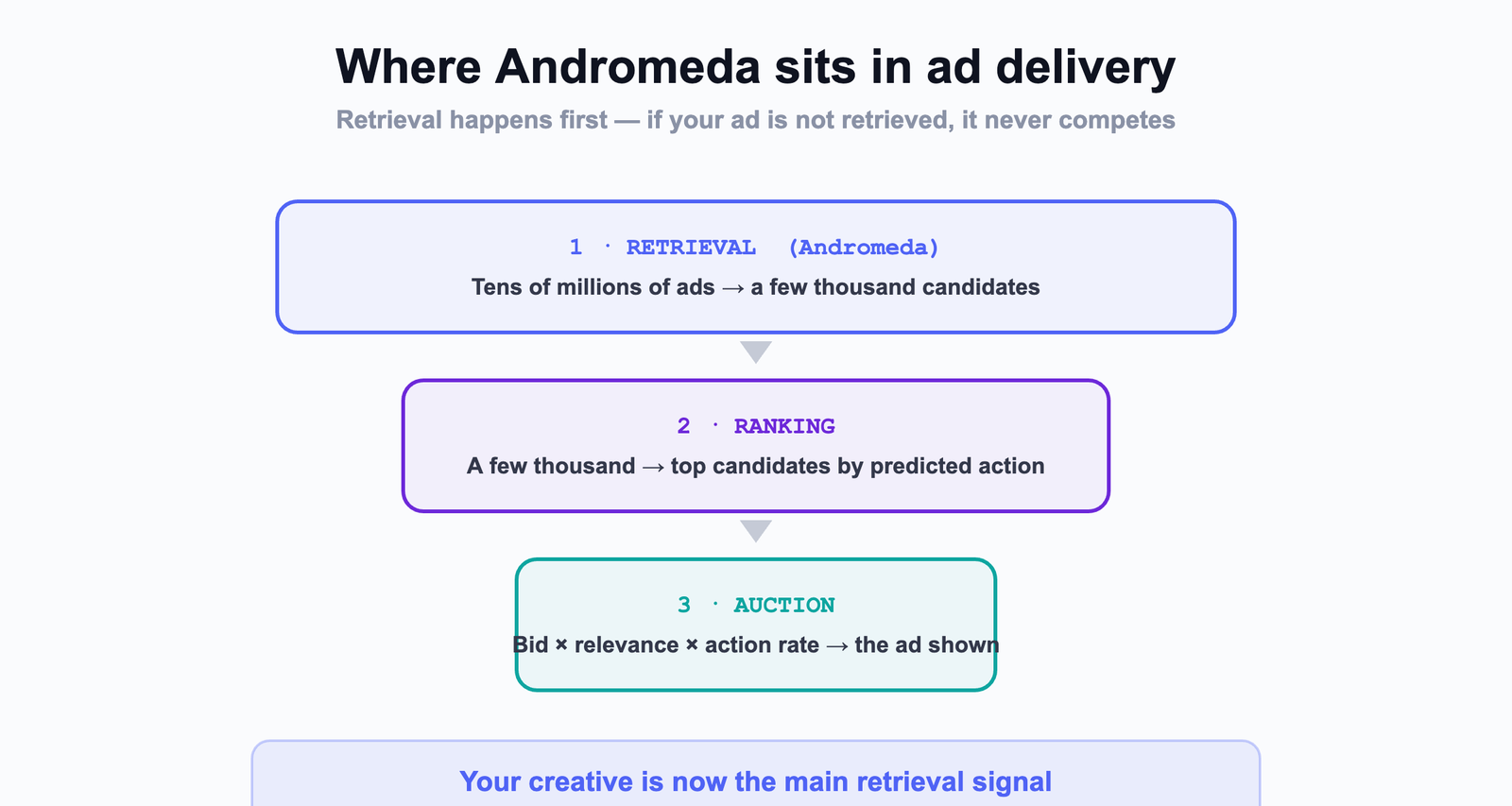
Retrieval comes first — if your ad isn't retrieved, it never competes.
Why did Meta need this? Because creative volume exploded. Once AI creative tools and Advantage+ let advertisers upload 50, 100 or hundreds of auto-generated variations instead of five, the old retrieval layer simply couldn't keep up. Andromeda was Meta's answer to that scale problem — and Meta reported recall and ad-quality improvements at launch as it rolled out across accounts through 2024–2025.
Why your Facebook ads suddenly changed
Here's the part that confused thousands of advertisers: accounts switched over to Andromeda at different times. Some saw performance swing in December 2024; others sailed along until well into 2025. If your account flipped and you didn't know why, it looked like the algorithm had simply broken — CPMs climbing, ROAS sliding, campaigns that printed money for years suddenly bleeding.
Nothing was broken. The rules changed underneath you. Strategies built for the old audience-first system — stacked interests, dozens of narrow ad sets, tiny tweaks between ads — stopped working because Andromeda rewards almost the opposite behavior. And crucially, this wasn't a privacy or tracking change: your Pixel didn't break and Meta isn't tracking users more than before. Meta just got dramatically better at using the data it already had.
The big shift: your creative is now your targeting
This is the single most important change to understand. Under the old system, targeting and creative were separate jobs — you picked an audience, then showed it an ad. Under Andromeda, your creative is the targeting signal. The system reads your ad's visuals, copy, format and messaging to infer who should see it, then finds those people across a broad pool.
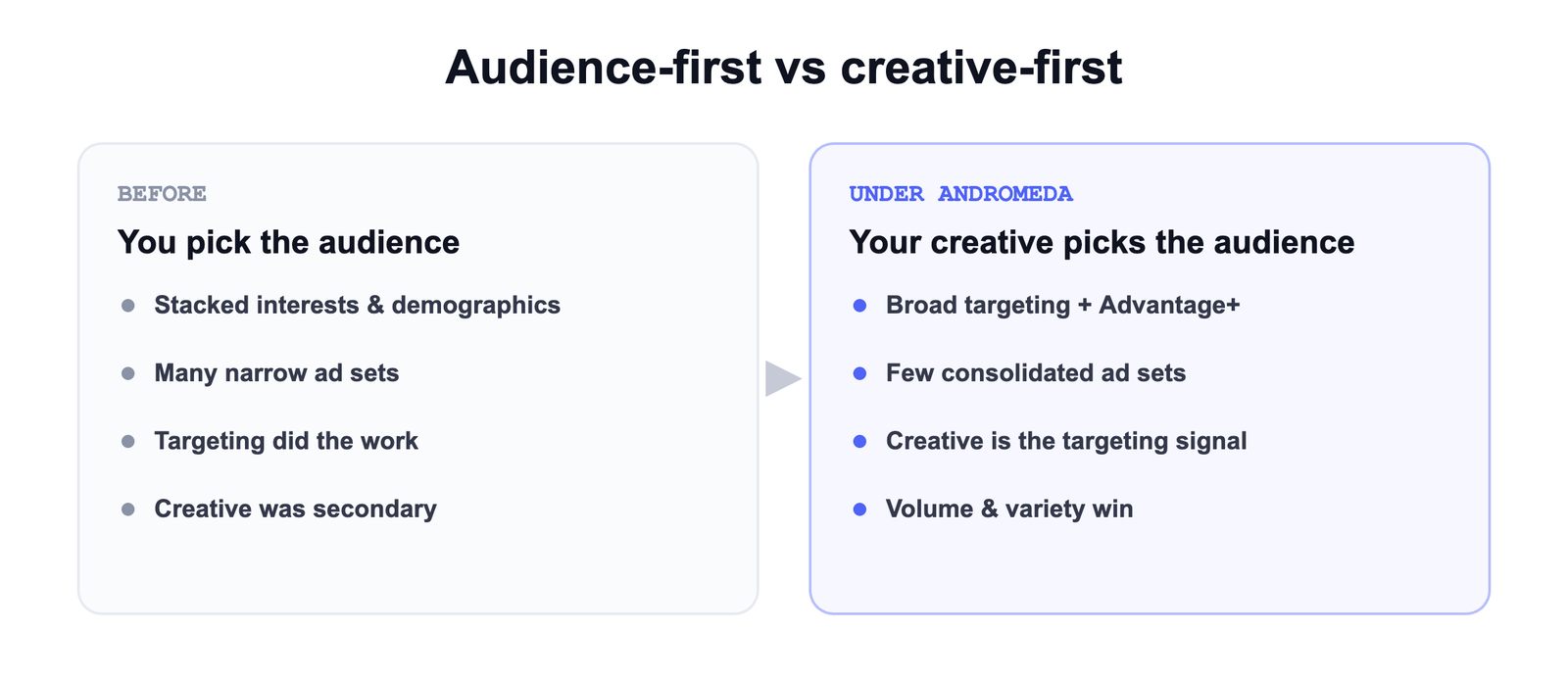
The shift from picking the audience to letting the creative pick the audience.
A lifestyle video of someone using your product on a hike gets served to outdoor enthusiasts. A UGC testimonial about saving money finds bargain-conscious shoppers — automatically, without you targeting either group. The consequence is blunt: a mediocre creative with perfect targeting now loses to a great creative with broad targeting. The leverage has moved almost entirely to what you put in the ad, not who you point it at. (If you're rethinking creative, our guides to Facebook ad creative trends and the best ad creative tools go deeper.)
What happened to interest targeting and lookalikes
They still exist — but they've been heavily de-powered. Meta now recommends broad targeting for most campaigns and has pushed Advantage+ as the default for Sales, Leads and App Promotion objectives. A few practical realities under Andromeda:
- Broad beats narrow. The system performs best with a wide pool to search; running 20 narrowly-targeted ad sets mostly fragments learning and wastes budget.
- Lookalikes are signals, not fences. Seed a 1% lookalike and Andromeda will quickly expand past it, finding similar users through behavioral signals you'd never target by hand.
- Consolidate. Fewer ad sets with bigger budgets give the algorithm cleaner signal than many tiny ones competing with each other.
Why your winning ads burn out faster now
A side effect advertisers feel immediately: top performers don't last as long. Because Andromeda identifies and scales a winning creative faster, it also exhausts the responsive audience faster — many buyers report winners fading in 2–4 weeks rather than months. Two things make this worse if you're not ready for it:
- Near-duplicates get grouped. Swapping a headline color, changing a CTA or trimming two seconds usually counts as the same ad. Minor variations no longer count as fresh creative.
- Tracking quality matters more. If your Pixel and Conversions API aren't sending clean, deduplicated data, Andromeda can't evaluate your creative properly. Check your event match quality score in Events Manager — a low score means Meta is struggling to connect conversions to real users, and your delivery suffers.
The Andromeda playbook: how to adapt
Stop fighting the AI and feed it what it's built for — variety, volume and velocity. The advertisers winning under Andromeda mostly do these things:
- Go broad + Advantage+. Strip most interest and demographic restrictions and let the system find your audience.
- Diversify creative for real. Test genuinely different angles, formats and personas — problem/solution, testimonial, demo, founder story, static, carousel, UGC — not micro-variations of one ad.
- Raise testing velocity. Meta's own guidance points to roughly 20–30 new creatives a month. The AI creative tools that exploded recently exist precisely to make that volume affordable.
- Consolidate budget into fewer ad sets so learning isn't fragmented.
- Fix tracking. Run Pixel + Conversions API with deduplication, pick one primary conversion event, and keep your event match quality healthy.
- Refresh early. Replace creative before it fatigues rather than waiting for performance to collapse. Watch your CTR and CPM/CPA as early-warning signals.
Old world: build the perfect audience, then create an ad. New world: build a portfolio of strong, distinct creative and trust Andromeda to match each piece to the right people. Creative is now the campaign.
Why account trust still matters under Andromeda
One thing Andromeda didn't change: the account you run on still shapes your results. All this creative testing and aggressive scaling is exactly the kind of activity that gets low-trust accounts flagged — and a poor account-quality or feedback score can mean worse delivery, higher effective CPMs, or an outright ban that stops your testing dead. No retrieval engine can save an ad account that isn't allowed to spend.
That's why media buyers run on agency ad accounts. A whitelisted account inside an established, high-trust Business Manager gives Andromeda a stable base to deliver from — no preset spend caps to throttle scaling, fewer wrongful rejections, and a rep who can reverse a bad disapproval in minutes so your creative-testing engine never stalls. On Clikim's accounts, 0% spend and top-up fees on wire mean none of your budget leaks before it reaches the auction — and for TikTok, verified high-spend entities are associated with better CPMs and approval rates. Feed Andromeda great creative; run it on an account built to scale.
Frequently asked questions
What is Meta's Andromeda update?+
Why did my Facebook ads stop working in 2025?+
How is Andromeda different from the old ad system?+
Is Andromeda a setting I can turn on or off?+
How do I make my Facebook ads work with Andromeda?+
Does interest targeting still work after Andromeda?+
Why do my winning ads fatigue faster now?+
Great creative needs an account built to scale
Feed Andromeda your best creative — and run it on whitelisted Meta and TikTok infrastructure with 0% fees, high-trust delivery, no spend caps, and a rep who answers in minutes.