
Top Facebook Ad Creative Trends for 2026 (What Actually Wins)
Targeting is mostly automated now — which means your creative is the campaign. Here are the creative trends defining high-performing Facebook ads in 2026, why each one works, and how to put it to use, with examples throughout.
In 2026, the Facebook creatives that win are UGC-style, short-form vertical videos that land a hook in the first 3 seconds, feel authentic rather than polished, and are tested at volume. Static images and carousels still convert in a diversified mix, and partnership (creator) ads are surging. The throughline: creative is now the primary performance lever, so the brands producing the most relevant variations win.
Why creative is the campaign now
For years, the edge in Facebook advertising came from targeting. That era is over. Meta's machine learning — Advantage+, broad audiences, and its newer ranking systems that evaluate huge numbers of ad variants in parallel — has made targeting largely a commodity. The platform is now extremely good at finding the right person if you give it the right creative.
The practical consequence: your creative is the new targeting. The visuals and hook you choose are the strongest signal Meta uses to decide who sees your ad, and by most practitioner estimates the large majority of performance work in 2026 is creative operations rather than media buying. That's also why the same offer can win or lose entirely on the strength of the creative — a dynamic we see directly in how creative quality feeds CPM and CPA.
The 8 trends at a glance
Here's the landscape in one view before we go deep on the ones that matter most.
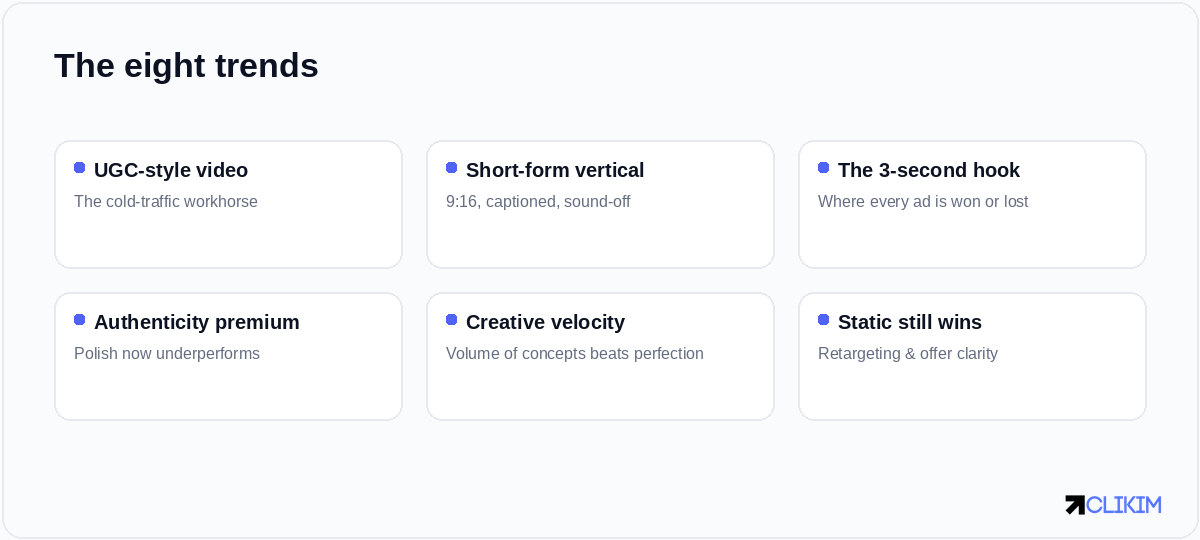
The eight trends shaping high-performing Facebook creative in 2026.
1. UGC-style video is the default
User-generated-content-style video isn't new, but in 2026 it has become the default format for high-performing advertisers. The key word is style: most of it is produced by brands and agencies, then deliberately crafted to look organic — because content that doesn't look like an ad earns more genuine engagement, and Meta rewards that engagement with cheaper, wider delivery.
Three reasons it wins: it has lower thumb-stop resistance (people are trained to skip polished ads, but UGC blends into the feed), it carries an implicit trust signal, and it's cheap to produce at scale — one creator can film ten variations in a day. The best performers aren't random selfie videos, though; they're briefed and structured to look spontaneous while being engineered to convert.
ExampleA raw unboxing clip — someone opening your product for the first time, filmed on a phone in natural light, with first-person copy ("okay, I wasn't expecting this…"). It feels unscripted, which is exactly why it converts. You can study real ones in the Meta Ad Library to see how brands structure them.
2 & 3. Short-form vertical — and the 3-second hook
The format and the opening are inseparable, so treat them together. Vertical 9:16 is the primary canvas: the vast majority of Meta's ad inventory is vertical and nearly all users are on mobile, so you build vertical-first and let the system adapt for other placements. Keep it short — roughly 10–30 seconds for most direct response — and design for sound-off with burned-in captions, because most video is watched without sound (Meta details the specs across its ad formats).
But none of that matters if the opening is weak. The first 1–3 seconds decide the scroll-stop. Your ad enters the feed between a friend's photo, a Reel and a message notification; if the opening doesn't immediately make sense, the scroll wins. Front-load your strongest visual or boldest claim before any logo sting or slow brand intro.
Example✗ Weak: a 3-second animated logo, then a slow pan to the product. ✓ Strong: open on a face mid-sentence — "I stopped buying [category] after I found this" — product already on screen. The claim is the first frame.
Anatomy of a winning creative
Most high-performing direct-response videos follow a simple, repeatable skeleton. It's flexible, not rigid — but if you're unsure how to structure a creative, start here.
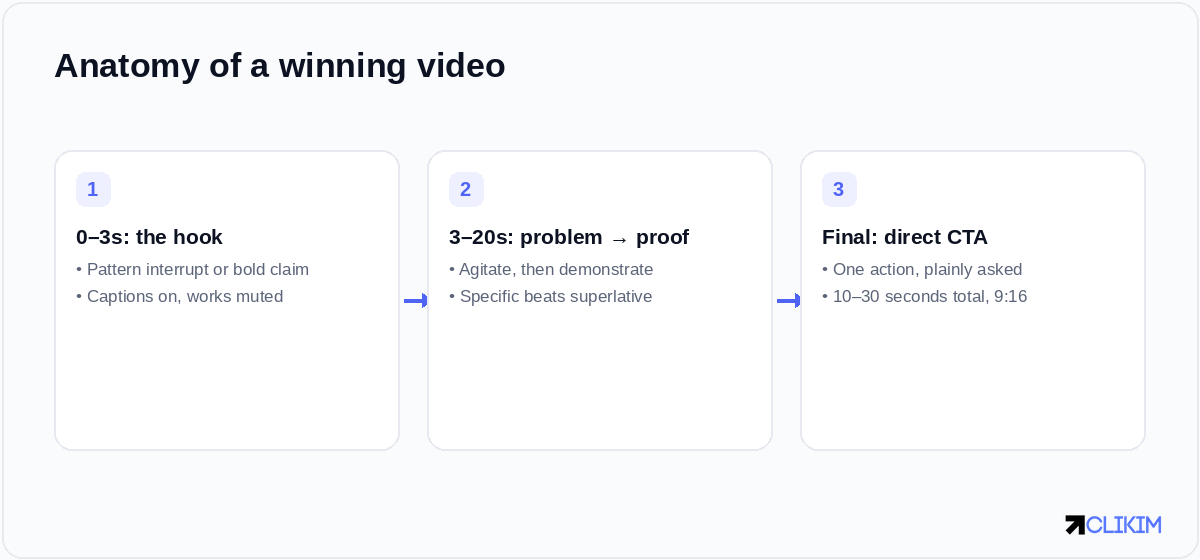
Hook → problem → solution + proof → direct CTA.
The hook stops the scroll; the problem names the viewer's pain in their own words; the solution and proof show the product in use with a believable result or a real review; and the CTA gives one clear next step. Keep the call to action direct and practical — "See pricing" or "Shop now" reliably beats vague aspiration like "Unlock your potential." And remember the meta-point on the card: format matters less than the volume of formats you can test.
4. The authenticity premium
This trend is broader than UGC: even non-UGC creative is shifting toward a less-produced, more authentic aesthetic. As AI-generated content floods every feed, consumers have grown skeptical of anything that smells manufactured — and the most valuable currency on the platform is now trust. Ads that feel like a real human made them outperform ads that feel like a machine is selling to you.
The authenticity premium shows up across the whole ad:
- Copy: conversational and first-person, specific rather than generic marketing-speak.
- Visuals: real environments over studio sets, real lighting over perfect lighting.
- Social proof: real customer quotes with attribution, not anonymous five-star fluff.
- CTAs: direct and practical over hype.
Old: "Discover our revolutionary solution that transforms how you work." 2026: "We switched 3 months ago. Here's what actually changed." Same product, completely different believability.
One caution: authenticity can't be faked. Over-scripted creator reads and forced enthusiasm kill trust fast. A useful test for any UGC ad — would this still sound credible if a customer sent it to a friend? If not, rewrite it.
5, 6 & 7. Static, carousel & partnership ads
Video gets the headlines, but a winning account runs a diversified format mix — and the algorithm explicitly rewards that diversity. Don't abandon the formats below just because video is hot.
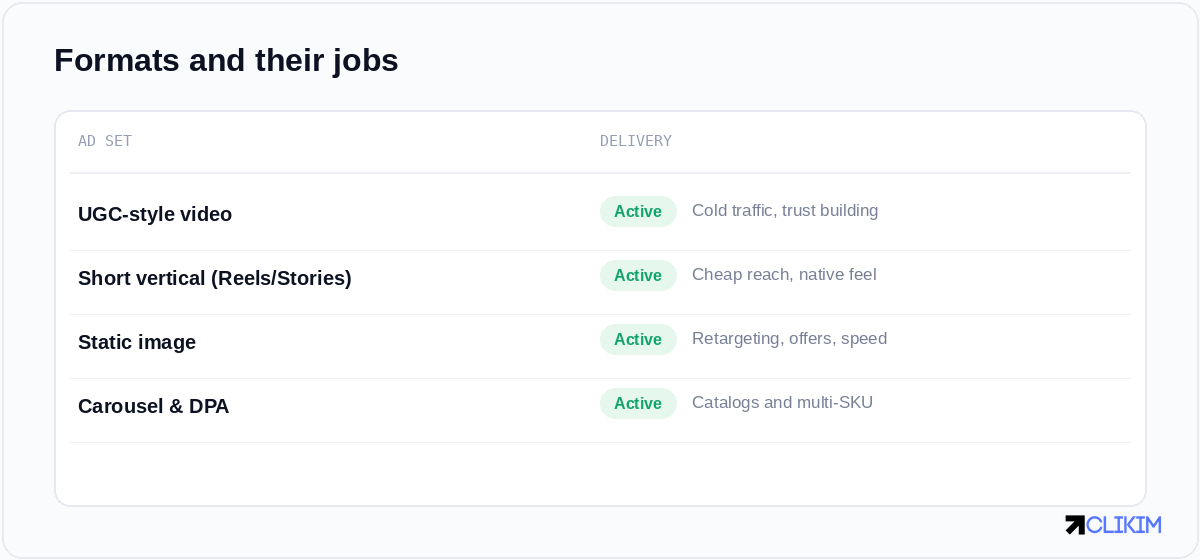
A diversified format mix beats betting everything on one.
- Static images still win. They drive a large share of conversions and are cheap and fast to test. Review-style statics (a customer photo plus screenshot-style text) and comparison layouts (the "old me / new me" meme format) are especially strong because they mimic organic content rather than screaming "ad."
- Carousels & DPA are back for e-commerce and retargeting. Carousel link ads tend to deliver lower cost per click and per result than single-image ads, and dynamic product ads remain a retargeting workhorse.
- Partnership (creator) ads are the rising star. Instead of running from your brand Page, the ad runs from a creator's own handle — so it looks like an organic post from someone the viewer may already follow. Partnership ads with testimonial elements have been reported to convert meaningfully better than standard ads.
Comparison and "before/after-style" creative is powerful — but in regulated categories like health, weight loss and beauty, literal before-and-after imagery and personal-attribute language are restricted. Keep the angle compliant; see our guide to Facebook advertising policies before you build those.
8. Creative velocity (and where AI fits)
If there's one habit that separates top accounts from the rest, it's volume. Because privacy changes moved the advantage from targeting to creative, the advertisers producing and testing the most concepts per week win auctions at lower costs. The largest spenders push hundreds of variations a month; for most brands, the practical benchmark is 15–25 fresh variations monthly — and that's mostly variations on proven concepts (new hooks, new openings, new formats), not 25 ideas from scratch.
This is where AI earns its place: not as a magic creative button, but as a way to spin one strong concept into many testable variations quickly. Use human creators for your hero concepts, then use AI to generate variations and keep the pipeline full. Two caveats: authentic, human-feeling content still tends to beat generic AI output, and Meta now requires disclosure of AI-generated or AI-modified content — skipping it has become a common rejection reason.
Why velocity also protects youCreative fatigue is real — performance typically peaks within 7–14 days as frequency climbs and CTR drops, pushing your effective CPM up. The fix is never a new audience; it's fresh creative on a cadence. A steady testing pipeline is what keeps costs down as winners wear out.
How to apply this without burning your account
Trends are only useful if you can act on them safely. A simple operating system:
- Lead with UGC-style vertical video for cold prospecting; keep statics and carousels for fast testing and retargeting.
- Obsess over the first 3 seconds. Test five hooks on every concept before testing anything else.
- Run a weekly creative cadence. Pause fatigued ads (rising frequency, falling CTR) and feed the algorithm fresh variations.
- Keep it authentic and compliant. Real voices, honest claims, AI disclosed where used, and policy-safe angles in regulated niches.
- Run it all on a stable account. High creative velocity only pays off if your account can absorb constant new ads, the occasional wrongful rejection, and aggressive scaling without going down — which is exactly what an agency ad account is built for.
That last point is the quiet foundation under everything above. Testing 20 new creatives a month and scaling winners hard is exactly the kind of activity that gets fragile accounts flagged. It's why high-velocity advertisers run on stable, high-trust Facebook agency ad accounts — whitelisted, no preset spend cap, and a rep who can reverse a wrongful rejection in minutes so your testing never stalls. Find more tactical breakdowns like this one on the Clikim blog.
Frequently asked questions
What is the most effective Facebook ad creative format in 2026?+
Why does UGC-style content outperform polished ads?+
How important is the hook in a Facebook ad?+
Are static image ads still worth running?+
How many creatives should I test per month?+
What is the ideal length and format for a Facebook video ad?+
What are partnership ads?+
Does creative quality affect my ad costs?+
Do I need to disclose AI-generated content?+
Creative that scales needs an account that keeps up
Whitelisted infrastructure — no preset spend limits, so winning creative never waits on infrastructure.