
Average CPC on Facebook (2026 Benchmarks by Industry)
US ecommerce pays $0.70–1.60 a click; finance pays $3+. Here are the 2026 CPC benchmarks for eleven industries, the six forces that set your number, the levers that lower it — and the ones that lower it by selling you worse clicks.
Average Facebook link-click CPC in 2026 (US): $0.70–1.60 for ecommerce, ~$2.35 B2B/SaaS, $3+ for finance and legal.
By vertical: ~$0.72 apparel, ~$1.28 fitness, ~$1.42 education. Your CPC is set by industry competition, objective (purchase clicks cost more by design), audience temperature (retargeting clicks 30–60% cheaper), creative (higher CTR = auction discount), placements and season.
The only lever that cuts CPC and CPA together is better creative — most others trade click quality for click price. Judge on CPA/MER; use CPC to diagnose why they moved.
- US Facebook link-click CPC in 2026 averages $0.70–1.60 for ecommerce, ~$2.35 for B2B, and $3+ for finance/legal.
- CPC is competition for your audience's attention — verticals with rich customer values bid it up for everyone.
- The cleanest CPC discount is CTR: the auction charges relevant ads less per click, full stop.
- Most 'cheap click' levers (awareness objectives, bargain placements) trade click quality for click price — CPA rises while CPC falls.
- Judge campaigns on CPA and MER; read CPC only to diagnose why CPA moved.
- Compare your CPC only against your own vertical and objective — cross-vertical comparisons are noise.
What CPC actually measures
Cost per click is the auction’s receipt for one unit of attention: what it cost to get one person from the feed to your page. Meta doesn’t price clicks off a rate card — every click’s price is an auction outcome, set by how many advertisers want your exact audience at that moment and how relevant your ad is compared to theirs.
That’s why the honest answer to “what’s a good CPC” is always relative: to your industry, your objective, your audience temperature, and above all to what the clicks convert into.
That last clause is the trap this whole article circles. The panel above shows two stores paying the same dollar per click where one pays 3.5× the other's CPA — identical CPC, wildly different businesses. CPC is a diagnostic gauge, not a goal. Optimize it directly and the platform will happily sell you the cheapest clickers it owns — the same population that makes the Traffic objective a beginner trap.
2026 CPC benchmarks by industry
Link-click CPC by vertical. The spread is competition for the same eyeballs: verticals with high customer values bid attention up for everyone in them.
Read the table as a competition map. Finance and legal pay $3+ because a single customer is worth thousands, so everyone in the vertical can rationally bid attention sky-high. Apparel pays $0.72 because margins are thin and the audience is enormous. Your benchmark is your row — an ecommerce brand at $1.20 is normal; a law firm at $1.20 is getting a gift.
(These figures are for link clicks with conversion-oriented objectives; “all clicks” numbers — which count reactions and expands — run misleadingly cheaper.) For the sibling numbers, see our CPM vs CPA breakdown and CTR benchmarks; Meta’s own ads guide documents the formats behind them.
Are link clicks and “clicks (all)” the same metric?
No — “clicks (all)” counts reactions, comments, expands and profile taps, so it reads much cheaper. Benchmark and optimize on link clicks (or landing page views, stricter still).
The six things that move your CPC
- Industry sets the baseline — see the table.
- Objective layers on top: purchase-optimized delivery hunts rarer, higher-intent people, so its clicks cost more than awareness clicks by design. Comparing CPCs across objectives is comparing different products.
- Audience temperature is the next multiplier — retargeting pools click 30–60% cheaper than cold prospects because familiarity does half the ad’s job.
- Creative is the lever you control most directly: the auction’s pricing formula literally discounts ads people want to click, so a CTR jump from 1% to 2% roughly halves effective CPC.
- Placement mix matters at the margins — feeds cost premium, Stories and Audience Network run cheaper with lower intent.
- Seasonality taxes everyone: Q4 CPCs run 20–40% above Q1 as retail budgets flood the auction.
Lowering CPC (and when you shouldn't)
Every row cuts CPC. Only the first one reliably cuts CPA with it — most of the rest trade click price for click quality.
The table’s honest column is the third one. Awareness objectives will cut your CPC 80% and your sales 100% — the clicks are real, the buyers aren’t. Advantage+ placements genuinely save money if you audit conversion quality, not just click price.
The one unambiguous lever is creative: better hooks, tighter angles and native-feeling formats raise CTR, and the auction converts that relevance into a discount on every click while also improving traffic quality. That’s the only row where CPC and CPA fall together — which is why the highest-leverage CPC work happens in your creative pipeline (our creative tools roundup covers the 2026 stack), not in your bid settings.
Reading CPC as a diagnostic
Where CPC earns its place is trend reading:
- CPC up, CTR flat — competition rose: seasonality or new entrants bidding on your audience. Nothing is wrong with your ads.
- CPC up, CTR down — creative fatigue: the auction is charging you more because people want your ad less. Refresh creative before touching budgets.
- CPC down, CPA up — the quality trap: you’re buying cheaper, worse clicks, usually after an objective or placement change.
- CPC stable, CPA up — the problem is downstream: landing page, offer, or tracking, not traffic.
Ten seconds with two metrics tells you which team owns the fix. If spend itself has stalled — clicks aren’t happening at any price — that’s a delivery problem, not a pricing one: see ads not spending.
How do I know if rising CPC is competition or my creative?
Pair it with CTR and CPM. CPC up with CTR flat and CPM up is competition (season, new entrants). CPC up with CTR falling and CPM flat is creative fatigue — refresh the ad, don’t touch the structure.
Facebook CPC against the other channels
For budget-allocation context: Google Search clicks in comparable US verticals run 2–4× Facebook’s — $2–5 for ecommerce terms, $8–30+ for legal and insurance — because search clicks carry declared intent; the person asked for the product. TikTok clicks price 20–40% under Facebook’s with younger skew and lower conversion rates; LinkedIn runs $5–12 for B2B targeting no other platform can replicate.
The comparison isn’t about crowning a cheapest channel — it’s about what each click contains. Facebook’s position in the stack is manufactured demand at mid-range prices: it interrupts people who weren’t searching, at a click price that leaves room for the conversion rate interruption implies.
Which is why a Facebook click at $1.10 and a Google click at $3.50 can be identical business decisions — and why blended MER, not per-channel CPC, should arbitrate the budget split.
CPC by placement and format
Within one campaign, click prices spread wider than most advertisers expect:
- Feed placements (Facebook and Instagram feed) run the premium — highest attention, highest competition, typically the top of your range.
- Stories and Reels price 15–30% under feed with a different consumption mode: full-screen, fast-swiping, unforgiving of non-native creative — cheap clicks that only stay cheap if the creative belongs there.
- Right column is desktop-only, cheap and low-volume — a retargeting nook, not a growth channel.
- Audience Network is the bargain bin: clicks at a fraction of feed price, from third-party apps where accidental taps are a real fraction of volume.
The practical read: let Advantage+ placements spread delivery, but audit the conversion quality per placement monthly rather than celebrating the blended CPC — a placement mix that cut CPC 20% while Audience Network contributed zero purchases didn’t save you anything.
Format matters the same way. Video clicks generally price under static clicks (Meta rewards watch-time signals), carousels sit between, and lead-form ads register cheap "clicks" that are really form-opens — one more reason the metric only means something inside a like-for-like comparison.
A worked CPC audit (five minutes, real numbers)
Here’s the reading sequence on a real account: a supplements brand, $180/day, CPC drifting from $1.10 to $1.68 over three weeks — a 53% rise and a panicked “ads are broken” note.
Step one, CTR: down from 1.7% to 0.9% over the same window. That single pair nearly closes the case — the auction isn’t more expensive, the ad is less wanted.
Step two, frequency: 3.8 on the main ad set. Fatigue confirmed; the audience has seen the creative out. Step three, CPM: roughly flat ($13.20 → $14.05), ruling out a competition spike or seasonal tide.
Step four, the fix: two fresh creative concepts launched into the same structure — not new audiences, not bid changes, because the diagnosis said creative. Ten days later: CTR 1.9%, CPC $0.98, CPA back under target.
The counterfactual is what makes the audit valuable. Without the reading order, the common move is dropping budget or narrowing the audience — both of which restart learning, neither of which addresses fatigue, and both of which would have converted a creative problem into a delivery problem. Two metrics, read in order, routed the fix to the right team on the first try.
The CPC number nobody benchmarks
One structural footnote. New, low-trust ad accounts quietly pay more per click than aged ones: conservative delivery, restricted optimization while trust builds, and spending caps that keep campaigns stuck in the expensive learning stage. Two advertisers with identical ads can see 20–40% CPC gaps purely on account standing.
It’s the least discussed line in the CPC equation and the reason serious media buyers run agency ad accounts — aged, whitelisted, uncapped infrastructure (how ours work) where the auction treats you like the established advertiser you’re pricing against.
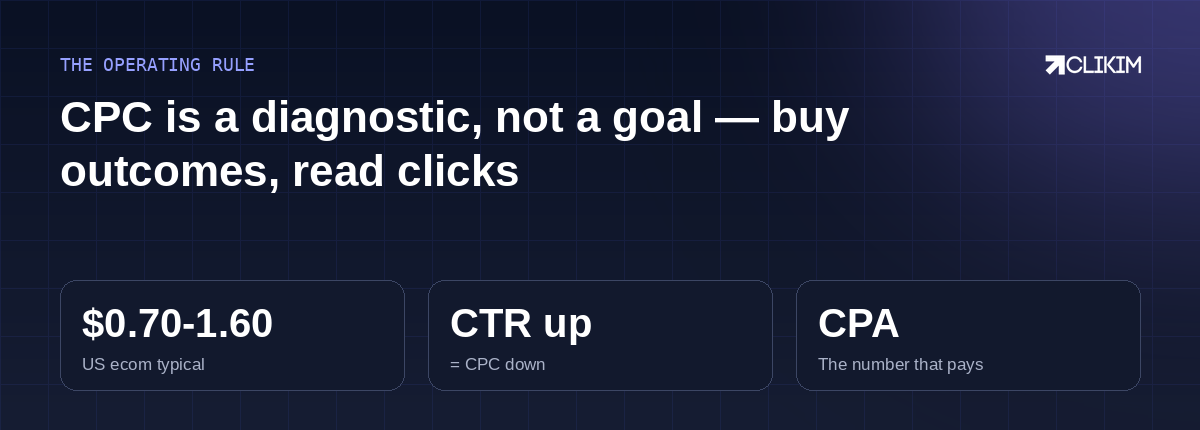
Buy outcomes, read clicks: CPC explains why CPA moved — it should never replace it.
The 2026 cost benchmark report — CPM, CPC, CPL and CTR from every major dataset, one honest table.
Frequently asked questions
What is the average CPC on Facebook in 2026?+
Is a $2 CPC bad?+
Why is my Facebook CPC so high?+
What's the fastest way to lower CPC?+
Does the campaign objective change CPC?+
Is CPC or CPM the better metric to watch?+
Does retargeting really lower CPC?+
Do new ad accounts pay higher CPCs?+
Should I ever optimize for cheap clicks directly?+
Which placements have the cheapest CPC?+
Stop paying the new-account click tax
Aged, whitelisted infrastructure — no preset caps, auction-trusted from day one, under a BM2500.