
Facebook Ad Relevance Diagnostics (Decoded)
Quality, engagement rate, conversion rate — three rankings that grade your ad against everyone competing for the same audience. Here's what each one actually measures, the combination table that names your real suspect, and the fix library for every low score.
Ad relevance diagnostics are three relative rankings — quality, engagement rate, conversion rate — comparing your ad to others competing for the same audience.
They appear after ~500 impressions. Read them as a triage tool when CPA is bad, in combination: low quality = the ad uses bait tactics (fix before Meta punishes the account); low engagement = the first 3 seconds fail (fix hooks); low conversion = the landing page breaks the promise (fix the page, not the ad).
All three average-plus with bad CPA? The problem is offer, tracking or account limits — things no ranking can see. Don’t chase “above average” on winners; average is where profitable ads live.
- Ad relevance diagnostics are three relative rankings — quality, engagement rate, conversion rate — each measured against ads competing for your exact audience.
- They need 500+ impressions to exist, and they're a diagnostic for bad CPA, not a scoreboard to optimize when results are fine.
- The three rankings point at three different suspects: the ad's tactics, the hook, or the landing page.
- Combinations beat single readings — low conversion with healthy engagement means fix the page, not the ad.
- Chasing 'above average' everywhere is a trap: plenty of profitable ads sit at average, and bait tactics that juice engagement get punished by quality.
- If all three are healthy and CPA is still bad, the problem lives where diagnostics can't see: offer, price, tracking, or account limits.
What replaced the relevance score
Meta retired the single 1–10 relevance score years ago because it hid more than it revealed — one number couldn't say what was wrong. Its replacement, ad relevance diagnostics, splits the judgment into three rankings you'll find in Ads Manager's columns: quality ranking, engagement rate ranking, and conversion rate ranking. Each grades your ad against the other ads competing for your same audience, on a five-step scale from "above average" to "below average (bottom 20%)."
Two properties define how to use them. First, they're relative: "below average" means your competitors for that audience are beating you, not that you failed an absolute bar. Second, they're lagging and coarse: they need ~500 impressions to appear at all, update slowly, and compress reality into five buckets. That makes them useless as a daily KPI and genuinely useful as a triage tool — when CPA has already told you something is wrong, the three rankings tell you which room to search.
The three rankings, and the suspect each one names
Each ranking is relative to ads competing for the same audience — 'below average' means below your competitors, not below some absolute bar.
Quality ranking is Meta’s read on whether the ad itself repels people: engagement bait (“comment YES if…”), withheld-information hooks, sensational claims, spammy aesthetics — plus behavioral evidence like hide and report clicks.
A low quality ranking is the most dangerous of the three because it isn’t just a performance note; it’s the same signal family Meta uses for policy enforcement, and sustained bottom-20% quality invites the kind of scrutiny that ends with rejected ads and flagged accounts.
Why don’t my ads show any relevance diagnostics?
The rankings need roughly 500 impressions per ad before they populate, and they only apply to ads competing in auctions. Low-budget ads, brand-new launches and some optimization goals simply haven’t generated enough data yet.
Engagement rate ranking predicts whether anyone will stop for the ad at all. Low here almost always means the first three seconds fail — the hook, the opening frame, the headline. It is emphatically not a landing page problem; people are scrolling past before your page enters the story.
Conversion rate ranking predicts what happens after the click, compared against advertisers optimizing for the same event. Low here with healthy engagement is the classic "great ad, broken destination" signature — slow page, promise mismatch between ad and landing content, surprise shipping costs, a form with eleven fields.
Reading combinations (where diagnostics earn their keep)
The combinations matter more than any single ranking — and the last row is the most important: healthy diagnostics never guaranteed a healthy business.
Single rankings mislead; pairs diagnose. The most common profitable pattern is boring: average across the board. Meta itself notes that moving a ranking from average to above average rarely pays, while fixing a below-average ranking usually does — the buckets are wide, and the top of "average" is a fine place to run a business from. The rankings exist to catch outliers, not to gamify.
The last row of the table deserves its own paragraph. When all three rankings are healthy and the campaign still loses money, the temptation is to keep polishing creative — but the diagnostics just told you the creative isn’t the problem.
The suspects that remain are the ones no ranking can see: an offer the market prices differently than you do, a tracking break starving optimization (check Events Manager before anything else), competitive CPMs your margin can’t carry, or an account-level constraint throttling delivery — the domain of ads not spending and its cousins.
The fix library, by ranking
Raising a low quality ranking
Delete the bait. Every “tag a friend,” artificial-urgency countdown, and information-withholding hook (“you won’t BELIEVE step 3…”) trades short-term clicks for a quality mark that raises your costs on every future auction.
Rebuild the ad to look like content the placement’s natives would post: platform-native framing, honest claims, readable text. If your product category naturally attracts hostile feedback (politics-adjacent, weight loss, finance), invest in comment moderation — hides and reports feed this ranking directly.
Raising a low engagement rate ranking
Work exclusively on the first three seconds. Test three structurally different hooks against each other — a question, a bold claim, a pattern interrupt — while holding everything after second three constant; the ranking is telling you people never got that far. Native-feeling video (vertical, captioned, fast open) beats produced polish here almost every time. Don't touch the audience yet: engagement rankings measure the ad, and swapping audiences resets your read.
Raising a low conversion rate ranking
Audit the destination before the ad. Load the landing page on a mid-tier phone over cellular — if it takes four seconds, that’s the whole diagnosis.
Then check promise-match: the headline the click was sold on should be the first thing the page says. Then friction: guest checkout, visible shipping costs, forms cut to minimum fields. The companion metric here is your funnel’s actual conversion rate against vertical norms — if the page converts organic traffic fine but paid traffic poorly, revisit the audience and the promise, in that order.
Two case readings from real accounts
Case one: a home-goods store, CPA 2.2× target. Rankings: quality average, engagement below average (bottom 35%), conversion above average. The combination reads itself — the few people who click convert beautifully, but almost nobody stops scrolling.
The team had been about to rebuild the landing page; the diagnostics said the page was the healthiest part of the funnel. Three new hooks later (same body, same page, same audience), the engagement ranking climbed to average within two weeks and CPA landed 15% under target. The page rebuild would have cost a month and fixed nothing.
Case two: a course seller, CPA slowly drifting up for six weeks. Rankings: all three average or better, every week, on every ad. The creative team kept shipping refreshes anyway — each one “worked” for a few days, then drifted again, which everyone read as fatigue.
The actual culprit surfaced in Events Manager: a checkout-platform migration had quietly halved purchase-event volume, so delivery was optimizing on starved signal. Healthy diagnostics were the tell — the rankings were screaming not the creative the whole time. One tracking repair beat six weeks of new ads.
The shared lesson: the rankings' highest value is vetoing the fix you were about to make. Most teams default to touching creative because it's the part they control; diagnostics exist to say "wrong room" before the effort is spent.
A 60-second diagnostic workflow
Operationalized, the whole tool is one minute inside the weekly review:
- Filter to ads with meaningful spend and CPA above target — diagnostics on winners are a distraction.
- Add the three ranking columns.
- For each flagged ad, read the combination against the table above and route the fix: bait-ectomy, new hooks, or landing audit.
- If all three are average-plus, stop staring at creative and check tracking, offer and account constraints.
- Re-check the ranking two weeks after the fix ships — the buckets move slowly.
That cadence keeps diagnostics in their lane: a coarse compass consulted when the money says you’re lost, not a dashboard to please.
Do relevance diagnostics affect my ad costs?
Indirectly but genuinely — the same relevance machinery discounts auction prices for ads people respond to. Ads stuck in the bottom quintiles pay more per impression and click than competitors showing the same audience better creative.
When the account outranks the ad
A closing note that belongs in every diagnostics discussion: sustained low quality rankings compound at the account level. Meta’s trust systems read a portfolio of bottom-quintile ads as a signal about the advertiser, and the consequences arrive as tighter review, more frequent rejections, and eventually the restrictions covered in our account ban guide.
New accounts have no cushion for this — a low-trust account running borderline creative is stacking two risk multipliers. It’s part of why serious operators start from agency ad accounts with established standing (how ours work): the same average-quality ad that survives on an aged, trusted account can be the last straw on a fresh one.
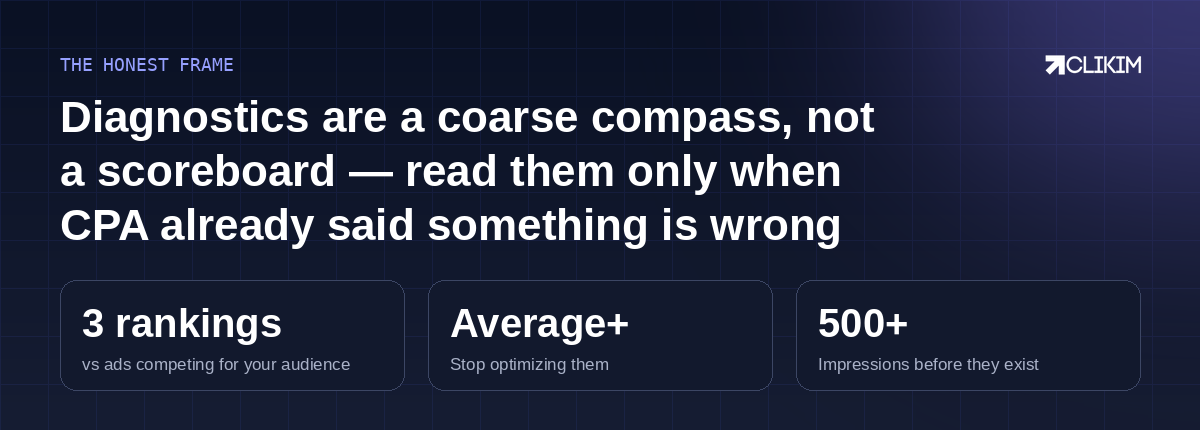
Read the rankings when CPA says something is wrong — the combination names the room to search.
Frequently asked questions
What happened to Facebook's relevance score?+
What does 'below average' actually mean in ad relevance diagnostics?+
Should I try to make every ad 'above average'?+
My conversion ranking is low but engagement is fine — what do I fix?+
What causes a low quality ranking?+
Can healthy diagnostics coexist with a losing campaign?+
Do low rankings put my ad account at risk?+
How long after a fix do the rankings update?+
Do the rankings apply to every campaign type?+
Creative judgment works better on a trusted account
The same ad gets more room on an account with standing. Whitelisted infrastructure — aged, uncapped, under a BM2500.