
Why Banks Decline Meta Charges — and How to Stop It for Good
The most maddening decline in advertising: your card works at the supermarket, the SaaS renewals, everywhere — except when Meta tries to charge it, mid-campaign, at 2am. This is the bank’s side of the story: what their risk systems see when an ad platform charges, and the fixes that end the cycle permanently.
Banks decline Meta charges because ad-platform billing looks like fraud to their risk models — not because anything is wrong with your card.
Irregular threshold-based amounts, high velocity on scale-up days, a risky merchant category, often foreign acquiring: the pattern trips the model. EU cards add 3DS chain breaks; cross-border setups add currency mismatch.
The permanent fixes: one proper call registering Meta as a recurring merchant, a dedicated business card matching your account’s currency and country, and a backup method on file. At scale, the real answer is moving off retail cards entirely.
Two sides of every decline (know which one you’re on)
When a Meta charge fails, one of two systems said no, and they need opposite responses. Platform-side failures — Meta rejecting or restricting the payment method, billing-threshold problems, account flags — are the territory of our payment-failure guide. Bank-side declines — the issuer refusing the authorization — are this article. The tell: check Billing settings for the decline reason, then check your banking app. If the bank shows no attempted transaction, or shows it declined while the card works elsewhere, you’re bank-side — and calling Meta support about it wastes a day you could have spent making one phone call to the right party.
What the bank’s risk model sees when Meta charges
Issuer fraud models score every authorization in milliseconds on pattern features — and ad-platform billing trips several at once:
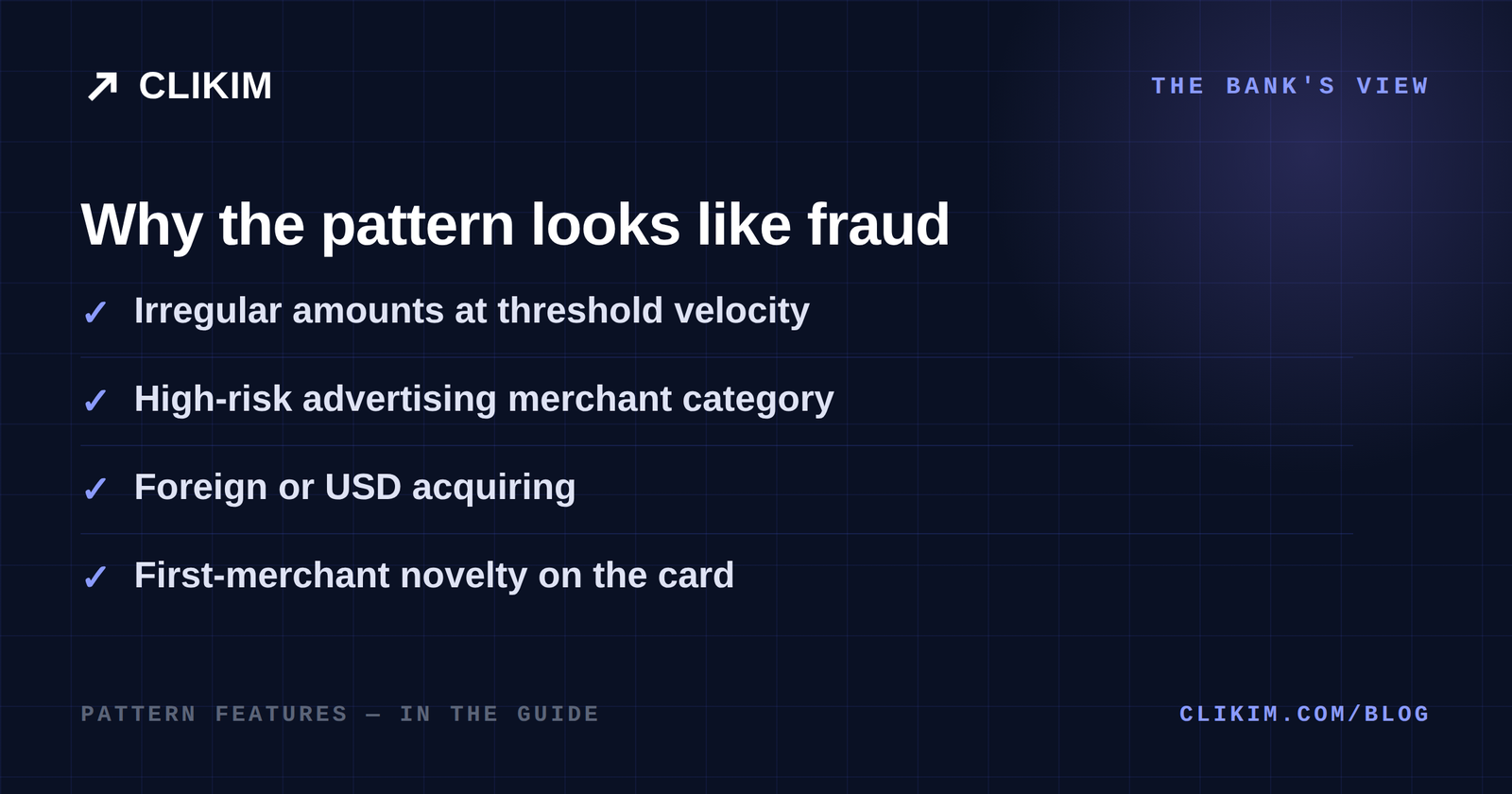
Ad-platform billing trips several fraud-model features at once — the bank judges the pattern, not your business.
- Irregular amounts at irregular intervals: threshold billing means charges arrive at odd values, sometimes several in one day during scale-ups — exactly the velocity pattern card-testing fraud produces. (The threshold mechanics behind this are documented in our Meta billing guide — thresholds escalate from ~$25 upward as trust builds, so charge sizes keep changing.)
- High-risk merchant category: advertising services sit in an MCC many issuers score cautiously — a category historically abused by stolen cards (fraudsters test and burn cards on ad platforms constantly, which is precisely why platforms run their own card-risk scoring too; you’re caught between two paranoid systems).
- Foreign acquiring: depending on your market, Meta’s charges may present as foreign or USD-denominated transactions — instant friction for consumer cards with conservative international settings.
- First-merchant novelty: the first-ever Meta charge on a card is the likeliest to decline; models distrust new merchant relationships, especially in risky categories.
The unifying insight: the bank isn’t judging your business — it’s judging a pattern. Which is good news, because patterns can be whitelisted.
The 3DS/SCA trap (EU and UK advertisers)
European cards add a regulatory layer: PSD2’s Strong Customer Authentication requires two-factor authentication on customer-initiated card payments, implemented as 3D Secure. Ad billing’s saving grace is the merchant-initiated transaction (MIT) exemption — you authenticate once when adding the card, and subsequent recurring threshold charges ride the exemption. Until the chain breaks: a reissued card, an issuer that soft-declines asking for authentication a recurring charge can’t provide, a 3DS challenge that failed at setup (OTP to an old number, no banking-app confirmation, a timeout). Symptoms: the card added fine but charges fail repeatedly, or every attempt bounces to an authentication screen. Fixes: re-add the card and complete the 3DS challenge deliberately, confirm your bank’s authentication method actually reaches you, and ask the issuer whether it’s declining MIT charges on this merchant — some do until told otherwise.
Currency and geography mismatches
The quiet chronic case: card and ad account disagreeing about where you are. An ad account’s currency and country lock at creation; a card issued elsewhere — or funding in a different currency — generates conversion friction on every charge and elevates both the bank’s suspicion and the platform’s (mismatch is the most-reported payment flag on ad platforms, per our Google-side guide — Meta’s risk systems rhyme). Advertisers in volatile-currency markets face the worst version: local cards declining USD ad charges by bank policy. The clean solution is structural — a USD account and card for USD ad operations (the stack options in our banking ranking exist substantially for this) — not daily fights with a retail bank’s FX desk.
The permanent fixes, in order
- Call the bank once, properly. Not “please unblock” — tell them: recurring merchant, expected amounts and frequency, request whitelisting for the merchant and category. Business banking desks do this routinely; consumer hotlines may need the words “recurring merchant authorization.”
- Dedicate a card to ad spend. A business card used only for platform billing builds exactly the clean per-merchant history both risk systems reward — and isolates ad billing from the card-freezing chaos of everyday spend disputes.
- Match currency and country end to end — card, account billing country, funding currency. One-time structural fix, permanent decline reduction.
- Keep a backup method on file. Meta retries backups before pausing delivery — a $0-cost insurance policy against 2am pauses.
- Headroom and hygiene: limits sized for scale-up months, expiry dates calendared, and never — ever — a bank-side chargeback on ad platform charges: platforms treat those as near-terminal account events.
Fixing it at scale: when retail cards are the wrong tool
Past a certain spend, decline-fighting is a symptom of using consumer-grade instruments for an industrial job. The operators’ endgame has two shapes. Fintech cards built for ad spend — issuer relationships that expect platform billing, virtual cards per account, programmatic controls (the platforms we rate in the stack pillar). And at the top of the market, getting cards out of the loop entirely: Meta pushed its largest advertisers to invoicing in 2026 (the full story), and funded-balance billing through agency account infrastructure achieves the same thing at any size — ads spend a pre-funded balance, and the entire decline surface simply ceases to exist. When the fix list above becomes a recurring chore, that’s the signal you’ve outgrown the card era of your own operation.
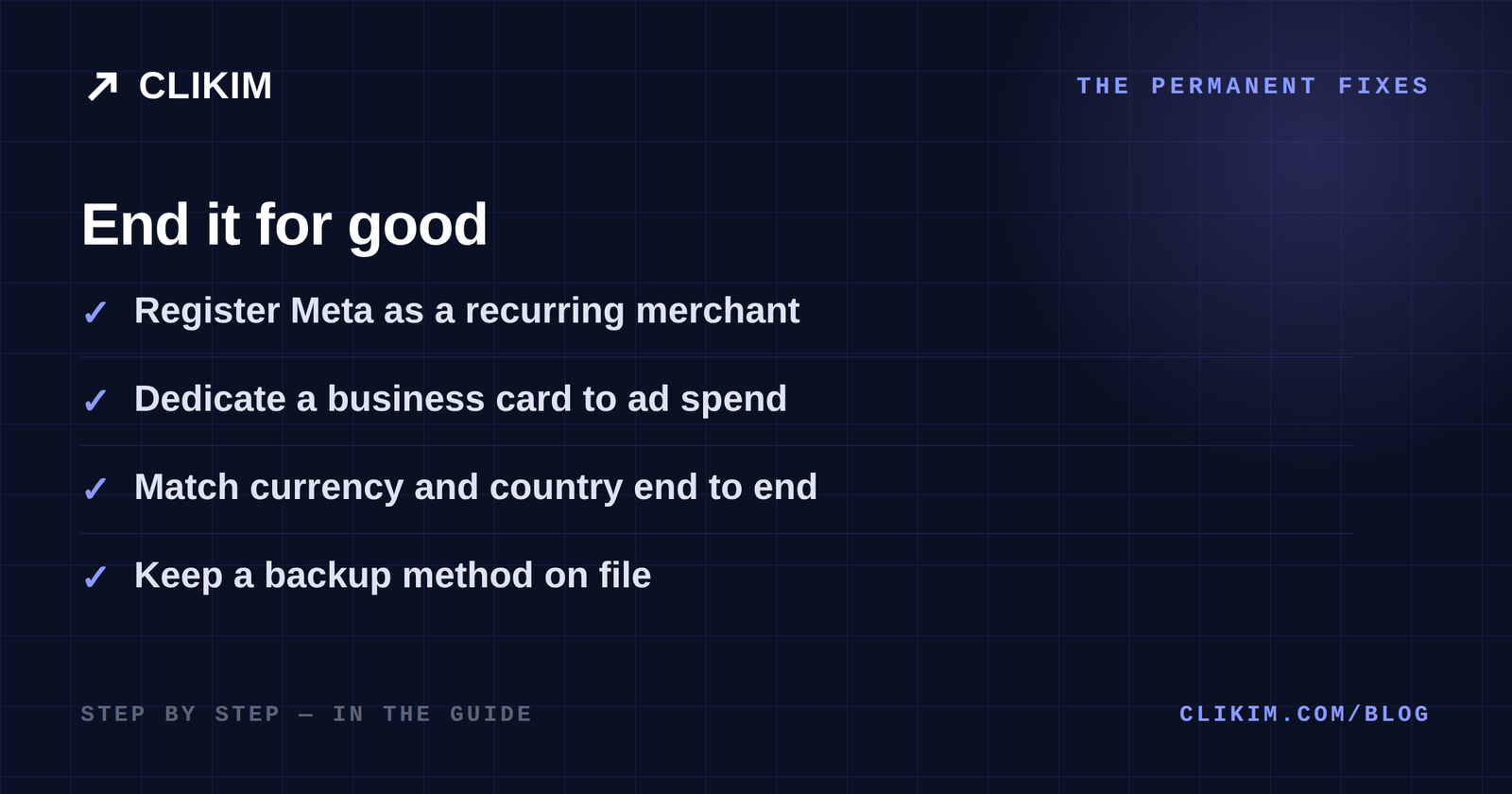
One proper phone call and three structural moves end the 2am decline cycle.
Frequently asked questions
Why does my bank keep declining Facebook ads charges?+
How do I stop my card being declined by Meta?+
Why does my card work everywhere except Facebook?+
What is the 3DS problem with Facebook ads in Europe?+
Can declined payments get my ad account restricted?+
What’s the permanent solution at high spend?+
Done fighting your bank at 2am?
Funded-balance billing means no charges to decline — whitelisted accounts, 0% wire top-ups, a rep in minutes.