
The 7 Best UGC Agencies & Services for Meta Ads (2026)
Reviewed by pricing model, not hype: pay-per-video marketplaces (Billo, JoinBrands), scaling subscriptions (Insense, Trend), and managed services (minisocial, Cohley, inBeat) — who each one actually fits, what they really cost, the red flags, and the five-line brief that doubles your usable-asset rate.

Pick by stage, not by brand name. Testing (<$10k/mo spend): pay-per-video marketplaces — Billo (from ~$99/video) or budget-tier JoinBrands. Scaling ($10–100k/mo): subscription pipelines — Insense (from ~$500/mo + creator fees, direct Meta whitelisting) or Trend credits. Brand-led: managed — minisocial (licensed micro-influencer campaigns), Cohley (approvals/rights at scale) or inBeat (full agency). Whoever you pick: demand full paid-usage + whitelisting rights upfront, brief with 3 hook variations per concept, and feed Meta 8–15 fresh videos monthly.
• The UGC market splits into three models: pay-per-video marketplaces (Billo, JoinBrands), subscription platforms (Insense, Trend) and managed services (minisocial, Cohley, inBeat) — pick by ad spend stage, not by brand names. • Budget the real number: marketplace videos run ~$60–300 each; subscriptions add creator fees on top of the plan; managed campaigns start in the low thousands. • Meta's creative machine wants 8–15 fresh videos a month — the pipeline matters more than any single hero video. • The brief is 80% of quality: hook variations, one message per video, native pacing — the same creator delivers a 2× better ad with a 2× better brief. • Always buy full paid-usage rights + whitelisting upfront; retroactive licensing costs more and stalls launches. • UGC volume only pays off on an account that can spend — capped accounts bottleneck the whole pipeline.
The 2026 UGC market, mapped honestly
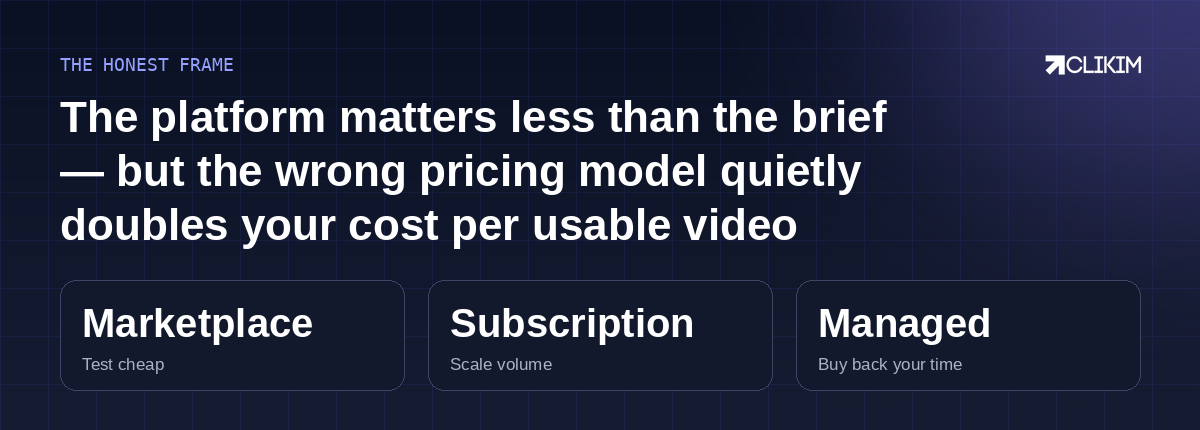
“UGC agency” now means three different businesses wearing one label, and most disappointment comes from buying the wrong model for your stage. Pay-per-video marketplaces sell assets: you brief, a creator delivers, you own the video — cheap, fast, variable quality. Subscription platforms sell a pipeline: monthly access to vetted creators, tooling, and (the good ones) direct integration into Ads Manager for whitelisted creator ads. Managed services and agencies sell outcomes: strategy, casting, approvals, rights and delivery handled for you, at prices that assume your time is the expensive part.
Match the model to your testing framework: if you're validating angles under $10k/mo spend, marketplaces give you cheap reads; from $10–100k/mo the subscription pipelines keep the 8–15-videos-a-month engine fed; beyond that, managed partners buy back your team's hours. Our sister guide covers the broader creative tool stack — this one is strictly the human-content layer.
The seven, reviewed
2026 pricing models verified at time of writing — always confirm current rates. The pattern: marketplaces price per asset, subscriptions price the pipeline, managed services price the outcome.
1. Billo — the testing workhorse
Billo is where most DTC brands buy their first real UGC: pay-per-video from roughly $99, video packs, fast turnaround, and a creator pool deep enough that re-ordering variations is trivial. The honest read: quality is a distribution, not a guarantee — order three videos per concept, expect one winner, and treat the $99 as the cost of a lottery ticket with good odds. For pure testing economics, nothing beats it.
2. Insense — the scaling pipeline
Insense is the strongest option once UGC stops being an experiment: subscriptions from ~$500/month (billed quarterly) plus creator fees, vetted creators, and — the differentiator — direct integration with Meta and TikTok Ads Manager for creator whitelisting, so ads run from creator handles with your budget behind them. Do the real math before committing: plan cost + creator payments per video lands the blended price well above marketplace tier. You're paying for pipeline reliability.
3. minisocial — licensed micro-influencer content, handled
minisocial runs fully-managed campaigns with micro-influencers, delivering fully-licensed assets without you touching casting or contracts. Projects start around the price of a decent freelancer month, and the sweet spot is consumer brands that want authentic content plus a whisper of organic reach, minus the ops burden. Less ideal for always-on testing lanes — it's campaign-shaped, not subscription-shaped.
4. JoinBrands — volume on a budget
JoinBrands is the budget marketplace: cheap per-video pricing, huge creator pool, fastest way to flood a testing lane with variations. The trade is that you are the creative director — brief quality carries everything, and the misses are part of the price. Pair it with the hook-variation discipline below and it's absurdly cost-effective; use it lazily and you'll conclude UGC “doesn't work.”
5. Cohley — the content engine for bigger teams
Cohley sells a managed content platform — briefs, creators, approvals, rights management and reporting in one system, priced custom. It earns its keep when multiple stakeholders touch creative (brand, legal, performance) and content needs flow to more channels than Meta. Below ~$50k/mo in ad spend it's usually more machine than you need.
6. Trend.io — predictable credits, mid-scale
Trend prices in credit packs — a predictable per-asset budget with full usage rights included, sitting between marketplace chaos and subscription commitment. Check the creator pool against your niche before buying credits; it's strongest in lifestyle, beauty and consumables.
7. inBeat — the full-agency option
inBeat is a proper agency: UGC production plus paid-social strategy, casting from a large micro-influencer network, retainer pricing. The right choice when you want one throat to choke for both content and media thinking — and the wrong one if you only need videos, because you're paying for strategy whether you use it or not.
The brief that doubles your hit rate (whoever you hire)
Every platform above delivers dramatically better assets with the same five-line brief structure: (1) One message per video — a video about everything converts on nothing. (2) Three hook variations per concept — same body, different first three seconds; hooks are where CTR is won. (3) Native pacing — captioned, vertical, cut every 2–3 seconds, watchable on mute. (4) A concrete scenario, not a script — “you're unpacking it in your kitchen and something surprises you” beats word-for-word lines every time. (5) The don'ts — banned claims for your category (critical in restricted verticals), competitor mentions, music rights. Send this with 2–3 reference ads you admire and your usable-asset rate roughly doubles.
Three real stacks (how brands actually combine them)
The $5k/mo tester: JoinBrands or Billo only — $600–900/month buys 6–9 videos across 2–3 concepts. Every video goes into a structured testing lane; the goal is finding one angle that beats the control, not building a library. When two consecutive months produce winners, graduate. The $40k/mo scaler: Insense subscription as the spine (pipeline + whitelisting for the proven angles), with Billo still running as the cheap-experiments lane — marketplace videos test new angles at $99 each, and only validated concepts get the pricier vetted-creator treatment. Blended cost per usable video drops because misses happen at marketplace prices. The $150k/mo brand: minisocial or Cohley handling brand-safe hero content and rights management, Insense feeding the performance lane, and an internal editor cutting every delivered asset into 3–4 hook variants — the highest-leverage hire in the whole system, because it turns 10 purchased videos into 35 testable ads.
The common thread: nobody serious uses one vendor for everything. Marketplaces are for cheap reads, subscriptions for reliable volume, managed services for time you'd rather buy back — and the editor who multiplies variations is worth more than any of them.
Red flags when hiring UGC help
Walk away from: rights ambiguity (if paid usage and whitelisting aren't explicitly included, they're extras you'll pay for mid-launch); portfolio-only vetting (ask for ads that ran and any performance context, not showreels); guaranteed-ROAS promises (content vendors don't control your offer, landing page or account health); and agency lock-ins beyond a quarter — the market moves too fast to be trapped in a 12-month retainer for a commodity that marketplaces sell à la carte.
The bottleneck nobody briefs for
One structural note before you build the pipeline: 8–15 fresh videos a month only matter if the account can test and scale them. A capped new account turns a $3,000 content investment into a queue — twelve videos waiting behind a $100/day ceiling — and a mid-test account ban orphans the whole library. The brands running serious UGC volume pair the content pipeline with managed whitelisted infrastructure: uncapped spend for honest testing, faster review handling for creator whitelisting, and replacements so the library never sits idle. Content is the fuel; the account is the engine displacement.
Match the model to your stage, brief like a director, and keep the account layer uncapped.
Frequently asked questions
What's the difference between a UGC agency and a UGC platform?+
How much does UGC for Meta ads cost in 2026?+
How many UGC videos do I actually need per month?+
Is Billo or Insense better for Meta ads?+
What usage rights do I need for UGC in paid ads?+
What is creator whitelisting and is it worth it?+
Can't I just find UGC creators on Twitter/X or Fiverr directly?+
What makes a UGC brief good?+
Do these platforms work for restricted categories like supplements?+
Why does my ad account matter more than my UGC vendor?+
Should I hire an in-house editor instead of buying more videos?+
How do I judge whether a UGC video 'worked'?+
How fast should I expect delivery?+
Does UGC work for B2B and services, or only ecommerce?+
Feed the pipeline through an uncapped account
Whitelisted Meta & TikTok infrastructure — test every video you buy, scale the winners without a ceiling. Operated on BM2500 infrastructure.