
Facebook Ads for Supplements (The Compliant Playbook)
Supplements are legal to advertise on Meta — and rejected three times as often as normal ecommerce. Here's the claim ladder that decides approvals, the creative formula that outperforms the banned stuff anyway, the real enforcement patterns advertisers report, and the account setup that survives the category.
Supplements are allowed on Meta, but the vertical runs on hard mode: no disease or measurable-outcome claims (“supports energy” survives, “lowers blood sugar” is drug territory), no implied conditions (“sick of your…?” trips personal-attributes rules), no before/after imagery, and 18+ floors on anything weight-adjacent. Win with ingredient transparency + ritual framing + claim-free social proof, keep the landing page on the same ladder, audit live AND paused ads monthly, appeal once cleanly — and run the category on aged, whitelisted account infrastructure with backups, because fresh accounts + supplements is the classic ban combo.
• Supplements are legal to advertise on Meta — but the vertical sits inside health & wellness restrictions, personal-attributes rules and 18+ targeting floors, so rejection rates run roughly 3× normal ecommerce. • The line that decides everything: function vs disease. “Supports energy” survives; “fixes fatigue” doesn't; “lowers blood sugar” is drug territory. • Before/after imagery and implied-condition hooks (“sick of your…?”) are the two fastest ways to a rejection — and repeated rejections compound into account restrictions. • The winning 2026 creative angle is ingredient transparency + ritual, not outcome promises — and it outperforms the banned stuff anyway. • Weight-loss adjacent products: 18+ targeting minimum, no negative self-perception, timeframes only under strict conditions. • The account layer decides survival: fresh accounts running supplements start distrusted — aged, whitelisted infrastructure absorbs the vertical's scrutiny. • Build the compliant system once: claim ladder → creative formula → landing-page consistency → account insurance.
Why Meta treats supplements as a suspect category
Start with the enforcement logic, because every rule below follows from it. Supplements sit at the intersection of three things Meta's systems are paranoid about: health claims (a decade of miracle-pill scams trained the classifiers), body image (regulators and internal policy both punish negative self-perception), and ingestibles (anything you swallow carries liability). The result is a review environment where the same sentence that's fine for a phone case — “you'll feel the difference in a week” — gets a supplement ad rejected.
The formal rulebook lives in Meta's health and wellness ad standards and the drugs and pharmaceuticals policy — but the rulebook understates the practical reality: enforcement is done by classifiers that pattern-match your words, imagery and landing page against banned claim classes. You're not arguing with a lawyer; you're avoiding tripwires. Scroll any advertiser community — r/FacebookAds fields supplement-rejection threads weekly — and the same five stories repeat. We've decoded them in the table below.
The claim ladder: what's banned, risky and safe
The claim ladder that decides everything. Meta's reviewers don't grade your intentions — they pattern-match your words and imagery against the banned classes.
Three rules of thumb compress the whole table. One: if a sentence names or implies a disease, a diagnosis, or a measurable medical outcome, it's dead — “lowers cortisol”, “reverses insulin resistance” and “helps with your ADHD” are all the same rejection. Two: if the ad implies you know something personal about the viewer (“struggling with gut issues?”), the personal-attributes policy kills it regardless of product. Three: if the imagery tells an outcome story words avoided — a shrinking waistline, a before/after split — the classifier reads the image, not your careful copy.
What supplement advertisers actually report (and what it means)
The five most common complaints in advertiser communities, decoded. Most “random” enforcement is a pattern the advertiser can't see from inside one account.
The most instructive pattern is the second row: “approved for weeks, then banned overnight.” Approval on Meta is not a verdict, it's a provisional pass — ads get re-reviewed when they scale, when users report them, or when a policy wave sweeps the category. Advertisers experience this as randomness; from the platform side it's a queue. The defense is boring: audit every live and paused ad against the claim ladder monthly (paused ads count against you in a category review), and delete the borderline experiments instead of archiving them.
The creative formula that wins clean
Here's the good news the policy doom obscures: the compliant angles now outperform the banned ones for durable brands. The 2026 formula: ingredient transparency (“500mg magnesium glycinate — the form your body actually absorbs, third-party tested”) builds the trust that outcome claims used to fake; ritual framing (“the 7am non-negotiable”) sells the habit, not the cure; specific social proof (“4.8 stars from 12,000 customers”) does the persuasion without a single health claim; and founder/expert UGC — a formulator explaining why they chose an ingredient — is the highest-trust format in the vertical. What you give up in clickbait CTR you get back in conversion quality and, more importantly, in an ad account that still exists in Q4.
Two execution notes. First, the landing page is part of the ad: review follows your link, and a compliant ad pointing at a page shouting “CURES INSOMNIA” fails as one unit — keep the claim ladder consistent end to end. Second, testimonials need the same discipline: a customer saying “my joint pain vanished” in your ad is your health claim now; curate reviews toward experience and ritual (“I actually look forward to taking it”).
Targeting and the 18+ floors
Weight-management and body-adjacent supplements carry a hard 18+ targeting minimum, and “body-adjacent” is read broadly — fat burners obviously, but also detox teas, appetite-anythings and transformation-flavored pre-workouts. Broad targeting is your friend here for a second reason: interest stacks like “diabetes awareness” or “weight loss” can themselves read as targeting people by condition, compounding personal-attribute risk. Go broad, let the creative qualify the audience, and let clean conversion signal steer delivery — the compliant setup is also the better-performing one in 2026.
The account layer: where supplement brands live or die
Every risk above lands on infrastructure. A fresh ad account launching supplements combines two suspicion multipliers — new-account distrust and a scrutinized category — which is why so many brands report bans at trivial spend. The survival stack: a warmed page with real organic history, pixel + CAPI from day one, claim-ladder discipline in every asset, one clean appeal per rejection (repeated appeals on the same ad read as spam — the full decision tree is in our rejections guide), and the piece most brands add only after the first disaster: aged, whitelisted agency ad accounts with backup infrastructure ready. High-trust accounts genuinely absorb more category scrutiny — same ads, more room — and replacements turn a ban from an extinction event into a bad afternoon. The wider map of restricted categories is in our restricted industries hub.
A worked rescue: from three strikes to scaling clean
The composite case we see most often: a sleep-supplement brand arrives with three rejections in two weeks, one disabled ad account, and the conviction that Meta “hates supplements.” The audit tells a different story. Ad one: “Wake up refreshed — fixes your insomnia naturally” (disease claim, dead on arrival). Ad two: “Tired of lying awake at 3am?” (personal attributes — implies the viewer's condition). Ad three: a yawning-to-energetic split image (transformation story told visually). Three different tripwires, one pattern: every asset promised an outcome to a person presumed to have a problem.
The rebuild inverted the grammar. New hook: a formulator on camera — “Most sleep gummies are melatonin candy. Ours is 200mg L-theanine and magnesium glycinate, and here's why that matters.” Landing page rewritten to the same ladder, FDA disclaimer in place, reviews curated toward ritual (“part of my wind-down every night”) instead of miracle quotes. Targeting flattened to broad 18+. The result over six weeks: zero rejections, CPA within 12% of the old claim-heavy ads' numbers — and trending better as the account accumulated clean history instead of strikes. The claims the brand thought were its edge were actually rented performance with the account as collateral.
The pre-launch compliance pass (10 minutes per ad)
(1) Read the copy hunting for disease words, measurable outcomes and timeframes. (2) Read it again as the personal-attributes police: does any line imply you know the viewer's condition? (3) Look at the imagery with the sound off: does it tell a transformation story? (4) Open the landing page: same ladder, same discipline, FDA disclaimer where it belongs. (5) Check targeting: 18+ where required, no condition-flavored interests. (6) Check the testimonial quotes for smuggled claims. Ten minutes that saves a strike — and strikes, not single rejections, are what end accounts.
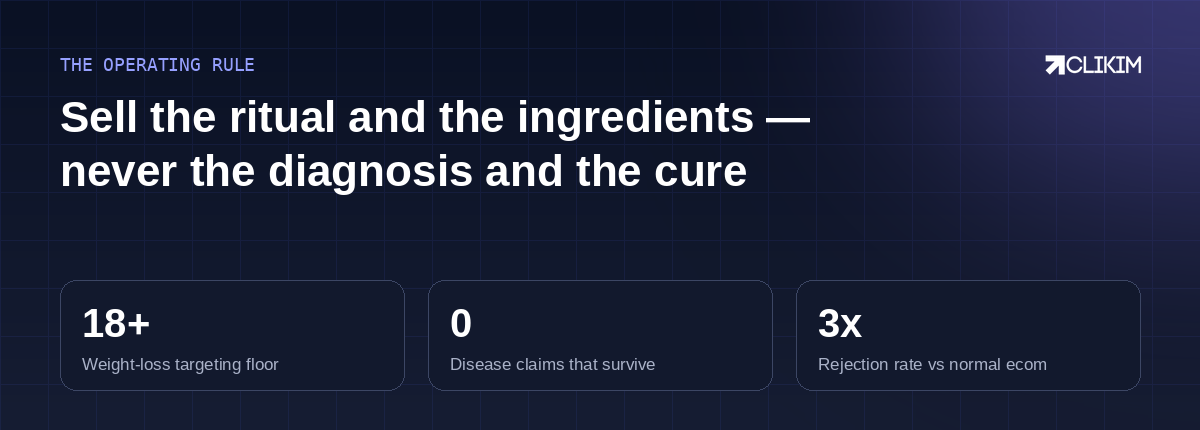
Sell the ritual and the ingredients. The brands that stopped promising cures are the ones still advertising.
Frequently asked questions
Can you advertise supplements on Facebook in 2026?+
Why do my supplement ads keep getting rejected?+
What supplement claims ARE allowed on Facebook?+
Are before-and-after photos really banned?+
Can I say “helps with anxiety” or “lowers cortisol”?+
Why was my ad approved and then banned weeks later?+
My competitors run non-compliant claims. Why can't I?+
Do I need an FDA disclaimer on my landing page?+
What targeting should supplement brands use?+
How many rejections before my account is at risk?+
Should supplement brands use an agency ad account?+
What's the best-performing supplement ad angle right now?+
Can I retarget people who visited my supplement site?+
Run supplements on infrastructure built for scrutiny
Aged, whitelisted infrastructure with lifetime replacements — the survival kit for restricted verticals. Operated on BM2500 infrastructure.