
Facebook Ads for Dropshipping (The 2026 Survival Playbook)
Dropshipping is allowed on Facebook — but its patterns look like scam patterns to Meta's enforcement systems, so the vertical runs on hard mode. Here's the playbook that survives it: infrastructure before spend, claims discipline, feedback-score protection, and the account strategy that outlives ban waves.
Dropshipping is permitted on Facebook — but Meta reads its typical launch pattern as a scam signature, so survival is an infrastructure game.
Fresh account + new domain + aggressive discounts + slow shipping + fast spend ramps is the exact silhouette enforcement was trained on. The playbook: build trust before traffic (aged/whitelisted ad account, verified BM, warmed page, pixel + CAPI), and keep claims honest — the page feedback score from shipping complaints throttles and kills accounts no creative can save.
Test 2–3 products a week over full attribution windows instead of the 10-a-day churn, use native UGC video, scale winners in 20–30% steps, and keep backup account infrastructure ready — one account is zero accounts.
- Dropshipping is legal and allowed on Facebook — but its patterns overlap with scam patterns, so the vertical carries structural ban risk.
- The 2026 playbook is infrastructure first: aged account, verified BM, warmed page, pixel + CAPI — before the first dollar of spend.
- Page feedback score is the silent killer: sustained shipping complaints throttle delivery and end accounts regardless of ad quality.
- Claims discipline beats claims aggression: fake slashes and countdown timers buy short-term CTR and long-term enforcement.
- Scale in 20–30% budget steps — spend spikes on new accounts read as fraud patterns.
- Winning products change monthly; surviving infrastructure compounds. Build the second, rent the first from the market.
- One account is zero accounts: serious operators keep backup infrastructure ready before they need it.
Why Facebook treats dropshippers as suspects
Start with the uncomfortable framing, because every tactic below follows from it: Meta cannot see your supply chain. It can’t verify that your fulfillment works, your product photos are honest, or your customers get their packages. All it can read is patterns.
And the observable pattern of a legitimate dropshipping launch (fresh account, fresh domain, aggressive discount claims, long shipping windows, fast spend ramps) is nearly identical to the observable pattern of a scam. Years of actual scammers using dropshipping’s exact playbook have trained Meta’s enforcement systems on your silhouette.
That's why the failure mode isn't "my ad was bad" — it's account-level: caps, restrictions and bans that arrive at $200 of lifetime spend, before any campaign had a chance to prove itself. The model of the business is fine (Shopify's overview covers the mechanics); the execution environment is hostile. So the 2026 playbook inverts the beginner's instinct: infrastructure and compliance first, product testing second, scaling third.
Every row is a statistical guilt-by-association problem: Meta can't inspect your warehouse, so it reads your patterns — and bad actors trained it on yours.
Step 1 — Build the stack before the store spends
The left column is how most dropshippers start; the right column is who's still advertising in month six. The product barely matters to this table.
The table is the whole argument. Meta’s trust systems price every signal you emit, and most of those signals are set before your first campaign: account age, BM verification, page history, domain reputation, payment standing. A brilliant product on the left-column stack dies in review; a mediocre one on the right-column stack gets room to iterate.
Concretely: run pixel + CAPI from day one (dropshipping margins can’t afford 30% signal loss), post organic content on the page for two weeks before advertising, use a domain without a rap sheet, and advertise from an aged, whitelisted account — the full case is in what an agency ad account is, and it’s the difference in the panel above.
Step 2 — Claims discipline (the feedback score is watching)
Two enforcement surfaces decide dropshipper lifespans. The first is ad review: pricing theater ("$149 $19 TODAY ONLY"), miracle claims, before/after imagery and engagement bait all pattern-match to the scam corpus in Meta's Advertising Standards — each rejection is survivable, but rejections accumulate into account scrutiny (the mechanics are in our rejected-ads guide).
The second surface is quieter and deadlier: the page feedback score. Meta surveys your actual buyers post-purchase, and sustained complaints — almost always about shipping time in this vertical — sink a score that first raises your costs, then throttles delivery, then kills the page’s ability to advertise at all. No creative fixes it.
The mitigations are boring commerce: honest delivery estimates on the product page (not the checkout), suppliers with US/EU warehouses for hero products, order tracking emails, and fast refunds on the inevitable stuck package. In 2026, two-week silent shipping is not a margin strategy — it’s a countdown timer.
What is the page feedback score, exactly?
Meta surveys your buyers after purchase; sustained complaints — mostly about shipping time — sink a per-page score that first raises costs, then throttles delivery, then removes the page’s ability to advertise. It’s the one metric no ad optimization can rescue.
Step 3 — Product testing without torching the account
The classic dropshipping testing loop (launch 10 products at $10/day each, kill 9 tomorrow, repeat) was built for an era of disposable accounts — it churns creative, spikes and slashes spend, and accumulates exactly the instability signals that flag new accounts.
The 2026 version tests fewer products with more intent: 2–3 candidates a week, each with 2–3 genuinely different creatives, judged over full attribution windows (a day-one read on a $15 budget is noise), killed by CPA logic rather than vibes.
Broad targeting beats interest-stacking for testing — it exits learning faster and reads product appeal, not audience-picking skill. The account-level rhythm stays smooth: consistent daily spend, winners scaled by 20–30% steps, losers turned off without restructuring the account every morning.
Step 4 — Creative that converts without triggering review
The creative meta for dropshipping has fully converged on native-feeling UGC video: real hands, real product, honest voiceover, captioned, vertical. It outperforms polished ads and reads as content rather than as the ad-farm aesthetic review systems distrust.
The angle hierarchy that works: problem-agitation (“your knife dulls in a month”) over discount-shouting; demonstration over claims; specific social proof over superlatives. Skip the tactics that juice day-one CTR and feed the quality ranking’s blacklist — fake countdowns, “90% off,” stolen competitor footage. Our creative tools roundup covers the 2026 production stack for teams of one.
The unit economics Facebook forces on you
One more reality the ad platform imposes: dropshipping margins have to be built for auction prices, not the other way around. Work the math backwards before testing anything.
US ecommerce CPMs run $10–18 and purchase conversion rates for cold dropshipping traffic land near 1–2%, which puts realistic CPAs at $20–45 for impulse-priced products. A $25 product with $12 landed cost has $13 of gross margin — it cannot buy a $30 customer, ever, no matter how good the creative gets.
The products that survive this arithmetic share a shape: $40–80 retail with 3–4× markup, a perceived value that supports the price, and ideally an upsell path (bundle, quantity break, complementary item) that lifts average order value 20–40% above the hero product’s ticket.
That AOV lift is frequently the entire difference between a "losing" and a winning product on identical traffic. A $34 AOV at a $31 CPA is a hobby; the same store with a bundle pushing AOV to $52 is a business. Before killing a product that converts but doesn't profit, exhaust the order-value levers — they're cheaper than new traffic and invisible to the ad account. And track it all against blended numbers from your store's books, not the platform dashboard alone; attribution flatters everyone.
Step 5 — Scaling and the ceiling nobody budgets for
When a product hits, the constraint stops being creative and becomes account capacity. New accounts carry invisible daily spending caps ($50–250/day is typical) that arrive exactly when your winner wants $800/day — and raising spend against a cap in aggressive jumps is itself a flag. The boring path is stepped 20–30% raises with stable CPA at each level.
The structural path is running infrastructure without the ceiling: managed whitelisted infrastructure under high-trust BMs (the BM2500 tier) with no preset caps, faster review handling — and, because this vertical’s risk never reaches zero, backup accounts ready before the ban, not after. One account is zero accounts; ask anyone who’s watched a $2k/day winner die mid-scale with Q4 inventory paid for.
If the worst happens anyway, the recovery path is in the banned-account guide — and the same infrastructure logic extends to TikTok agency accounts when you take the winning product cross-platform.
The pre-flight checklist, compressed
Before the first campaign goes live, all ten of these should be true:
- The ad account has age or agency standing, not a fresh personal profile.
- The Business Manager is verified.
- The page has two weeks of organic posts and a human-looking profile.
- The domain is clean and matches the store brand.
- Pixel + CAPI both fire and deduplicate on a test purchase.
- Product-page shipping estimates are honest and visible.
- Refund policy is one click from checkout.
- Every ad claim survives the “would I say this to a regulator” test.
- The launch budget ramps smoothly rather than spiking.
- A backup account path exists on paper before you need it in panic.
Ten yes-answers doesn’t make the product a winner — it makes the account durable enough to find out.
What margins do I need for Facebook ads to work?
Work backwards from realistic CPAs of $20–45 for cold traffic: products around $40–80 retail at 3–4× markup survive; a $25 product with $13 of margin can’t buy a $30 customer no matter how good the ads get. Bundles and upsells that lift AOV 20–40% often decide profitability.
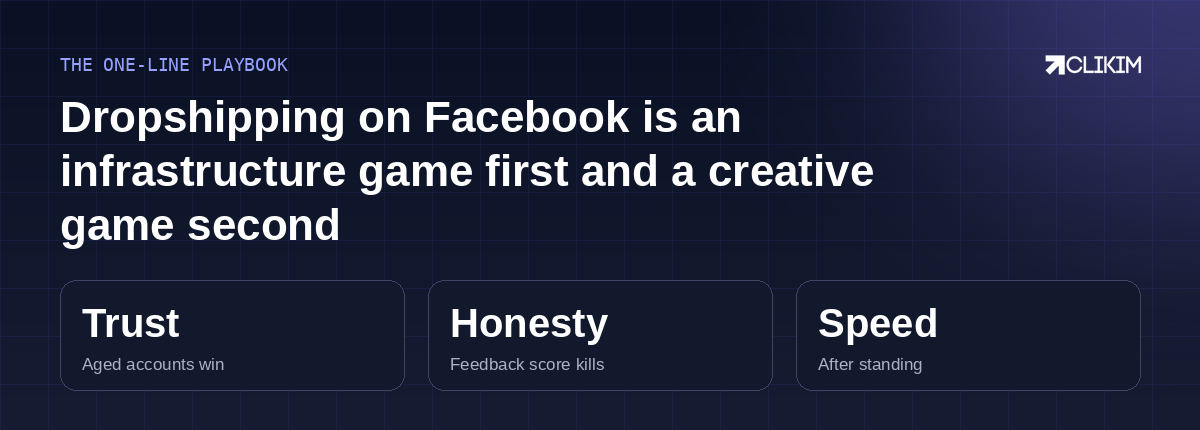
Products are rented from the market; infrastructure is owned. Build the part that compounds.
Frequently asked questions
Is dropshipping allowed on Facebook in 2026?+
Why do dropshipping ad accounts get banned so fast?+
How much budget do I need to test a dropshipping product?+
Should I use broad targeting or interests for dropshipping?+
What creative works best for dropshipping in 2026?+
How fast can I scale a winning dropshipping product?+
What's the biggest hidden ceiling for dropshippers?+
Do I need backup ad accounts?+
Does this playbook work for TikTok dropshipping too?+
My dropshipping account already got banned — what now?+
Run dropshipping on infrastructure that survives
Aged, whitelisted Facebook & TikTok infrastructure — no preset caps, faster review handling, replacements ready. Operated on BM2500 infrastructure.