
How the Facebook Ads Auction Actually Works
Every impression you've ever bought was won in a milliseconds-long auction you never saw. Here's the total value formula that decides winners, why relevance outbids money, what you actually pay, and the levers that genuinely move your prices.
Facebook auctions every impression individually and awards it to the highest total value: bid × estimated action rate + ad quality — not the highest bid. Two of the three terms are relevance, so strong creative literally buys cheaper reach, while boring or baity ads pay a quality tax. Winners pay roughly the minimum needed to beat the runner-up, your CPM is your personal auction report card, and the real levers are creative, broader audiences, clean conversion signal and fresh rotation — not bidding more.
• Facebook runs a total-value auction: bid × estimated action rate + ad quality — not highest-bid-wins. • Two of the three components are creative and relevance, not money. • Winners pay roughly the minimum needed to beat the runner-up, not their max bid. • Your CPM is your auction report card — unique to your ads, not a market price. • Relevant ads get discounted reach; boring ads pay a quality tax. • Better signal (CAPI, right event) improves Meta's estimates and your prices. • Pacing spreads your budget across the day's auctions — panic-editing breaks it.
One auction per impression
Every time someone opens Facebook or Instagram, every ad slot they're about to see is auctioned — individually, in milliseconds, among every advertiser targeting that person at that moment. Billions of these micro-auctions run daily, and your campaign's "results" are just the aggregate of the ones you won and what you paid for them. Understanding this one mechanism explains almost everything that otherwise looks mysterious about Facebook advertising: why CPMs differ between advertisers, why creative changes move costs, why narrow audiences get expensive.
The crucial twist is how a winner is chosen. Meta doesn't sell each slot to the highest bidder — that would flood feeds with whatever junk paid most and eventually destroy the audience worth selling. Instead it picks the ad with the highest total value, a score that combines what you'll pay with how likely the user is to want what you're showing.
The total value formula
Total value = bid × estimated action rate + quality. Two of the three components are creative, not money.
Bid is what a result is worth to you, expressed through your bid strategy — on lowest cost, Meta effectively bids on your behalf to spend your budget; on a cost cap, it bids within your constraint. Estimated action rate is the machine's prediction that this specific user will do what your campaign optimizes for — click, buy, sign up — based on everything it knows about them and about how people have responded to your ad so far. Ad quality captures the experience itself: engagement signals, negative feedback (hides, reports), clickbait/engagement-bait penalties, and post-click experience.
Read the formula again and notice the imbalance: money is one term; relevance is two. An ad users demonstrably want can carry a modest bid past a rich competitor's boring one. This isn't Meta being charitable — showing people things they respond to is what keeps them scrolling, so the auction is engineered to price attention-wasting and subsidise relevance.
What you actually pay
Winning doesn't mean paying your bid. The auction behaves like a second-price mechanism: the winner pays approximately the minimum needed to have beaten the runner-up's total value. In practice this means your costs float with competition — the same ad, same audience, costs more in Q4 because the runner-up bids rose, not because anything about your account changed.
This is also why obsessing over bid amounts is mostly wasted energy on lowest cost: you're not choosing prices, the competitive landscape is. Your controllable input is the total-value side — making Meta's machine want to show your ad because users respond to it.
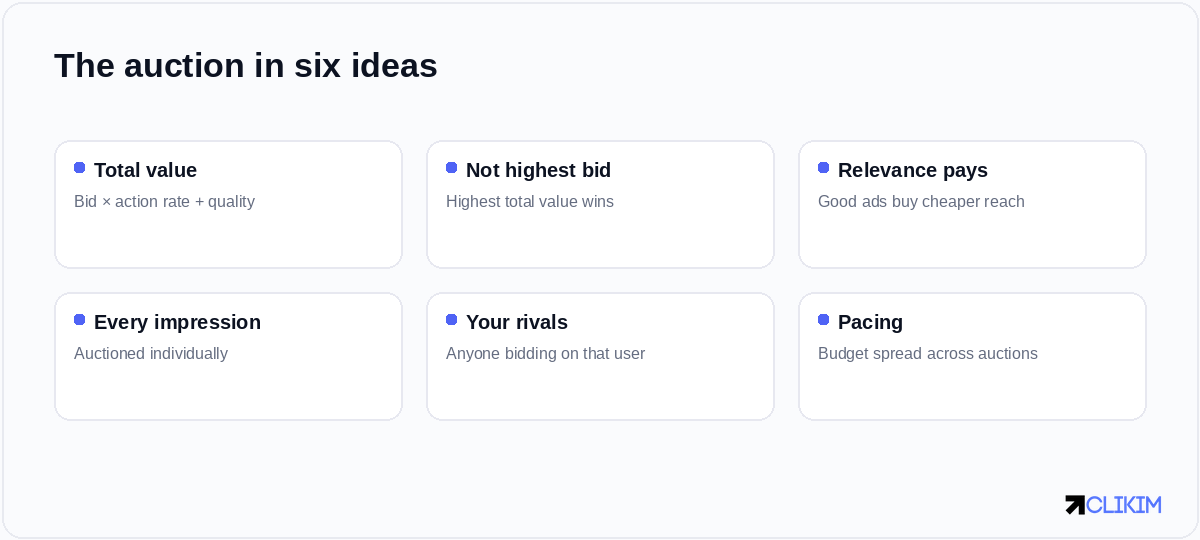
Six ideas that replace all the auction folklore — total value decides, and relevance is two-thirds of it.
Your CPM is a report card, not a price tag
Advertisers talk about CPM like a market rate — "CPMs are $15 in ecommerce" — but the auction makes CPMs personal. Your CPM is the blended outcome of the auctions you entered with your creative against your competitors. Two brands targeting identical audiences routinely pay 2× different CPMs because one's creative earns better action-rate estimates and quality scores.
So when your CPM jumps with no targeting change, the auction is telling you something specific: either competition rose (seasonality, new entrants) or your total value fell (creative fatigue, weakening engagement). The benchmark tables locate you; the auction explains you.
Where the action-rate estimate comes from
The estimated action rate deserves special attention because it's the auction's centre of gravity. Meta predicts, per user per ad, the probability of your optimization event. Early in an ad's life the estimate is uncertain — that's precisely what the learning phase is: the system buying information about how people respond so its predictions (and your delivery) stabilise.
Two things feed the estimate. First, your ad's own performance history — every impression teaches the model who responds. Second, your conversion signal: if the pixel misses half your purchases, the model learns from a distorted sample and predicts worse, which prices you worse. This is the unglamorous reason Conversions API setup shows up in auction outcomes — better signal, better estimates, better prices. Your optimization event choice matters the same way: asking for purchases with three purchases a week gives the model nothing to predict with.
The quality term (and its penalties)
Ad quality is mostly invisible until it isn't. Meta demotes — explicitly — engagement bait ("comment YES if…"), withheld-information clickbait, sensational or low-quality landing experiences, and ads accumulating negative feedback. These penalties don't reject the ad; they quietly tax its total value, so it wins fewer auctions at worse prices, and the advertiser experiences it as "Facebook got expensive".
The flipside is a free lever: ads people genuinely engage with — watched, shared, commented on positively — carry quality credit into every auction they enter. This is one mechanism behind UGC's outperformance: native-feeling content collects engagement signals that polished interruptions don't.
A worked example
Make it concrete. Three advertisers compete for one impression to the same user. Advertiser A bids the equivalent of $20 CPM but runs a tired stock-photo ad the model scores at a 0.4% action rate with mediocre quality. Advertiser B bids $12 with a sharp UGC video the model scores at 1.1% and strong quality. Advertiser C bids $30 with an engagement-bait post carrying an active quality penalty. Multiply it out and B's total value tops the ranking despite the smallest bid — B wins, and pays just enough to edge A's score, not B's own maximum.
Play the same auction a million times across a campaign and the pattern becomes your P&L: B's "expensive-looking" creative investment returns discounted reach every single day, A burns budget subsidising weak creative, and C wonders why reach collapsed. When buyers say "creative is the new targeting", this multiplication is the mechanism they're describing.
When you bid against yourself
One auction subtlety worth knowing: your own ad sets can meet in the same auction. Meta prevents literal self-competition by entering only one of your ads per auction — but fragmented accounts still pay for overlap, because audience-sharing ad sets split each other's signal, learn slower, and each look weaker than a consolidated set would. This is the auction-level explanation for the consolidation advice in our structure guide: ten thin ad sets don't out-compete rivals, they dilute your own total value.
The symptom is high CPMs on overlapping audiences plus ad sets stuck in learning. The fix is structural: merge overlapping audiences, concentrate the budget, and let one strong signal enter the auction instead of five weak ones.
Auction myths, retired
Most auction folklore dissolves once you see the total-value formula.
Pacing: the auction's quiet partner
One more mechanism completes the picture. Your budget isn't dumped into the first auctions of the day — a pacing system spreads it, aiming to spend smoothly while favouring the cheapest valuable opportunities across the day. This is why spend curves look even, why results often cluster at odd hours (the pacer found cheap inventory), and why constant mid-day budget edits hurt: each significant change forces the pacer to re-plan, and per our budget-mode guide, can rattle learning too.
Give the pacer stable instructions and a full day to work. Buyers who panic-edit at 11am because the morning looked slow are interrupting a system that was saving budget for the evening's cheaper auctions.
How to actually win more auctions
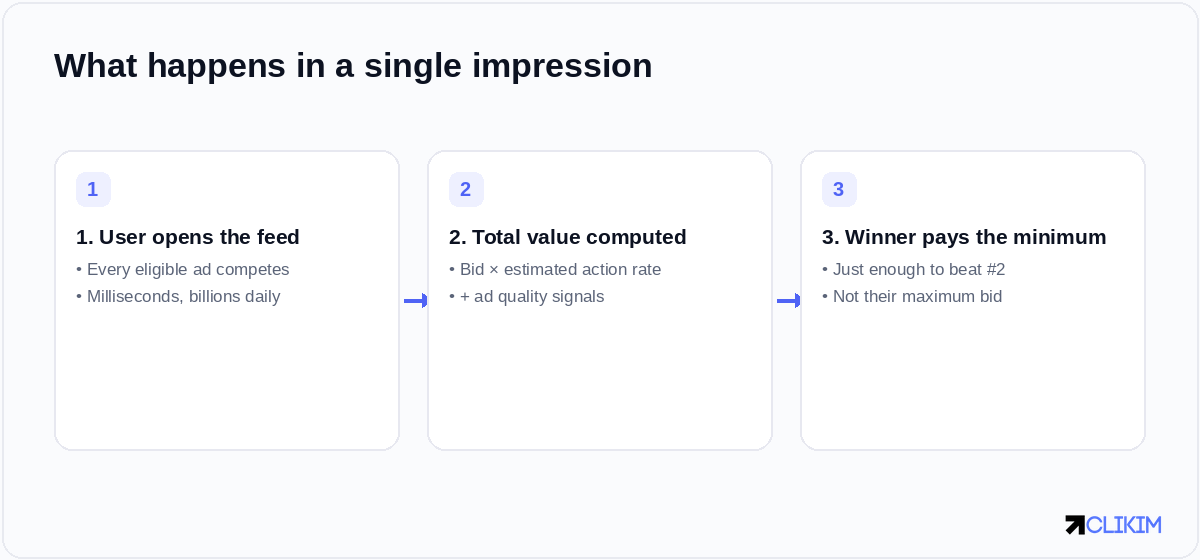
Milliseconds per impression: compute total value, rank, winner pays just enough — repeat billions of times.
Every practical optimization is an auction lever in disguise — this table is the whole game.
Notice what's absent from that table: "bid more". On lowest cost, you can't meaningfully out-bid your way to efficiency — you can only out-value competitors. Every durable Facebook optimization is, mechanically, an increase in estimated action rate or quality: sharper creative, broader pools of auctions to select from, cleaner signal, fresher ads. The auction is the reason those practices work.
The account layer under the auction
One input the formula doesn't show: the system's confidence in the advertiser. New and low-trust accounts operate with tighter delivery, more conservative estimates, and hard ceilings like the $250/day cap — effectively entering every auction with a handicap until trust accumulates. Restrictions and resets throw away the performance history your estimates were built on.
That's the auction-mechanics case for stable infrastructure: a mature, whitelisted agency ad account brings accumulated trust and uninterrupted history into every micro-auction — so the total value you've earned actually gets to compete.
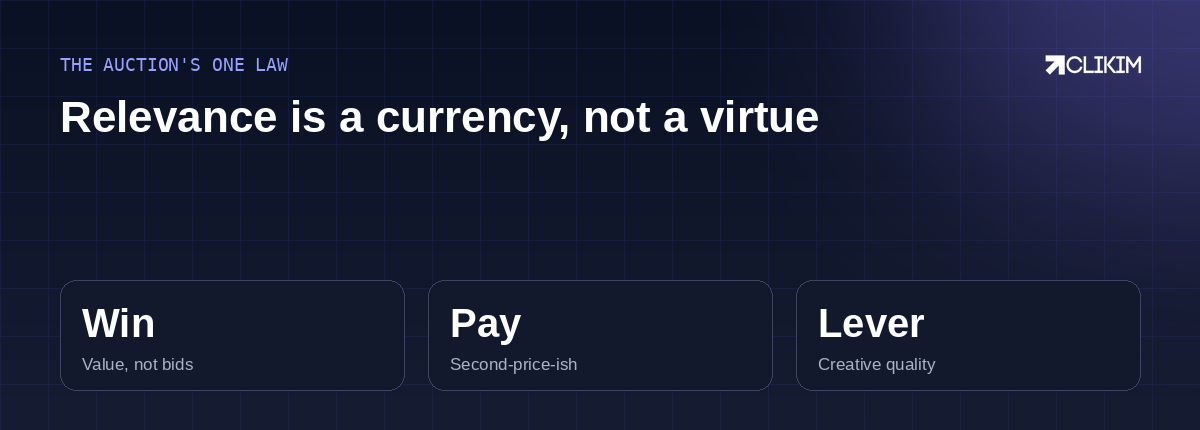
Second-price mechanics, value-ranked winners — the whole optimization playbook is really auction physics.
Frequently asked questions
How does the Facebook ads auction work?+
Does the highest bidder win the Facebook auction?+
What is estimated action rate?+
What is ad quality in the auction?+
What do I actually pay when I win?+
Why is my CPM different from my competitor's?+
How do I lower my Facebook ad costs via the auction?+
Does the learning phase relate to the auction?+
What is budget pacing?+
Do big brands always win the auction?+
Does account trust affect the auction?+
Why did my costs spike in Q4?+
Win auctions on value — enter them on trust
Your creative earns the total value. Managed whitelisted infrastructure with mature trust and no preset caps makes sure it gets to compete. Operated on BM2500 infrastructure.