
Why Does Facebook Keep Banning My Ad Account?
One ban is an incident; a pattern has a cause. Here's why Facebook keeps banning your ad account, why spinning up new ones makes it worse, and the three moves that actually break the cycle.
Facebook keeps banning your ad account because you're running on low-trust infrastructure — new or personal accounts with fragile Page quality, payment risk, borderline creative, or linked assets that carry risk between them. Creating new accounts makes it worse, because the platform sees the same signals. Break the cycle by cleaning your inputs and moving to a high-trust account that doesn't carry your history.
Why it keeps happening (it's a pattern, not bad luck)
One ban is an incident. Three is a pattern — and patterns have causes you can name. If Facebook keeps banning your ad account, the problem usually isn't a single rogue ad; it's that you're running high-risk activity on low-trust infrastructure, and the platform keeps reacting to it. Treat the pattern, not the symptom, and the bans stop.
The frustrating part is that the obvious response — spin up another account and keep going — is exactly what feeds the loop. Let's break down why, then how to get out of it.
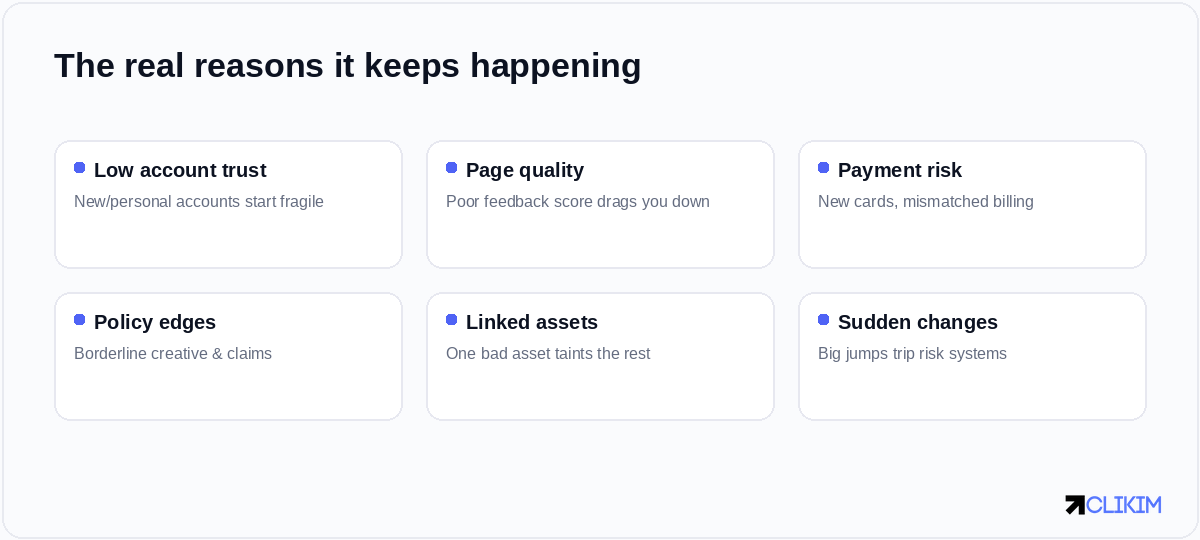
Most repeat bans come back to a small set of root causes — and almost all of them are about trust.
The real reasons your account keeps getting banned
Run down this list honestly; the answer is usually one or two of these compounding:
- Low account trust. Brand-new and personal accounts start with little trust and the tightest scrutiny. Every misstep counts double.
- Page or feedback quality. A low customer-feedback score or a flagged Page drags down everything connected to it.
- Payment risk. Fresh cards, mismatched billing country, or repeated payment failures read as risk.
- Borderline policy. Living on the edge of the Advertising Standards — aggressive claims, sensitive niches — means small mistakes tip you over.
- Linked assets. Risk travels between connected profiles, Pages, pixels and payment methods. One bad asset can taint the rest.
- Sudden changes. Violent budget jumps, new domains, and new payment methods all at once trip anomaly detection.
Why spinning up new accounts makes it worse
Here's the trap. An account gets banned, so you create a new one — same profile, same card, same Page, same offer. To the platform, that new account isn't a fresh start; it's a familiar risk signal wearing a new hat. The connections are visible, the behaviour is the same, and the new account often gets flagged faster than the last. You're not escaping the cycle; you're accelerating it.
This is why "just get another account" is the most expensive cheap advice in advertising. It feels like progress and quietly digs the hole deeper.
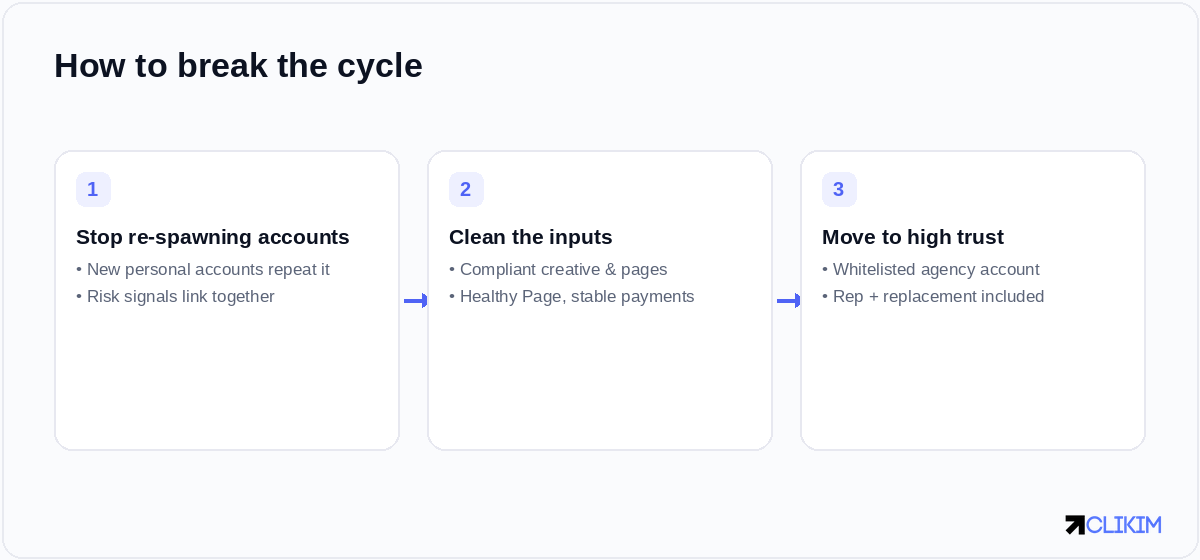
Breaking the cycle has three parts: stop re-spawning, clean your inputs, and move onto trust you don't have to rebuild.
How to break the cycle
Three moves, in order:
- Stop re-spawning personal accounts. Each one repeats the pattern and links more risk. If an account is permanently gone, don't immediately clone it — see how to appeal a disabled account first, and only move on once that's exhausted.
- Clean your inputs. Tighten creative and landing pages to sit comfortably inside policy, repair your Page quality, and stabilise your payment method. If delivery is also erratic, rule out the mundane causes in why Facebook ads don't spend.
- Move to high-trust infrastructure. Run on an account that starts with trust you didn't have to earn from zero, with a rep who can intervene before a flag becomes a ban.
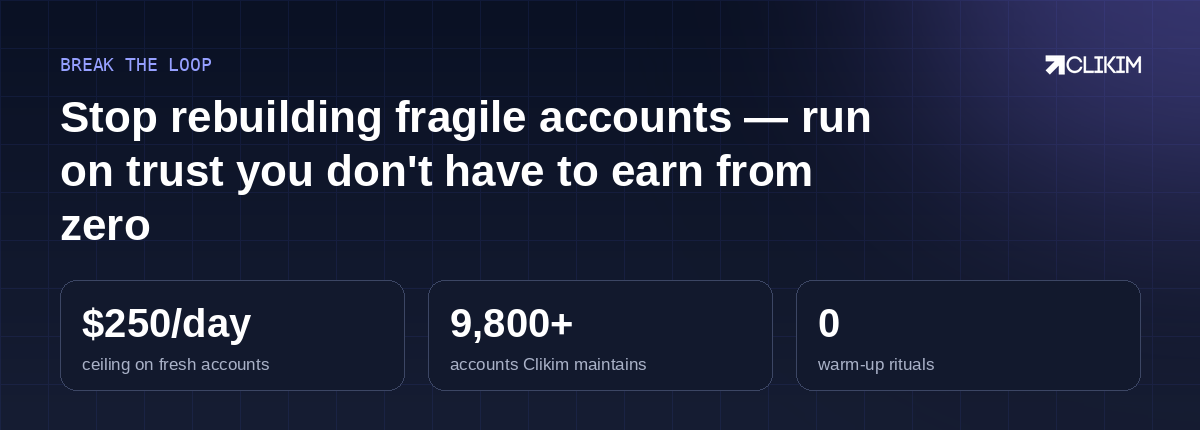
The way out isn't another fragile account — it's running on trust you don't rebuild from scratch.
When to switch to a higher-trust account
If you've been banned more than once or twice, you're past the point where better behaviour alone fixes it — the account history is working against you. That's the signal to switch. A whitelisted Facebook agency ad account is issued from an established Business Manager, so it doesn't carry your accumulated risk, and it comes with a dedicated rep plus a replacement if it's ever lost. If you want the mechanics, here's how to get one, and the wider agency ad accounts lineup.
Facebook Ad Account Bans in 2026: The State of Enforcement — what triggers bans, real appeal odds, vertical risk multipliers and the ban-proofing stack, with sources and quarterly updates.
Frequently asked questions
Why does Facebook keep banning my ad account?+
Does creating a new ad account avoid the ban?+
How many times can you get banned before it's permanent?+
How do I stop my Facebook ad account getting banned again?+
Can linked accounts cause repeat bans?+
When should I switch to an agency ad account?+
Done rebuilding accounts every few weeks?
Whitelisted Facebook infrastructure doesn't carry your old risk — under an established BM2500, with a dedicated rep and lifetime replacements.