
Google’s Advertiser Verification: Pass It the First Time
Verification went from an occasional prompt to core infrastructure: it gates ad serving, feeds every trust signal, and its failures pause accounts at the worst possible moments. Here’s the program mechanics, the document standards that pass first time, and the mismatches that quietly fail advertisers.
Google’s advertiser verification confirms who you are — and the prompt comes with a deadline, commonly 30 days, after which ads pause.
The pass-first-time rule is alignment: the legal name and country on your documents must match your payments profile and account details exactly. Mismatched paperwork is the dominant failure mode, not illegitimacy.
Verify before you’re asked. A completed verification removes one whole suspension family and strengthens every other trust judgment your account faces.
Why the program exists (and why it helps you)
Verification is Google’s answer to a decade of scam ads, impersonation and unaccountable advertisers: tie every account to a verifiable legal identity, surface that identity to users (“paid for by…” disclosures, advertiser pages), and give enforcement a real-world anchor. For legitimate advertisers, the burden pays back: a verified identity is the strongest standing trust signal an account carries, it removes a whole suspension family from your risk surface, and it materially strengthens appeals in every other family — reviewers resolve doubt in favor of accounts whose identity checks out (see how that plays in the appeal playbook).
Who must verify, and when
Directionally: everyone, eventually. Google has expanded verification continuously — by geography, vertical and trigger — so the operational question isn’t whether but when the prompt lands. Prompts arrive by email and in-account notification, commonly with a 30-day window; miss it and ads pause until verification completes. Certain triggers accelerate the prompt: sensitive verticals (finance, healthcare, political), risk signals on the account, payment anomalies, and — notably for readers of this cluster — fresh accounts scaling fast. The strategic implication is simple: verify before you’re asked. A paused account mid-scale is a self-inflicted wound with a known prevention.
The verification types
| Check | What it asks | Who it applies to |
|---|---|---|
| Identity — individual | Government-issued photo ID of the individual running ads. | Sole traders, individuals. |
| Identity — organization | Business registration documents (certificate of incorporation, tax registration such as an EIN letter in the US) plus, in some flows, ID of an authorized representative. | Companies — the standard path for agencies and brands. |
| Business operations | A questionnaire on your business model — what you sell, how you bill, your relationship to the products advertised — sometimes with supporting evidence. | Triggered case-by-case: sensitive verticals, risk-flagged accounts, unclear models like lead resale or arbitrage. |
| Payment verification events | Confirming payment-method ownership when billing signals raise doubt. | Ad hoc — usually alongside a payment flag. |
Agencies get a specific wrinkle: who verifies depends on who pays and who’s responsible. Where the client account bills the client’s payment profile, the client’s identity verifies; agencies managing through an MCC may verify at the manager level for their own standing while each client account carries its own verified identity. Misassigning this — agency documents on a client-billed account — manufactures exactly the mismatch that fails.
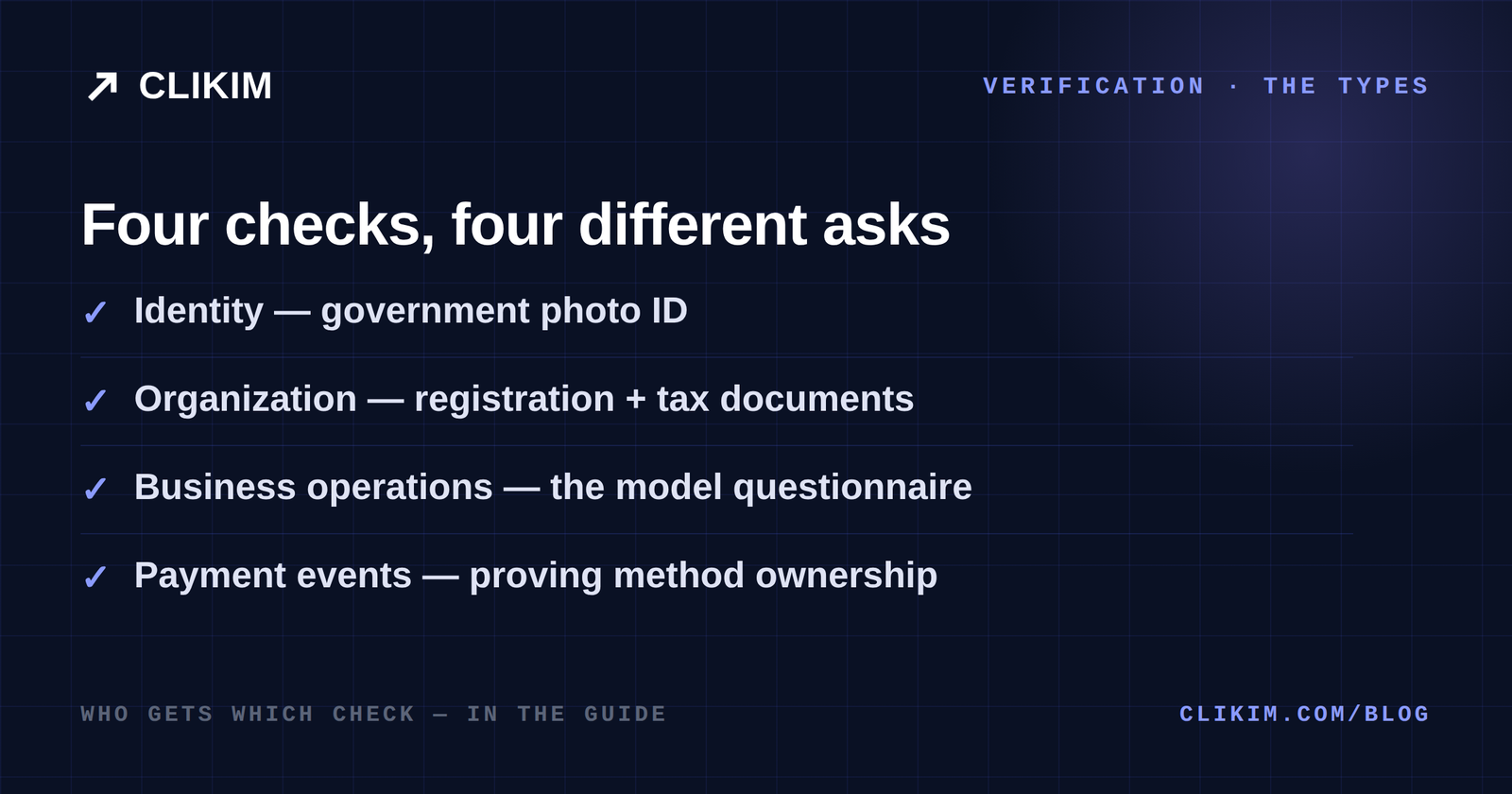
Identity, organization, business operations, and payment events — know which one you're in.
Documents that pass the first time
- Exact legal-name match across the trio: registration document ↔ payments profile ↔ account business name. “Acme Media LLC” vs “Acme Media” fails checks humans would wave through.
- Country coherence: documents from the entity’s registration country, matching the payments profile country. Cross-border operators: verify as the entity that owns the payment profile — this is the same identity triangle from the payment-flag guide.
- Current, legible, complete: full documents (all pages), unexpired, names and numbers readable — trivial-sounding, and a real rejection bucket.
- Representative authority: where an individual verifies for an organization, that person should visibly connect to the entity (officer, listed director, admin email on the domain).
Why verifications fail — the honest list
In rough order of frequency: name mismatches with the payments profile; wrong-country documents; verifying the wrong party (agency vs client, holdco vs operating company); expired or partial documents; business models the questionnaire can’t map to the site (the fix is making the site say plainly what the business does); and identity checks failed by the wrong individual attempting them. Almost every one is an alignment problem, not a legitimacy problem — which is exactly why the fix-first discipline from the appeals world applies here too: correct the mismatch, then re-attempt, rather than resubmitting the same contradiction.
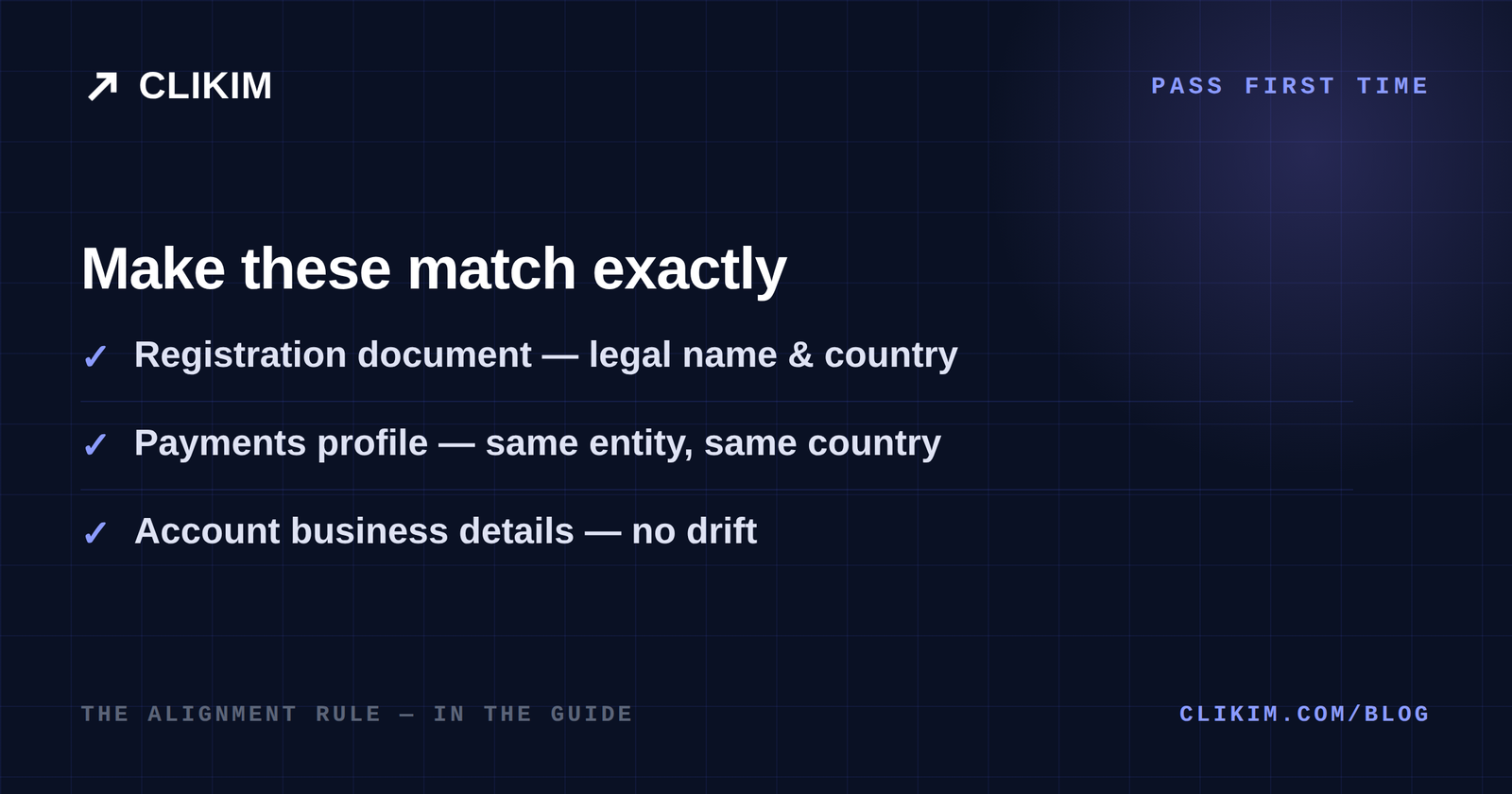
Exact-match alignment across three records is the entire game — 'Acme Media LLC' vs 'Acme Media' fails.
Verification as strategy, not compliance chore
Treat verification the way established operators do: front-load it (verify at account creation, not at prompt-deadline panic); keep a verification pack — registration certificate, tax letter, rep ID, payment-profile screenshot — current and stored where whoever manages the account can reach it; re-align after every corporate change (renames, re-registrations, new payment entities all silently break the triangle); and if you operate many accounts, make verification state part of onboarding checklists. Accounts inside established agency structures get this discipline as table stakes — the structure’s standing depends on every account in it verifying cleanly, which is one more quiet reason those accounts age better than cold signups.
Frequently asked questions
Is Google advertiser verification mandatory?+
What documents does Google verification require?+
Why did my Google verification fail?+
How long does verification take?+
Does verification prevent suspensions?+
Who verifies when an agency manages my account?+
Want accounts that verify clean and stay up?
Established structures, aligned billing, verification discipline built in — talk to a rep in minutes.