
What Is a Google MCC? The Manager-Account Guide
Every serious Google Ads operation — agencies, in-house teams with multiple brands, account providers — runs on manager accounts. Here’s how the MCC structure actually works: linking, permissions, consolidated billing, sub-manager hierarchies, and the architecture patterns that keep client accounts healthy.
A Google MCC (manager account) is an umbrella that links and manages many Google Ads accounts — it holds relationships, not ads.
Agencies use MCC hierarchies to separate clients cleanly, share assets, and unlock consolidated billing — up to monthly invoicing on earned credit terms. Linking never transfers ownership; it grants access that either side can sever.
It’s also the structure behind legitimate agency ad accounts: accounts operating inside an established manager inherit billing paths and standing a cold signup never gets.
What an MCC is — and what it isn’t
A manager account is a container, not an ad account: it can’t run campaigns of its own. What it does is link Google Ads accounts (and other manager accounts) under one roof, giving the manager dashboard-level visibility, cross-account reporting, shared negative-keyword and audience assets, automated rules across accounts, and centralized user administration. One login, an entire book of business.
The distinction that matters commercially: linking an account to an MCC does not transfer ownership. The client account remains its own entity with its own history — the manager gains administrative reach, which either side can sever. That’s why account access can be provided, managed, and revoked cleanly, and it’s the legitimate backbone of the agency-account model — as opposed to the grey market’s outright account sales.
Linking, permissions, and hierarchy mechanics
Linking is invitation-based: the manager sends a link request to a client account ID (or creates a new account directly inside the MCC); the client account admin accepts. Permission levels range from read-only through standard to admin — a client can grant campaign management while retaining ownership and billing control.
Hierarchies go deep: an MCC can link other MCCs (sub-managers), and large operations layer them — a top-level manager, sub-managers per region or team, client accounts at the leaves. Each account can be linked to multiple managers (with one designated for billing where consolidated billing is used), which is how a client can simultaneously grant access to their in-house team and an external agency. Google caps how many accounts a manager can link based on the manager’s standing and spend history — young MCCs start modest and earn capacity, which is one more reason established structures matter.
The billing options an MCC unlocks
| Billing mode | How it works | Who gets it |
|---|---|---|
| Client-level billing | Each account pays with its own payment profile — the default. | Everyone. |
| Consolidated billing | Multiple client accounts billed to the manager’s single invoice. | Managers approved for invoicing. |
| Monthly invoicing (credit terms) | Net-terms invoicing instead of card charges — the mode serious agencies run on. | Requires history: Google’s published bar involves meaningful time-in-good-standing and spend thresholds, assessed on the manager relationship. |
That last row is quietly the biggest deal in this article. Monthly invoicing removes card billing — and its whole failure surface (payment flags, declines, threshold games) — from the equation. Most independent advertisers never qualify alone; accounts inside an established manager structure ride on billing terms the structure already earned. It’s the Google equivalent of the invoicing shift Meta forced on large advertisers in 2026 — covered in our credit-line explainer — except on Google it’s a privilege you attain rather than a mandate you receive.
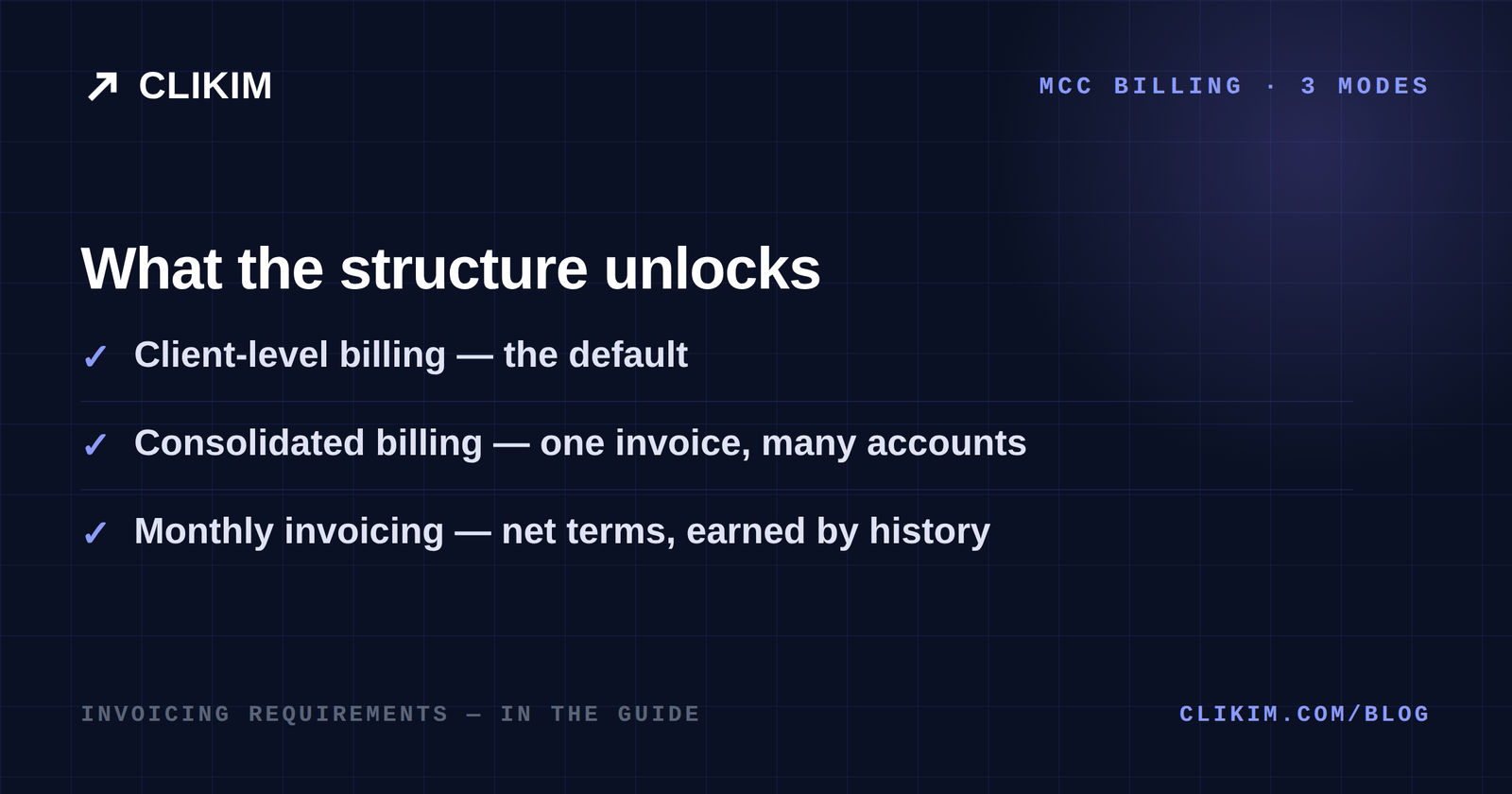
Client-level, consolidated, and the one that matters most: monthly invoicing on earned credit terms.
How agencies actually architect it
The pattern that scales: one client account per client business (never multiple businesses in one account), grouped under sub-managers by team or vertical, with naming conventions that survive employee turnover. Billing separated per client unless consolidated invoicing is deliberately chosen. Conversion tracking configured at the right level — cross-account conversion tracking through the manager where a client portfolio shares goals, account-level where they don’t. Shared negative lists and placement exclusions maintained once at manager level instead of copy-pasted forty times.
And the discipline part: separation is protection. When one client’s vertical draws a policy storm, a clean structure contains the blast radius. Managers who blur accounts across businesses — one account, many sites — build the exact pattern Google’s circumventing systems enforcement is trained to catch (see the suspension guide).
Setting up an MCC
Creation is free and takes minutes at the manager-account signup (a separate Google Ads flow) — you need a Google account not already attached to a regular Ads login, business details, and then you either create client accounts inside it or send link requests to existing ones. The honest caveat: a fresh MCC is a fresh trust profile. It earns linking capacity, billing options and enforcement benefit-of-the-doubt over time, exactly like a fresh ad account does. The structure is easy; the standing is what takes years — which is precisely what established agency-account providers are actually renting you.
MCC mistakes that hurt accounts
- One payment profile fanned across client accounts (outside proper consolidated billing) — the classic payment-linking flag.
- Mixing ownership and access: creating client accounts you should have linked, or vice versa — untangling ownership later is painful and occasionally fatal to history.
- Ex-employee admin ghosts: manager-level access outliving the people; audit quarterly.
- Linking radioactive accounts: a suspended account linked into your MCC associates its signals with your structure. Screen before you link — providers who don’t are renting you a condemned building.
- Sub-MCC sprawl: hierarchy depth without governance just multiplies the surface for all of the above.
Frequently asked questions
What does MCC stand for in Google Ads?+
Is a Google MCC free?+
Can an MCC run ads itself?+
Does linking my account to an agency’s MCC give them ownership?+
How many accounts can one MCC manage?+
What is consolidated billing in an MCC?+
Why do agency ad accounts come from MCCs?+
Need structure without the years of warm-up?
Run inside established manager infrastructure — real billing history, human escalation, replacements included. Talk to a rep in minutes.
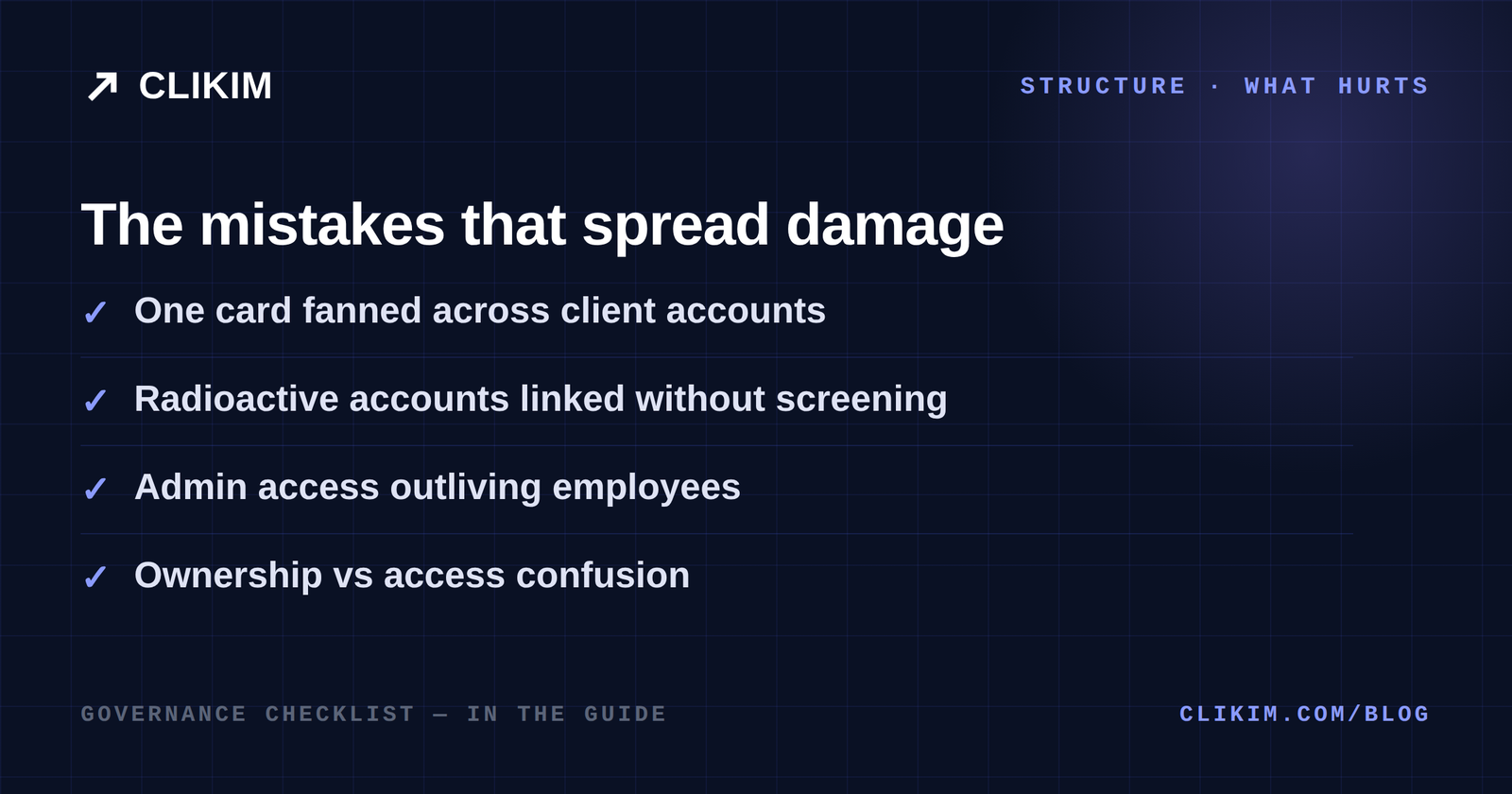
The structure protects accounts — until these patterns turn it into shared blast radius.