
How to Appeal a Google Ads Suspension: The Playbook
Most appeals fail before they’re submitted — wrong sequencing, no evidence, emotional prose, or the same broken setup resubmitted to the same machine. This is the operator’s playbook: fix first, document everything, appeal once, escalate correctly.
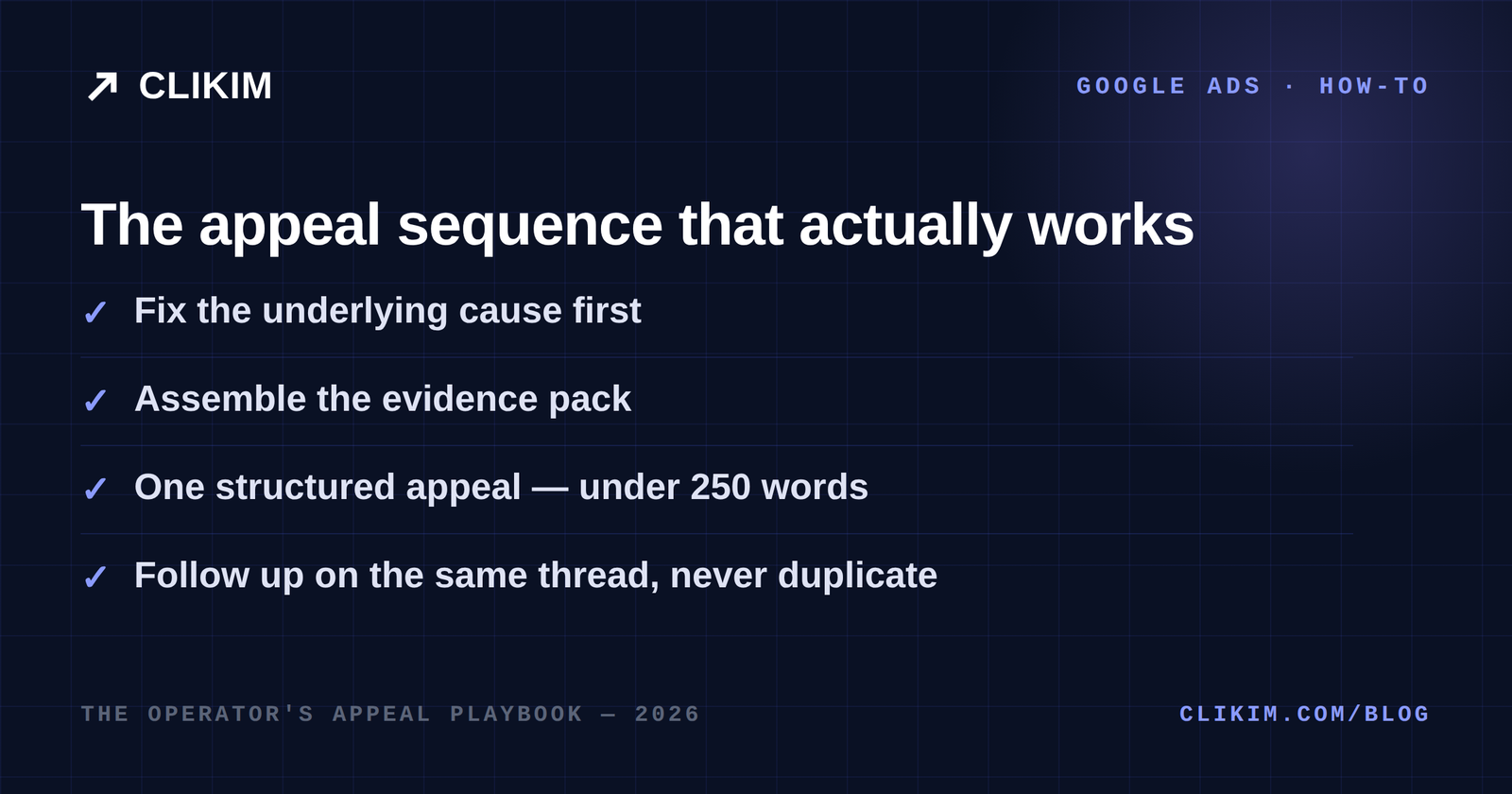
Fix first, then appeal once — an appeal is a re-inspection request, and reviewers re-check reality, not promises.
Read the exact suspension reason, repair the underlying cause, and assemble documents: registration, statements, screenshots of fixes. Then one structured appeal — identity, diagnosis, fix, commitment — in under 250 words of prose.
Timelines run from days to weeks. Follow up on the same thread; never file duplicates. Save the second appeal for genuinely new evidence, and never open a lookalike account while a review is live.
Before you appeal: the fix-first rule
An appeal is a re-inspection request, not a debate invitation. When you submit, a reviewer (or a model) re-examines your account against the violation — the live landing pages, the current payment profile, the verification state. If nothing changed, nothing changes. So the first move is never the form; it’s the fix:
- Read the exact reason in the account notification — the policy name matters, because the fix and the evidence differ per family (full taxonomy here).
- Payment suspensions: align the identity triangle first — business registration, verification identity and payment method agreeing on entity and country; replace the offending card; clear any balance. Our suspicious-payments guide covers the trigger list.
- Policy suspensions: repair every destination — claims, contact/refund pages, ad-to-page consistency — across the whole site, not just the flagged URL. Reviewers browse.
- Verification suspensions: complete the program with documents that match your payment profile exactly; mismatched paperwork is the whole genre of this failure.
The evidence pack, per suspension type
| Suspension family | What to attach or cite |
|---|---|
| Suspicious payment activity | Business registration certificate; bank/card statement showing the payment method belongs to the verified entity; note naming the original mismatch and the replacement method. |
| Circumventing systems | Evidence you’re a real, singular business: registration, operating history, staff/site consistency; a factual account of why the flag was a false positive (no prior suspended accounts, no cloaking, no recycled assets) — this is the one family where you’re proving identity, not fixing a setting. |
| Misrepresentation / business practices | Before/after of the corrected pages; proof of claims (certifications, reviews, fulfillment evidence); complete business info pages live on the site. |
| Unpaid balance / chargeback | Payment confirmation of the settled balance; if a bank dispute happened, its reversal — and the acknowledgment it won’t recur. |
What to write (and what never to write)
Structure beats eloquence. Four short blocks: Identity — account ID, business name, suspension date and stated reason. Diagnosis — the specific cause, named honestly (“the card’s issuing country didn’t match our registered entity”). Fix — what changed, with the attachments doing the proving. Commitment — one line on the go-forward setup. Under 250 words of prose; let documents carry weight.
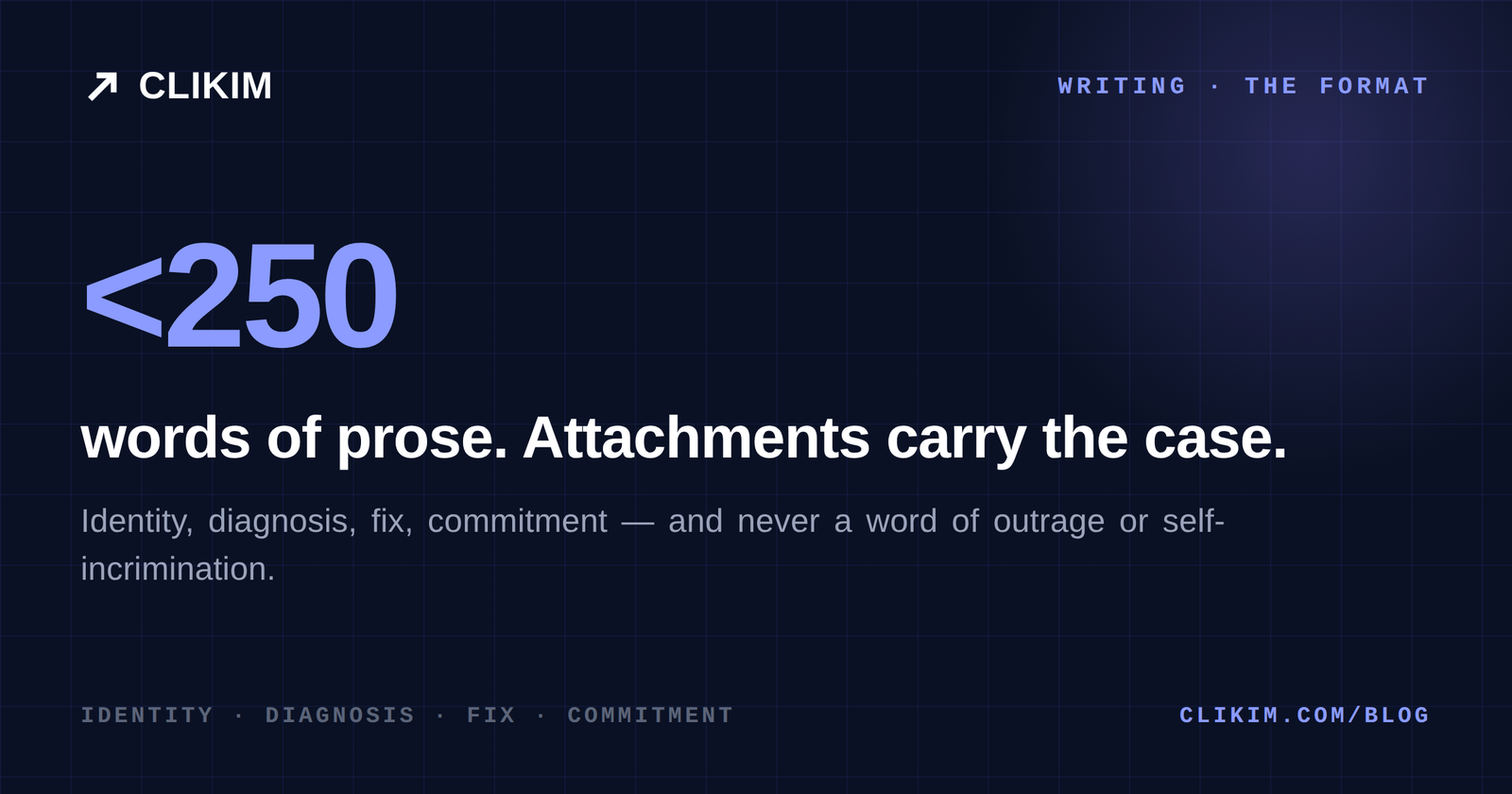
Reviewers have minutes, not hours — structure beats eloquence every time.
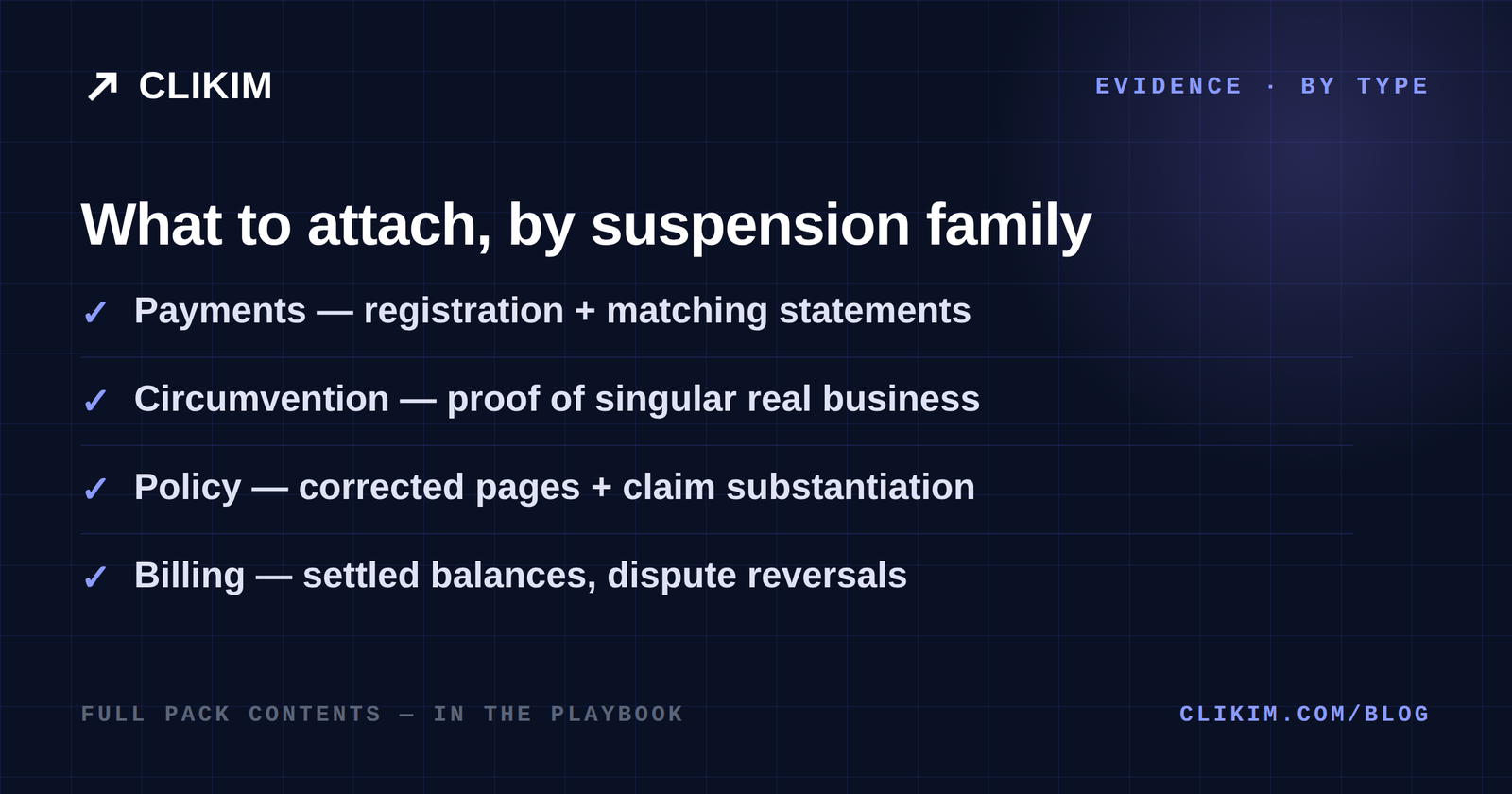
Appeals are case files, not complaints — documents do the arguing.
Never write: outrage, threats, essays, “I’ve spent $X with you,” or — the classic self-incrimination — explanations that casually admit a violation (“we only made a new account because the old one was suspended”). Reviewers can only act on what policy allows; give them a compliant file to say yes to.
Submitting, timelines, and the waiting game
Submit through the appeal path in the suspended account (the notice links it — choose the closest matching reason). Then calibrate expectations: some appeals resolve in 24–72 hours; policy and circumvention cases routinely take weeks. Silence is not rejection. The correct follow-up is on the existing case/thread after ~7 days; the incorrect follow-up — new duplicate appeals — trains automation to template-reject you. Meanwhile, don’t touch the account structure: no new accounts, no card swapping mid-review, no linking the suspended account elsewhere.
Second appeals and real escalation paths
A second appeal is worth filing only with genuinely new evidence — a document you couldn’t produce before, a fix that wasn’t live at first review. Beyond that: Google Ads support chat (billing and verification cases sometimes move through support even when policy appeals stall); an assigned Google rep, if your spend level has one — reps can’t overturn policy but can get cases actually looked at; and for advertisers inside manager structures, the structure’s own escalation channels — one of the material advantages of working with established providers, whose support relationships exist before you need them. Paid third-party “reinstatement services” occupy a spectrum from genuinely competent policy consultants to people charging $500 to paste your text into the same form — if you use one, judge them by whether they start with diagnosis or with guarantees.
When appeals fail: the fork in the road
Two legitimate paths. Rebuild properly: a genuinely new setup — separate entity where warranted, clean payment profile, compliant destination, patient ramp — accepting that shared fingerprints with the dead account are the risk to engineer away. Or operate inside established infrastructure: agency accounts in structures with existing billing history and human support, where your business runs on trust already earned. The path that isn’t legitimate — the quick lookalike account — reliably converts a maybe-recoverable case into a permanent circumventing systems verdict, and feeds the grey market its customers.
Frequently asked questions
How do I appeal a Google Ads suspension?+
How long does a Google Ads appeal take?+
How many times can I appeal?+
Should I pay a reinstatement service?+
Can I create a new account while appealing?+
What if my appeal is rejected with no explanation?+
Out of appeals, still in business?
Talk to us about running on established structures — real billing history, human escalation, replacements included. A rep replies in minutes.