
Google Ads vs Meta Ads: Where the Next Dollar Goes
The oldest budget question in performance marketing, answered the way operators actually decide it: by intent mechanics, unit economics, creative leverage, tracking reality — and the account-risk profiles nobody puts in the comparison charts.
Google captures demand; Meta creates it — that’s the entire comparison in one line.
Google wins when buyers already search for your solution: high-intent services, B2B, considered purchases. Meta wins when the product is discovered, not searched: visual ecommerce, impulse buys, new categories — and when creative volume is your edge.
Scaled advertisers run both: Meta builds the demand, Google harvests the searches it produces. And the tiebreaker nobody charts: account risk on each platform, and how resilient your infrastructure is when enforcement fires.
The core difference, stated plainly
Google’s auction sells existing intent: someone typed the problem or the product, and you bid to be the answer. Meta’s auction sells attention that resembles your buyers: the system finds people statistically like your converters and interrupts them with your creative. Everything downstream — costs, creative demands, funnel shape, scaling behavior — follows from that single difference. Intent capture converts at higher rates from smaller audiences; demand creation reaches vastly bigger audiences at lower per-impression cost but has to manufacture the desire it converts.
Everything downstream — costs, creative, scaling behavior — follows from this single difference.
Head-to-head
| Dimension | Google Ads | Meta Ads |
|---|---|---|
| Buyer state | Actively searching — bottom-funnel by default | Passively scrolling — you create the moment |
| Scaling constraint | Search volume: you can’t buy more demand than exists | Creative fatigue: audiences are huge, attention decays |
| Creative burden | Low — copy and feed hygiene | The whole game — volume and velocity of video/UGC |
| Time to signal | Fast on converting keywords | Needs conversion volume to train delivery |
| Best-fit categories | High-intent services, B2B, local, considered purchases | Visual ecommerce, impulse, new-category products, offers |
| Failure mode | Paying broad-match tax on junk queries | Feeding budget to fatigued creative |
Cost structures, honestly compared
Comparing average CPCs across platforms is mostly noise — the honest comparison is cost per qualified outcome in your category. Google’s clicks are dear but pre-qualified; competitive verticals (legal, insurance, finance) bid clicks into double digits because conversion rates justify it. Meta’s impressions are cheap and its clicks cheaper, but each carries lower intent — the funnel does the qualifying. Practical modeling rule: Google’s CAC is a function of your close rate on captured demand; Meta’s CAC is a function of your creative’s ability to manufacture it. Benchmark against your own account data, not platform averages — our Meta cost benchmarks and Google benchmarks exist for calibration, not gospel.
Creative and tracking: where the leverage lives
On Meta, creative is media buying now — targeting has collapsed into broad delivery steered by creative, so teams win on production volume, hook quality and iteration speed. On Google, the leverage is structural: query sculpting, feed quality for Shopping/PMax, landing-page relevance. Tracking follows the same asymmetry: Meta’s delivery is signal-hungry (CAPI and event quality decide performance — see our signal guides), while Google leans on conversion imports and value rules. Teams strong in creative production tilt Meta; teams strong in analytics and structure tilt Google. That internal-capability audit predicts platform success better than any benchmark table.
The account-risk factor nobody charts
Both platforms enforce with automation that produces false positives, and both can pause a revenue line overnight — but the risk profiles differ. Google’s sharp edges are account suspensions — payment flags and circumvention verdicts that kill whole accounts, with slow appeals. Meta’s are ad-account restrictions and creative-level rejections — more frequent, usually shallower, faster to recover. The operational conclusion scaled advertisers reach: platform diversification is also risk diversification, and infrastructure resilience — established structures, replacement paths, human escalation on both platforms — belongs in the budget-split decision alongside CAC. It’s the entire reason agency-account infrastructure exists as a category.
How to actually split the budget
- If demand for your category already exists: claim your branded and high-intent search first — it’s the cheapest revenue you’ll ever buy — then scale Meta to grow the demand pool. Watch branded search volume rise as Meta spend rises; that lift is Meta’s under-attributed dividend.
- If you’re creating a category: Meta-first; Google exists to catch the searches your Meta spend generates. Standing up search before demand exists buys crickets.
- B2B and services: Google-first for capture economics; Meta for audience building and retargeting once capture is saturated.
- Ecommerce at scale: both, structurally — Meta as the demand engine, PMax/Shopping as the harvest layer, measured on blended CAC and incrementality tests rather than platform-reported ROAS, which double-counts the same customer.
- Whatever the split: build infrastructure resilience on both sides before you need it — the comparison above assumes your accounts stay up.
Frequently asked questions
Which is better, Google Ads or Meta Ads?+
Which is cheaper, Google or Facebook ads?+
Should I start with Google or Meta?+
Do Google and Meta ads work together?+
Which platform is riskier for account bans?+
How should a small budget be split?+
Scaling on both platforms?
One provider, both infrastructures — whitelisted Meta accounts and established Google structures, funded balances, a rep in minutes.
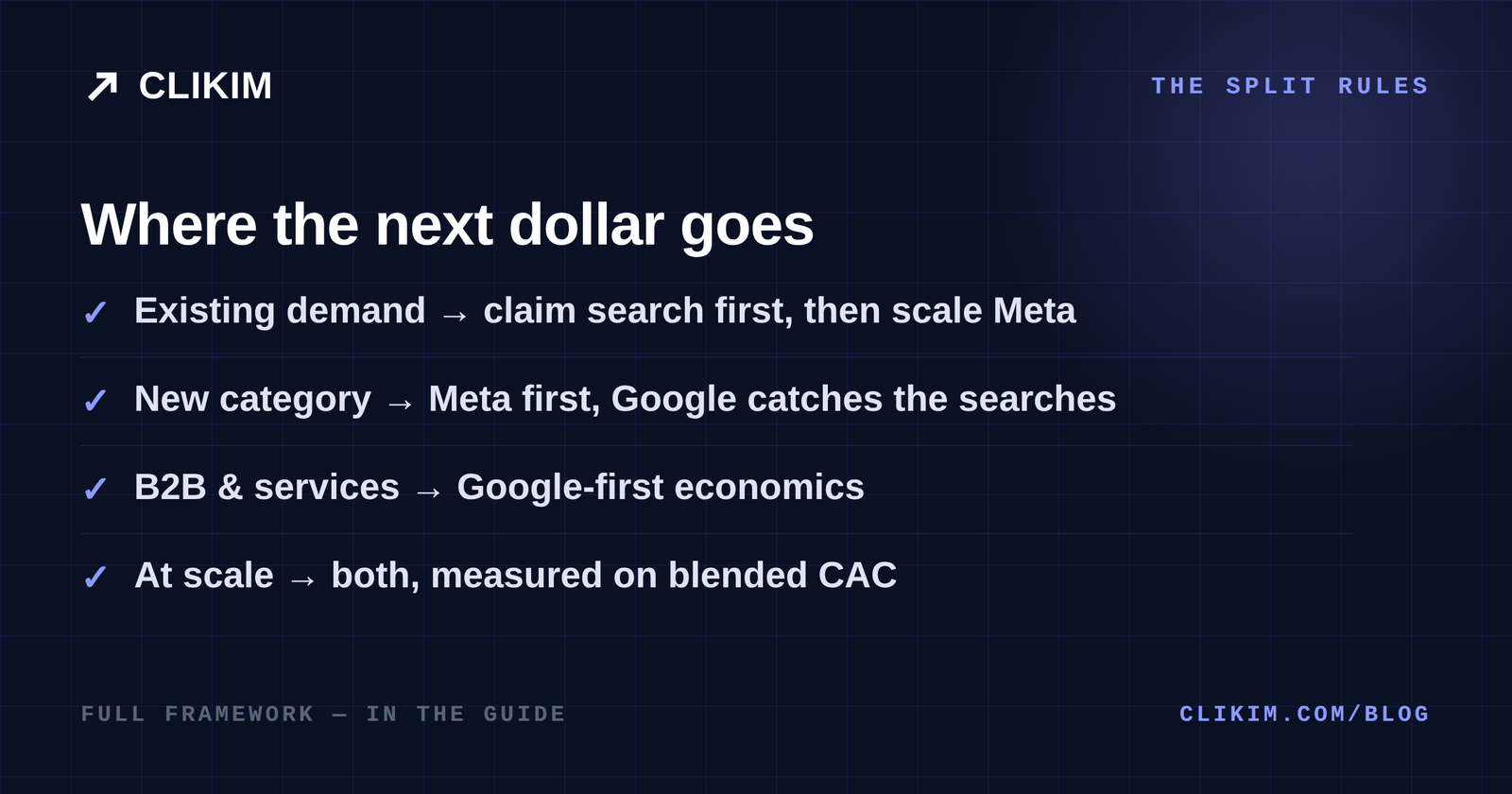
The split rules, by business type — and the risk-diversification factor that belongs in the decision.