
How to Prevent Facebook Ad Account Bans
Appealing a ban is slow and uncertain; not getting banned is free. Here's the practical playbook — warming new accounts, the daily habits that protect them, the setup loose ends to close, and the structural layer that does the rest.
To prevent Facebook ad account bans: warm new accounts with modest budgets and gradual scaling, keep creative comfortably inside policy, protect your Page quality, keep payments and identity stable, secure admins with 2FA, complete verification, and avoid stacking sudden changes. Account trust is cumulative and risk links across assets — protect the whole system. Running on a high-trust account adds a structural safety net.
Prevention beats recovery, every time
Appealing a disabled account is stressful, slow and uncertain. Not getting disabled in the first place is free. Yet most advertisers only think about bans after one lands — by which point trust is already damaged and options are limited. This guide flips that: a practical, do-this-now playbook to keep your Facebook ad accounts alive, whether you're warming a brand-new account or protecting one that's already running.
Two ideas underpin everything below. First, account trust is cumulative — it's built slowly and lost quickly, so every clean day is an investment. Second, risk links across assets — a single flagged profile, Page or payment method can drag down everything connected to it. Protect the whole system, not just the ads. Get those two right and most of what follows is common sense.
Warming a new account
New accounts are the most fragile, because they have no trust to spend. Treat the first couple of weeks as a warm-up rather than a sprint.
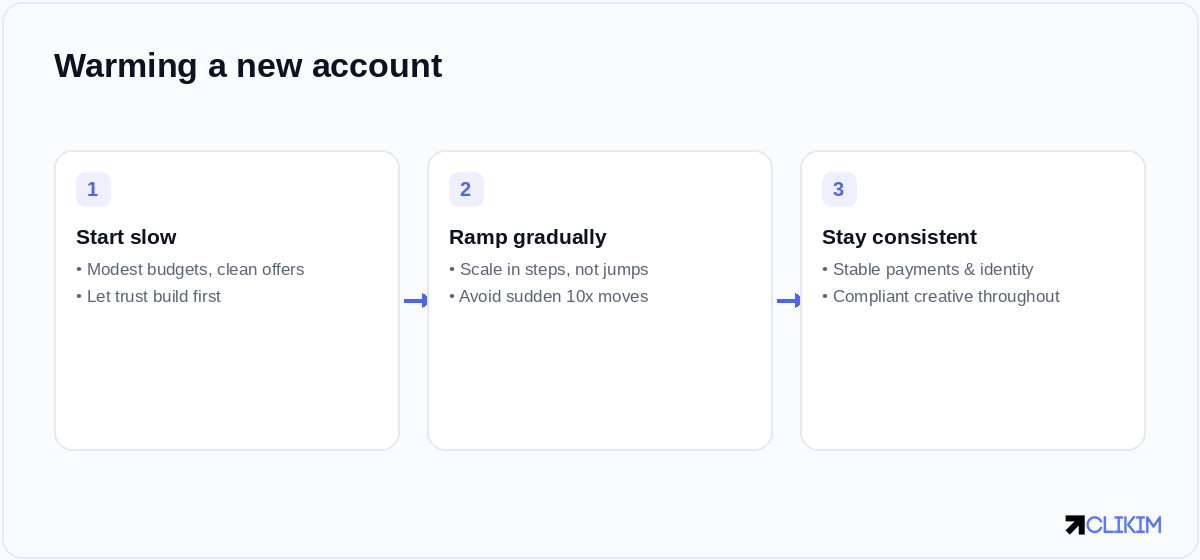
Warm a new account: start slow, ramp in steps, and keep payments and creative consistent throughout.
Start with modest budgets and your cleanest, most clearly-compliant offer. Let the account establish a track record before you push. Then scale gradually — stepping budgets up over days, not leaping 10x overnight, which is one of the fastest ways to trip anomaly detection. The goal of the warm-up isn't to make money immediately; it's to build the trust that lets you make money safely later. This is the same discipline that underpins scaling without getting banned, just applied at the very start of an account's life.
Daily habits that keep accounts alive
Once running, a handful of habits do most of the protective work.
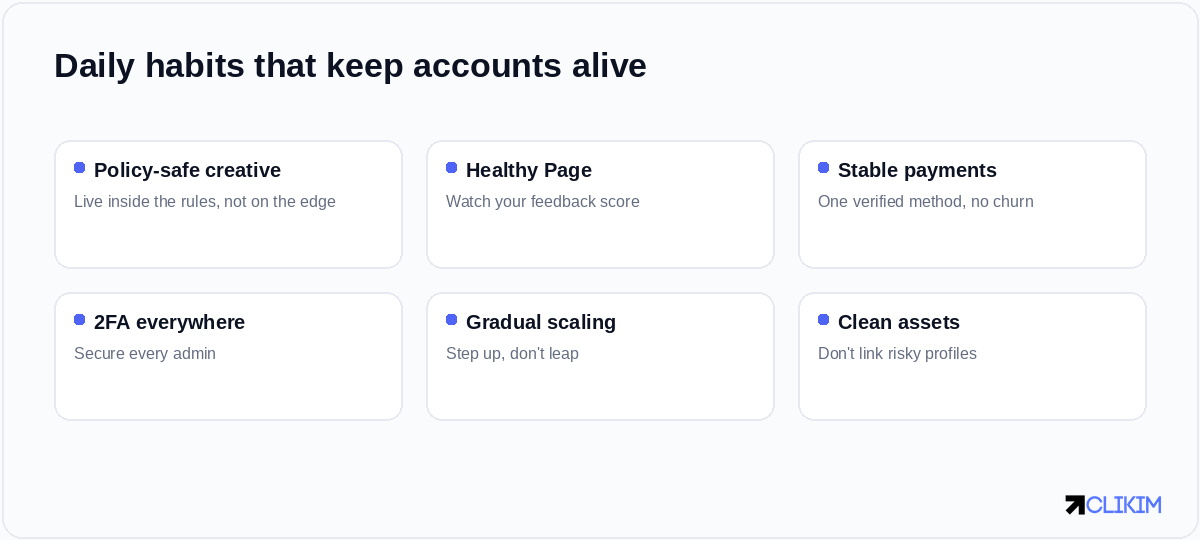
None of these are clever — they're the unglamorous habits that quietly keep accounts out of trouble.
- Keep creative comfortably inside policy. Don't live on the edge of the Advertising Standards. Treat every rejected ad as an early warning and fix the cause, rather than relaunching the same thing.
- Protect your Page quality. A poor customer-feedback score drags down the whole account; monitor it and address the source of complaints.
- Keep payments stable. One verified payment method, no constant churn of new cards, no mismatched billing country — repeated payment failures are themselves a risk signal.
- Secure every admin with 2FA. Suspicious-login flags are an avoidable cause of restrictions, and a common trigger for a restricted Business Manager.
- Don't link risky assets. Connecting previously-disabled profiles or Pages imports their risk.
Avoid sudden changes
Meta's systems watch for anomalies, and "anomaly" often just means "lots of change at once." A giant budget jump, a brand-new domain, and a fresh payment method on the same day reads as a possible account takeover. Spread changes out, and when you do scale, scale in steps. Boring and predictable is exactly what you want your account to look like.
Verify and complete your setup
An account with loose ends is an account that's easier to flag. Complete business verification, verify your domain, and keep your Business Manager tidy. Verified, complete businesses are treated as more legitimate and are less likely to hit certain restrictions — it's low-effort insurance.
The structural layer
Behaviour gets you a long way, but there's a ceiling: a brand-new personal account is fragile no matter how well you behave, because it simply hasn't earned trust yet. If you keep getting flagged despite doing everything right — see whether you're caught in the pattern described in why Facebook keeps banning accounts — the limiting factor is the account itself. Running on a whitelisted agency ad account starts you with trust you'd otherwise spend months building, and adds a rep who can catch issues before they become bans. Prevention and infrastructure work together; neither fully replaces the other.
Frequently asked questions
How do I prevent my Facebook ad account from getting banned?+
How do I warm up a new Facebook ad account?+
Does scaling too fast cause bans?+
Can one bad asset get my account banned?+
Does business verification help prevent bans?+
Do good habits guarantee my account stays alive?+
Behaving perfectly and still getting flagged?
Run on managed whitelisted infrastructure that starts with trust built in — plus a rep who catches issues before they become bans. Set up in about an hour.