
TikTok Agency Ad Account vs Self-Serve: What's the Difference?
Same Ads Manager, same auction — radically different experience. Self-serve starts every advertiser on probation; agency accounts arrive with inherited standing, real limits headroom and a human to call. Here's the honest comparison, including when self-serve is the right answer.
Both account types run the same TikTok Ads Manager — the difference is the wrapper.
Self-serve is free and instant but starts at zero trust: low spend caps, hair-trigger automated moderation, bot-queue appeals, and hard blocks on restricted verticals.
Agency ad accounts, issued through official TikTok partners, inherit the partner’s standing: high or no preset limits, human escalation, unlockable restricted categories, and replacement continuity.
Test the channel on self-serve; switch when limits, flags or your vertical start costing money — typically around $3–10k/month spend.
- Both run the same TikTok Ads Manager — the difference is trust, limits, support and vertical access.
- Self-serve: instant and free, but starts on probation — low caps, bot moderation, no human help.
- Agency accounts are issued through official TikTok partners with inherited standing and no preset caps.
- Restricted verticals (many are on TikTok) are agency-only territory.
- Agency ≠ immunity: same policies — what you gain is escalation and stability, not a free pass.
- Right sequencing: test on self-serve, scale on agency — or start agency if you're restricted or running client money.
- Via Clikim: whitelisted TikTok accounts, 0% top-up fees, no preset limits, dedicated rep.
Two doors into the same platform
Every TikTok advertiser uses the same Ads Manager, the same auction, the same formats from our TikTok ads guide. What differs is the door you entered through. Self-serve is the public door: sign up with an email and a card, and you're live in an hour — wrapped in every protection TikTok applies to strangers. An agency ad account comes through the partner door: issued under the umbrella of an official TikTok partner whose standing, spend history and compliance record you effectively inherit.
That inheritance is the entire product. TikTok's risk systems treat a brand-new self-serve account as a potential fraudster until proven otherwise; they treat a partner-issued account as the continuation of a relationship worth billions in annual spend. Same platform, radically different experience of it.
The differences, side by side
Same ads platform underneath — the difference is the trust, limits and support wrapped around your access.
What self-serve probation actually feels like
The self-serve limitations aren’t listed on a pricing page; you discover them. Daily spend caps that make real testing slow. A scaling attempt at week two that trips an automated flag. Ad rejections from conservative bot moderation with appeal queues measured in days.
And the compounding problem: every flag resets whatever trust you’d accumulated, so accounts that hit turbulence early stay in the penalty box for months. It’s the same trust arithmetic we’ve documented on Meta — the new-account cap, the warm-up grind — running on a younger, twitchier platform.
None of this is malicious. TikTok onboards millions of unknown advertisers and automation is the only way to police them. But "statistically reasonable for TikTok" translates, for an individual business, into weeks of throttled delivery and support tickets answered by templates. Probation is a tax on being unknown — and it's paid in time and missed volume.
What an agency account changes
- Limits — partner-issued accounts run with high or no preset spend ceilings; budget decisions return to your economics instead of your probation status.
- Moderation — the written policies are identical, but enforcement comes with process: a human rep who can review a flag, explain an ad rejection, and resolve same-day what a self-serve appeal queue chews on for a week.
- Verticals — whole categories that self-serve simply blocks become unlockable with proper approval and documentation.
- Billing — flexible top-up models — through Clikim, at 0% top-up fees — instead of a card on file hoping not to trip a payment flag.
And the underrated one: replacement. When something does go wrong — a false-positive ban, an account issue — an agency relationship means a path to a replacement account and continuity, instead of starting the trust ladder from zero. For a business whose revenue runs through the channel, that continuity is worth more than every other feature combined.
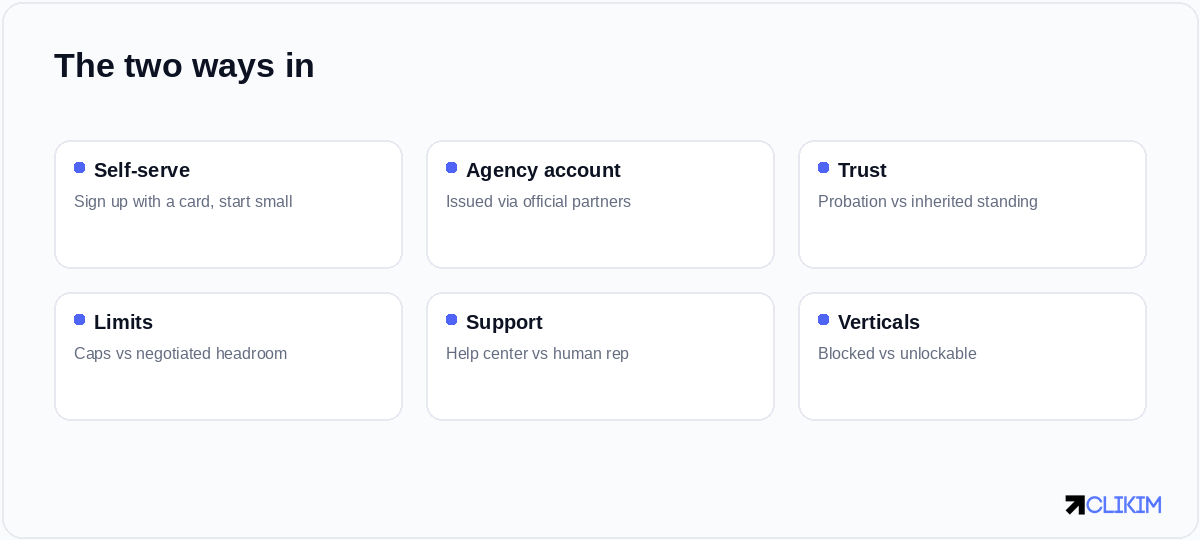
Two doors, one platform: the public door starts at zero trust; the partner door inherits standing.
The restricted-vertical reality
TikTok’s restricted list is broader than most advertisers expect — beyond the obvious (gambling, financial products) it catches supplements, some beauty claims, dating, and edges of wellness and finance that look innocuous from inside the business.
On self-serve, these ads simply die in review, repeatedly, until the account itself accumulates enough rejections to get flagged. There is no self-serve path through; there is only the partner path, where licensed and compliant advertisers in these categories get explicit approval and stable delivery.
If you're in one of these verticals, the self-serve vs agency question isn't a trade-off — it's the difference between advertising on TikTok and not. The same dynamic we cover for Meta in our restricted-industries work applies here with a stricter filter.
Myths, both directions
The category attracts myths from both directions — it's neither a loophole nor an enterprise-only club.
The middle row matters most: an agency account is not a policy exemption. Run non-compliant creative and it will be rejected; run it repeatedly and the account will suffer — with better communication along the way. What you're buying is infrastructure and process: headroom, humans, and continuity. Advertisers who expect immunity churn through providers and blame the category; advertisers who expect infrastructure scale quietly.
Who should use which
The split is spend and stakes: hobby budgets can afford probation; businesses can't.
The honest advice most providers won't give: if you're spending a few hundred dollars a month testing whether TikTok even works for you, stay self-serve. The probation tax is real but proportionally small at tiny budgets, and you'll learn the platform. The switch earns itself the day limits shape your plans, a flag costs you a launch, or your vertical hits the wall — for most growing brands, somewhere between $3k and $10k of monthly spend.
The economics: what probation actually costs
Put numbers on the “probation tax” and the decision usually makes itself. Suppose TikTok converts for you at a $25 CPA and your margin supports 400 orders a month — but self-serve caps hold you to a third of the necessary spend for six weeks while trust accrues. That’s several hundred orders deferred, not saved.
Add one false-positive flag (a near-certainty while scaling fast on a young account) costing a week of delivery and a re-learning window, and the “free” account has quietly cost more than a year of provider fees. The math flips only at small budgets, where deferred volume is negligible — which is exactly why the recommendation splits by spend.
When should I switch from self-serve to an agency account?
When limits shape your plans, a flag costs you a launch, or your vertical hits the wall — for most brands somewhere between $3k and $10k monthly spend. Below that, self-serve probation is a proportionally small tax.
There's also a planning cost that never shows in dashboards: teams on probationary accounts make timid decisions. Launches get postponed "until the account is warmer", winning ads get scaled slower than their data justifies, Q4 plans get hedged. Infrastructure uncertainty compounds into strategy uncertainty — the most expensive line item nobody budgets for.
Choosing a provider: five questions
The agency-account category has real providers and rebranded middlemen, so qualify anyone you talk to. Ask:
- Is the account issued through official TikTok partner infrastructure, and can they say so plainly?
- What are the top-up fees — stated as a percentage, in writing?
- What’s the replacement policy when an account is actioned — timeline and cost?
- Is support an actual named rep or a shared inbox?
- Which restricted verticals can they genuinely get approved, with what documentation?
Evasive answers on any of the five predict the experience you'll have at the worst possible moment. (For reference, Clikim's answers: yes-official, 0%, included replacements, named rep, and a published vertical list — the bar any provider should clear.)
Switching: what carries over
Moving to an agency account is not starting over. Your pixel and Events API data live at the business level; custom audiences rebuild from the same sources; and your hard-won creative learnings — hooks, angles, formats that convert — transfer completely, because they were never account properties. What resets is delivery history, which a properly-issued agency account compensates for with inherited standing; expect a brief re-learning window, not a restart.
Practical sequencing: keep self-serve running while the agency account spins up, port the winners, then wind down — a week of overlap, not a leap of faith.
What Clikim's TikTok accounts include
Our TikTok agency ad accounts are issued through official partner infrastructure: whitelisted standing, no preset spend limits, 0% top-up fees, and a dedicated rep for escalations and vertical approvals — with account replacement if things ever go sideways.
Two operating modes cover most needs: managed top-ups through Clikim, or spending on your own card where supported. Same-week setup, and the same infrastructure logic as our Facebook agency accounts — one relationship covering both platforms your media plan actually runs on.
Can my TikTok agency account still get banned?
Accounts can still be actioned for policy violations — the difference is process: a rep who reviews the flag, fixes false positives fast, and a replacement path that preserves continuity instead of months of rebuilt trust.
The pitch is deliberately boring: nothing here beats the algorithm or bends policy. It removes the probation tax, adds humans, and makes the account layer as reliable as the rest of your operation — so the thing that decides your TikTok results is your creative, the way it should be.
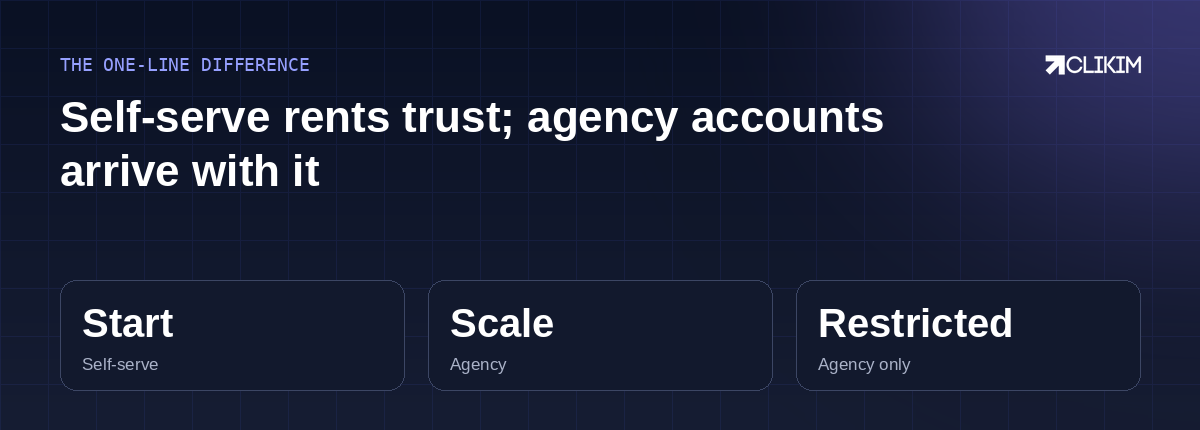
Test through the public door; scale through the partner one — or start there if you're restricted.
The complete agency accounts guide — the cross-platform mechanics, pricing and risk framework.
Frequently asked questions
What is a TikTok agency ad account?+
How is it different from a normal (self-serve) TikTok ad account?+
Do TikTok agency accounts bypass TikTok's ad policies?+
What spend limits do self-serve TikTok accounts have?+
Can I run restricted verticals on a self-serve TikTok account?+
Is a TikTok agency account worth it for small advertisers?+
What happens to my pixel and audiences if I switch?+
How fast can I get a TikTok agency account?+
Do agency accounts cost money?+
Should agencies running client budgets use self-serve accounts?+
Skip the probation tax on TikTok
Whitelisted TikTok agency ad accounts through official partner infrastructure — no preset spend limits, 0% top-up fees, dedicated rep, replacement continuity.