
How to Warm Up a Facebook Ad Account (Without Getting Flagged)
A fresh ad account is statistically indistinguishable from fraud — so Meta treats it that way. Here's the warm-up playbook: the trust signals the model reads, a week-by-week ramp, the velocity flags that reset everything, and the honest alternative that skips the probation.
New Facebook ad accounts start at zero trust: ~$250/day caps, twitchy review and conservative delivery until behavior proves otherwise. Warm up by being deliberately boring: $20–50/day of your safest creative in week one, then raises of 20–30% every 2–3 days, flawless billing, completed business verification, batched changes and no velocity spikes. Expect 2–6 weeks to real headroom — flags rewind the clock. The alternative: an agency ad account inherits partner trust and skips the probation entirely.
• New accounts start at zero trust: ~$250/day caps, twitchy review, conservative delivery. • Warm-up = weeks of deliberately boring behavior: small spend, clean creative, flawless billing. • Ramp in 20–30% steps every 2–3 days — velocity is the alarm most new accounts trip. • Lead with your safest creative; save aggressive angles for accumulated policy credit. • Complete business verification and keep BM/page/domain coherent from day one. • Typical timeline: 2–6 weeks to meaningful headroom — flags reset the clock. • The alternative: agency accounts inherit trust and skip the probation entirely.
Why new accounts are treated like suspects
Every fresh ad account looks identical to Meta's risk systems: no payment history, no policy record, no behavioral pattern — statistically indistinguishable from the thousands of fraud and ban-evasion accounts created daily. So the platform does what any risk system does with unknowns: it constrains them. The ~$250/day spending cap, hair-trigger reviews, conservative delivery, and fast escalation to restriction are not hostility — they're the default posture toward strangers.
"Warming up" an account is simply the process of converting yourself from stranger to known quantity: weeks of small, clean, predictable activity that gives the trust model evidence to relax on. Understand that framing and the whole playbook writes itself — every move below is just "look like the established business you are, at a pace the model can verify."
What the trust model actually reads
Trust is inferred from behavior — every row is a signal you control from day one.
Note what's absent: hacks. There's no secret setting — the model reads behavior over time, which is why warm-up can't be rushed, only ruined. The two most underrated rows are entity coherence (a verified business, an aged page with real content, a domain that matches — per our verification guide) and payment quality: card problems are the fastest trust-killer in the system, as covered in payment troubleshooting.
The ramp: small, steady, boring
Illustrative ramp for a fresh self-serve account — the pattern (small, steady, boring) matters more than exact numbers.
The pattern behind the numbers: prove one thing per phase. Week one exists to demonstrate payments clear and ads comply — run $20–50/day on your safest campaign and touch nothing. The build phase demonstrates business-like velocity: raises of 20–30% every two to three days, new campaigns added one at a time, everything spaced and deliberate. By the extend phase you're operating near the cap with a clean record — which is exactly the file that gets limit-increase requests approved.
Two disciplines carry the whole ramp. Batch your changes: five edits on Tuesday reads calmer than one edit daily — erratic accounts look risky regardless of spend. And never chase a flag with volume: if delivery hiccups or a review appears, hold or reduce; pushing spend into turbulence is how a hiccup becomes a restriction.
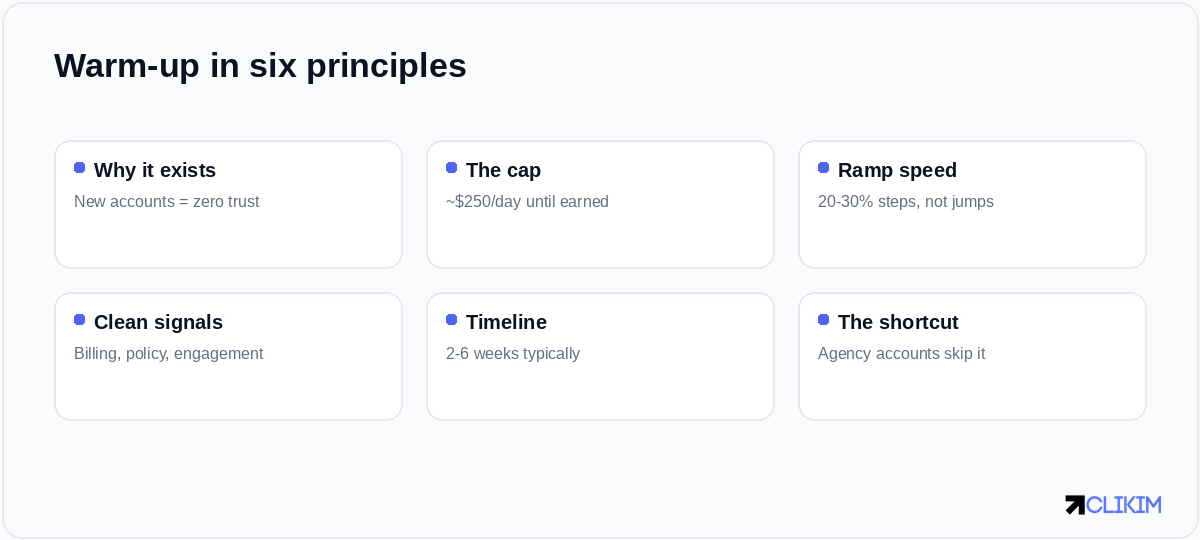
Six principles, one meta-rule: behave like the established business you are, at a verifiable pace.
Creative sequencing: safest first
A new account has zero policy credit — its first rejections are weighted heavily, and a cluster of them early can restrict the account outright. So sequence creative by risk: the first two weeks run your most conservative, claim-light, unambiguous ads (product-forward, benefit-plain, nothing that brushes policy edges — no before/afters, no personal attributes, no aggressive claims). Only after the account has approvals banked do you introduce edgier angles, one at a time, watching how review responds.
This is also the season for extra pre-launch scrutiny: run every ad against the policy checklist you'd normally trust to instinct. A rejection your established account shrugs off can cost a fresh account its momentum — the rejection playbook is cheap insurance this month.
The classic warm-up killers
Every classic warm-up failure is a velocity or coherence alarm — all avoidable, none creative-related.
Every row is the same alarm in different clothes: velocity or incoherence. Day-one $500 budgets, mass campaign launches, prepaid cards, brand-new-everything setups, budget whiplash — each pattern-matches to accounts that burn fast and disappear. The fix is never cleverness; it's patience and coherence. (And if you're warming up because a previous account died, be careful with asset reuse — association with flagged pages, domains or payment methods inherits the suspicion. Understand why accounts get chain-banned before rebuilding on the same foundations.)
Honest timelines (and what resets them)
A clean ramp reaches meaningful headroom in 2–6 weeks: caps loosening, reviews quickening, delivery normalizing. But the clock is conditional — a payment failure, a policy strike, or a velocity flag doesn't just pause progress, it rewinds it, because the model re-weights recent negative evidence heavily. Accounts that hit turbulence in week two often need longer than a fresh start would have taken.
Meanwhile the business cost compounds quietly: campaigns you couldn't launch, tests you couldn't run (the testing engine needs budget headroom a capped account doesn't have), seasonal windows you missed. Warm-up's real price isn't the ad spend — it's a month of constrained operations. Budget for that honestly when planning launches.
A worked four-week diary
Days 1–3: one campaign, one broad ad set, $30/day, two conservative ads. Business verification submitted, page reviewed for completeness, billing on the company card. Nothing else — the urge to build the full account structure now is exactly the velocity signal to avoid. Days 4–7: first raise to $40 after 72 clean hours; approvals banked: 4/4. Week two: steps to $55, then $70; a second campaign (retargeting) added mid-week — one addition, not five. A rejection on an edgier ad gets fixed-and-resubmitted same day, and the next raise waits an extra day on principle.
Week three: $90 → $115 → $150; the testing campaign joins with three modest cells. Delivery is boringly stable, which is the entire goal. Week four: operating at $180–220, flirting with the cap daily — the file now shows four weeks of clears, compliance and sane velocity. The limit-increase request goes in, and campaigns plan for real budgets. Total elapsed: a month of constrained operations that a business with a launch window may reasonably refuse to pay — which is the honest pivot to the section below.
After the warm-up: don't un-warm it
Trust decays under the same forces that build it. Keep the account warm with the habits that got it there: steady spend (long dark gaps read as risk), batched changes, clean billing, policy margins, and scaling by steps rather than leaps. The ban-prevention playbook is the maintenance manual; warm-up is just its intensive first month.
And keep monitoring Account Quality weekly — catching a flag early, while your record is clean, is the difference between a same-day resolution and a restriction spiral.
The alternative: skip the probation
Everything above assumes you must earn trust from zero — but that assumption is optional. An agency ad account is issued through an established partner relationship whose standing you inherit: no $250/day cap, no probation window, day-one headroom, plus a rep when something needs a human. For a business with real budgets and a calendar — a Q4 to hit, a launch that can't wait five weeks — the warm-up tax is a cost worth skipping entirely.
The honest split: warming up a self-serve account is free and teaches patience; agency infrastructure costs money and returns time. Hobby budgets take the ramp; businesses on deadlines increasingly don't. Both paths end at the same place — a trusted account — differing only in whether you spend weeks or a setup call getting there.
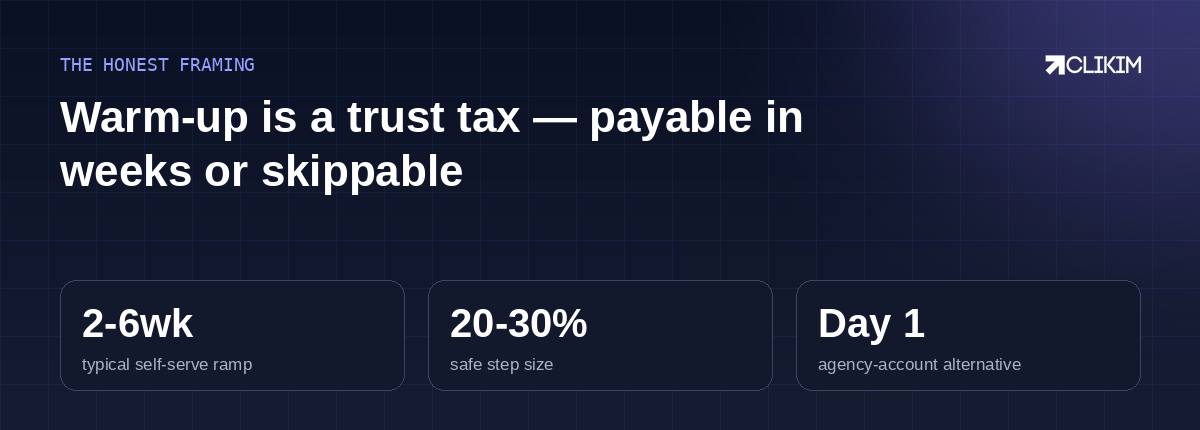
Weeks of boring behavior — or inherited standing on day one. Both work; only one has a calendar.
Frequently asked questions
What does it mean to warm up a Facebook ad account?+
How long does it take to warm up a Facebook ad account?+
How much should a new ad account spend per day?+
What gets new ad accounts flagged fastest?+
Should I run my best offer immediately on a new account?+
Does business verification help warm-up?+
Can I speed up the warm-up process?+
My account got flagged during warm-up — now what?+
Do spending limits increase automatically?+
Does warming up guarantee my account won't be banned?+
Is there a way to skip the warm-up entirely?+
Should I warm up multiple accounts at once?+
Launch on day one, not week six
Whitelisted infrastructure inherits established trust — no $250 cap, no probation ramp, and a dedicated rep from the start. Operated on BM2500 infrastructure.