
TikTok Ads in 2026: The Complete Guide
TikTok is a mature performance channel with one twist Meta buyers keep missing: it's a creative-velocity game, not a targeting game. Here's the full machine — structure, formats, the algorithm, tracking, costs, and how it really compares to Facebook.
TikTok ads run on a familiar campaign → ad group → ad structure, but the platform rewards different behaviour: broad targeting with native, fast-hooked vertical video doing the audience selection, refreshed 2–3× faster than on Facebook. Use In-Feed and Spark Ads for performance, install Pixel + Events API before spending, expect cheaper CPMs but less predictable conversion than Meta — and treat the two as a portfolio, not rivals.
• TikTok ads run on a familiar campaign → ad group → ad structure — the difference is the algorithm and the creative culture. • Creative is the targeting: broad delivery + native-feeling video beats micro-targeting. • The hook window is brutal — you have ~1.5 seconds to earn the view. • Creative burns 2–3× faster than on Facebook; plan weekly refresh, not monthly. • Spark Ads (boosting real posts) are TikTok's highest-trust format. • Track with Pixel + Events API before spending — same logic as Meta's CAPI. • Agency-level accounts unlock stability, higher limits and restricted-vertical access — same as on Meta.
Why TikTok ads in 2026
TikTok is no longer the experimental line on the media plan. It's a mature performance channel with a full-featured ads platform, serious ecommerce tooling, and an audience that long ago stopped being "just teenagers" — the fastest-growing ad segments are 25–44. What makes it strategically interesting is the price of attention: CPMs typically run cheaper than Meta's, and the discovery-driven For You feed gives new brands reach that mature Facebook accounts pay dearly for.
The catch — and the reason many Meta buyers bounce off it — is that TikTok rewards a different muscle. It is a creative-velocity channel: targeting does less, video does everything, and winners fatigue fast. Buyers who bring Meta habits (tight audiences, one polished ad, monthly refreshes) struggle; buyers who bring a content engine tend to print. This guide covers the whole machine so you can decide, and start, properly.
Account structure: familiar bones
If you know Meta, the skeleton transfers in minutes.
Structurally familiar if you know Meta — the differences are in the algorithm and the creative culture, not the hierarchy.
Campaigns hold the objective (traffic, conversions, catalog sales…), ad groups hold audience/placement/budget/bid, ads hold the video. Consolidation logic transfers too: fewer, better-funded ad groups learn faster than many starved ones — the same signal math behind our Meta structure guide applies, because both platforms need conversion volume per ad group to optimize delivery.
The formats that matter
Most performance budgets live in In-Feed and Spark Ads — the premium formats are brand tools, not ROI tools.
Two deserve emphasis. In-Feed is your workhorse: full-screen vertical video in the For You feed, skippable in a swipe, living or dying on its first seconds. Spark Ads are TikTok's cleverest invention — instead of uploading a "dark" ad, you put spend behind a real post from your account or a creator's, keeping its likes, comments and organic credibility. For UGC-driven brands, Spark is routinely the best-performing format on the platform because it doesn't just look native — it is.
How the algorithm thinks
TikTok's delivery system optimizes the same way Meta's does — find people likely to complete your event — but its inputs skew harder toward engagement signals on the video itself: watch time, completion rate, rewatches, shares. The For You feed is a content market first and an ad market second; videos that hold attention get cheap distribution, and videos that don't get buried regardless of your bid.
The practical consequence: your effective CPM is substantially a function of your creative. A video with strong hold rate can reach the same audience for a fraction of what a boring one pays — which is why the platform keeps repeating the mantra "don't make ads, make TikToks". It's not branding advice; it's auction math.
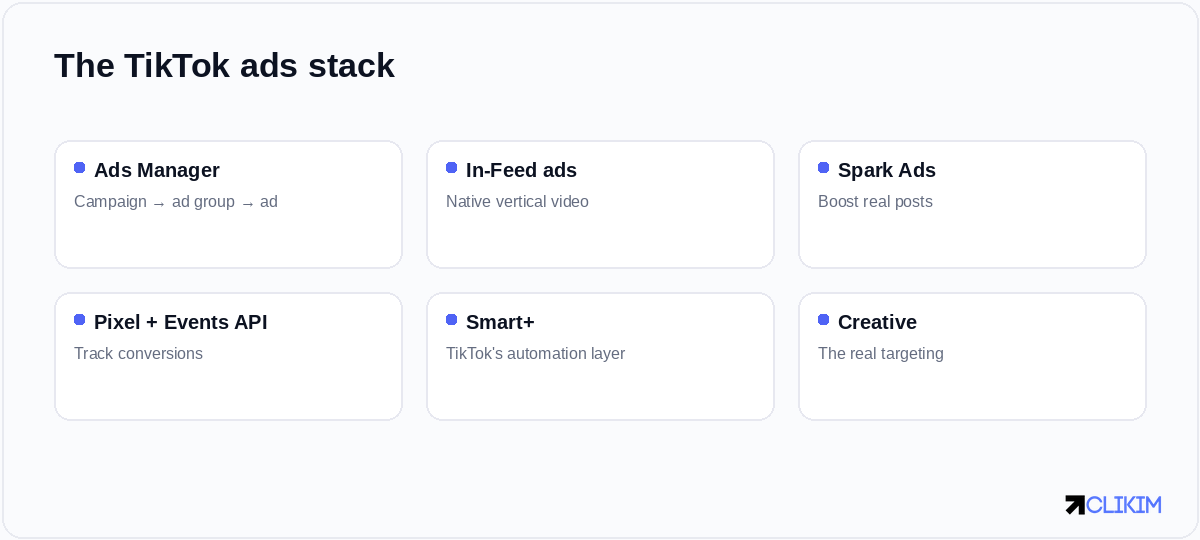
The stack: familiar structure, native formats, Pixel + Events API tracking, and creative doing the targeting.
Targeting: go broader than feels safe
TikTok offers the expected menu — demographics, interests, behaviours, custom and lookalike audiences — but its interest graph is shallower than Meta's decade of profile data, and its recommendation engine is exceptional. The winning pattern in 2026 is therefore broad-first: minimal constraints, conversion objective, and creative that self-selects the audience by who it stops. TikTok's Smart+ automation (its Advantage+ analogue) leans the same way.
Custom audiences (site visitors, engagers, customer lists) still earn their keep in retargeting, and lookalikes can help fresh pixels find footing. But if you're carving interest segments the way 2019-era Facebook taught you, you're paying extra CPM to constrain an algorithm that finds buyers better unconstrained. Sound familiar? It's the same lesson from our broad-targeting shift on Meta, arriving faster.
Creative: the actual game
Everything above is table stakes; this is the ranking factor. Winning TikTok creative is native (vertical, raw, person-to-camera — polish actively hurts), fast (the hook lands in ~1.5 seconds — a question, a claim, a movement, a pattern-break), and structured like content (problem → demo → payoff, with the product woven into a watchable story rather than presented). Trending sounds and formats help the algorithm categorise you, but the hook does the heavy lifting.
Then there's the burn. TikTok audiences chew through creative 2–3× faster than Facebook's — a winner might peak in days and fade within two weeks. Sustainable TikTok advertising is therefore a pipeline problem: 3–5 new videos a week, mostly iterations on proven angles (new hooks on winning bodies, per our UGC playbook — the entire genre was born here). Brands that treat creative as a monthly deliverable stall by week three.
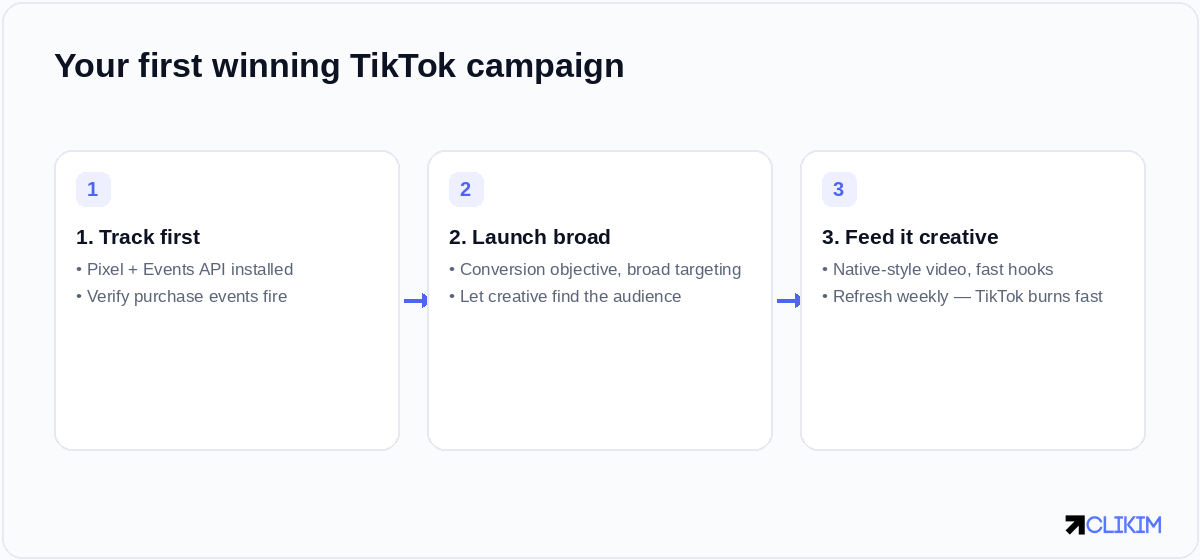
Track, launch broad, and keep the creative pipeline fed — TikTok rewards velocity over polish.
Tracking: pixel + Events API, non-negotiable
TikTok's measurement stack mirrors Meta's: a browser Pixel plus a server-side Events API, deduplicated by event ID. The same privacy erosion that broke browser-only tracking on Facebook applies here, so the same fix does too — run both, pass strong match parameters, and verify purchases fire before spending real money. Our Conversions API guide explains the architecture; TikTok's version is conceptually identical.
Skipping this doesn't just blur reporting — it starves the algorithm of the conversion signal it optimizes on, so your ad groups learn slowly and your costs read worse than reality. Track first, spend second.
What TikTok ads cost
Expect CPMs meaningfully below Meta's for comparable audiences — often in the $5–10 range where Facebook runs $10–20 — with minimums around $50/day at the ad group level. But price the full picture: cheaper attention converts less predictably (discovery mindset, not shopping mindset), and the creative pipeline is a real ongoing cost that Meta budgets often ignore. TikTok tends to win on cost-per-view and upper-funnel volume; Meta tends to win on conversion reliability. That's not a verdict — it's a portfolio argument.
Budget-wise, start where signal math points: enough daily spend for your ad groups to gather ~50 conversions a week each, same threshold logic as Meta's learning phase. Underfunded ad groups stay unstable on every platform.
TikTok vs Facebook: the honest comparison
Treat TikTok as a creative-velocity channel: cheaper attention that demands constant fresh video.
The mature answer for most brands is both, with different jobs: TikTok as the cheap-attention, creative-testing, discovery engine; Meta as the conversion-reliable scaling machine, often retargeting demand TikTok created. Creative learnings flow both ways — TikTok winners routinely become Meta UGC winners.
Reading TikTok metrics without fooling yourself
TikTok dashboards flatter you with engagement numbers — views, likes, shares — and it's easy to mistake a popular video for a profitable one. Diagnose top-down instead, the same discipline as our Meta creative framework: hook rate (2-second views ÷ impressions) tells you if the opening works; hold/completion tells you if the middle keeps them; CTR tells you if the bridge to your offer lands; and CPA/ROAS is the only verdict that pays rent. A video can win the first three and lose the fourth — that's an offer or landing-page problem, not a creative one.
One TikTok-specific trap: because attention is cheap here, cost-per-click can look fantastic while conversion rate craters — discovery-mode viewers click curiously and bounce. Judge the channel on blended cost per acquisition against your unit economics, not on the flattering upper-funnel line items.
Retargeting on TikTok
The warm layer works much like Meta's: build custom audiences from video viewers (25%/50%/75% watchers), profile engagers, site visitors via the pixel, and customer lists — then re-engage with intent-matched creative. Viewer audiences are TikTok's speciality; someone who watched 75% of your video is a genuinely qualified prospect, and a Spark Ad with social proof or an offer closes a meaningful share of them.
Keep the same discipline you'd use on Facebook (full playbook in our retargeting guide): segment by recency and intent, exclude recent purchasers, and cap how much budget the warm layer takes — retargeting harvests demand, your broad prospecting creates it. On a channel this discovery-driven, prospecting deserves the larger share.
The five mistakes that kill TikTok accounts
- Repurposing polished Facebook ads. The feed rejects them instantly; shoot native or don't bother.
- Micro-targeting. You're paying to constrain the platform's best asset — its recommendation engine.
- One winner, no pipeline. Creative burns in days here; no refresh cadence means a built-in cliff.
- Spending before tracking. No Pixel + Events API means the algorithm learns from noise.
- Judging on day two. Ad groups need their learning window here just like on Meta — fund it, then judge.
The account layer: same game, same solution
One more thing Meta veterans will recognise: the account itself is a constraint. Fresh self-serve TikTok accounts face spend limits, conservative automated moderation, quick flags on aggressive scaling, and hard walls around regulated verticals. The advertisers who scale smoothly are disproportionately on agency-tier accounts — issued through TikTok's official partner infrastructure, with higher trust, higher limits, human escalation paths, and access to verticals self-serve accounts can't touch.
That's exactly what a TikTok agency ad account from Clikim provides: whitelisted infrastructure, no preset spend ceiling, 0% top-up fees and a dedicated rep — so the creative machine you build actually has somewhere to run. Platform mechanics win auctions; infrastructure decides how far the wins can scale.
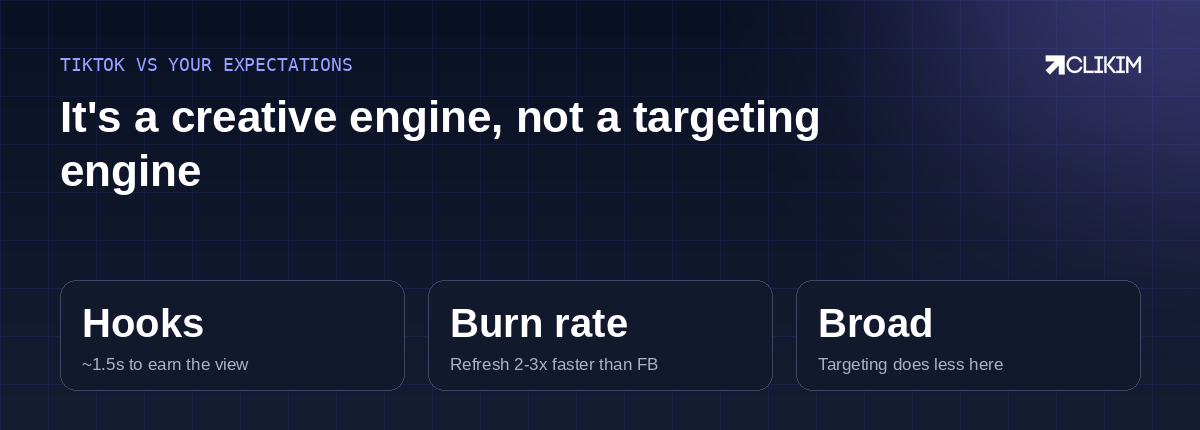
Cheaper attention, faster burn, creative-led delivery — TikTok pays whoever feeds it fastest.
Frequently asked questions
How do TikTok ads work?+
What are the main TikTok ad formats?+
What are Spark Ads?+
How much do TikTok ads cost?+
Should I target broad or narrow on TikTok?+
How long does TikTok ad creative last?+
Do I need the TikTok Pixel and Events API?+
Are TikTok ads better than Facebook ads?+
What makes a good TikTok ad?+
Why are my TikTok ads not converting?+
What is Smart+ on TikTok?+
What is a TikTok agency ad account?+
Bring the creative — we'll bring the infrastructure
Whitelisted TikTok agency ad accounts with no preset spend limits, 0% top-up fees and a dedicated rep. Scale the winners your pipeline finds.