
25 Facebook Ad Hooks That Stop the Scroll (2026)
The hook — frame one plus eight words — decides more than everything after it combined. Twenty-five working openers organized by the mechanism that powers them (loss, curiosity, contrarianism, identity, proof), each with an adaptation note, plus the 30-minute sprint that turns this file into your testing lane.
Five families cover the winning space: loss/pain ('This mistake is costing you $47/month'), curiosity gaps ('Day 14. It's not what I expected.'), contrarian flips ('We stopped doing [best practice] and results doubled'), identity call-outs ('If you run ads, stop scrolling' — call roles, never conditions), and proof-first ('We tested 214 hooks so you don't have to'). Rules: adapt structures with YOUR nouns and numbers — never transplant verbatim; test 3 hooks per concept on the same body; judge thumb-stop rate then full-window CPA; and when winners fade, swap the opener before reshooting — 80% of fatigue lives in the first two seconds.
• The hook — frame one plus the first eight words — decides more performance than everything after it combined. • Five families cover the winning space: loss/pain, curiosity gaps, contrarian flips, identity call-outs, proof-first. • Adapt, never copy: a swiped hook works because of specificity — swap in your product's numbers, nouns and stakes. • Test three hooks per concept with the body held constant; judge on thumb-stop rate, then CPA over full windows. • 80% of 'fatigued' ads have a tired opener and a healthy body — swap the first two seconds before reshooting anything. • Every hook here survives policy review when the claim behind it is honest — the restricted-vertical guides cover the exceptions. • Captions carry hooks: most viewers never unmute.
Why the first two seconds outweigh the next thirty
The auction prices attention, but the feed rations it: you get roughly two seconds of peripheral awareness before the thumb decides. Everything you paid for — the offer, the proof, the CTA — only exists for viewers the hook captured, which is why hook rate (3-second views ÷ impressions) is the most predictive early metric an ad produces, and why the cheapest performance upgrade in the entire system is rewriting eight words. This is a working swipe file: 25 hooks that are carrying spend in 2026, organized by the psychological mechanism that makes them work, each with an adaptation note — because the hook that works is never the swiped sentence, it's the swiped structure loaded with your specifics.
The five families (and when to deploy each)
Five families, five mechanisms. Match the family to the funnel slot and adapt the wording — verbatim swipes inherit nothing.
Family 1 — Loss & pain (cold traffic's native language)
1. “You're overpaying for [X] and nobody's going to tell you”
The 'nobody will tell you' clause adds conspiracy-adjacent curiosity to plain loss. Adapt: name the exact overpayment.
2. “This mistake is costing you $[N] every month”
Numbers beat adjectives. Use a defensible, specific figure — $47 outperforms $50 because it sounds computed.
3. “Stop [common behavior] — it's ruining your [outcome]”
Interrupts a habit the viewer did today. The closer the behavior is to 'this morning,' the harder it stops thumbs.
4. “Your [tool/product] is lying to you”
Works because the viewer suspected it. Follow immediately with the receipt or it's clickbait.
5. “The hidden fee inside every [category] purchase”
Category-level loss framing — perfect when you compete on transparent pricing.
Family 2 — Curiosity gaps (open loops, honest payoffs)
6. “I wasn't supposed to figure this out”
Insider-secret energy without naming anyone. The body must deliver an actual insight or quality feedback eats you.
7. “Everyone asks how we [result]. It's this.”
Implies existing demand for the answer — borrowed social proof plus a gap, closed in second three.
8. “The [industry] doesn't want this video spreading”
High octane, high risk: only when the content genuinely challenges an industry norm. Overuse trained audiences to smell it.
9. “Day 14 of [experiment]. It's not what I expected.”
The serialized hook — 'not what I expected' cuts both ways, and ambiguity is the loop.
10. “There's a reason [weird detail] — and it's smart”
Starts from a visual oddity in frame one (the product upside down, the strange ingredient). The image IS the hook; the line explains it exists.
Family 3 — Contrarian flips (disagree, credibly)
11. “Everything you know about [topic] is backwards”
The classic. Requires an expert face and a defensible flip — see the belief-flip playbook in this month's angles report.
12. “Stop taking advice from [default authority]”
Aim at a category of advice, not a person. 'Stop taking skincare advice from influencers with ring lights' — the specificity is the joke and the filter.
13. “[Popular practice] is dead. Here's what replaced it.”
Works in fast-moving niches where the viewer fears being outdated. Deliver the replacement by second five.
14. “We stopped doing [best practice] and results doubled”
First-person contrarianism — the receipt structure makes it a story, not a claim.
15. “Unpopular opinion: [mild heresy your buyers secretly believe]”
The trick: the opinion is only unpopular with non-buyers. Your actual audience nods — self-selection disguised as controversy.
Family 4 — Identity call-outs (self-selection at scale)
16. “If you run [role/activity], stop scrolling”
Blunt and still effective — because broad targeting means the feed does less pre-filtering than buyers assume. Call the ROLE (media buyer, gym owner), never a condition — personal-attribute rules.
17. “POV: you're the friend who always [niche behavior]”
Meme-native identity flattery. Ages fast; refresh the referenced behavior monthly.
18. “Only [audience] will understand this”
Exclusion as inclusion. Pairs with an in-joke visual; the comment section becomes the proof.
19. “You didn't buy [product] because of [real objection]”
Names the unspoken objection — instant 'they get me.' The body must actually dissolve the objection.
20. “This is for the ones still doing [hard thing] manually”
Dignifies the struggle before selling the shortcut. Warmer than 'you're doing it wrong' — same targeting effect.
Family 5 — Proof-first (receipts before promises)
21. “We tested [N] [things] so you don't have to”
Volume-of-work as credibility. The number should be uncomfortably specific — 'we tested 214 hooks' beats 'hundreds.'
22. “[Specific result] in [timeframe]. Here's the boring part.”
'The boring part' subverts the miracle-claim pattern — and signals honesty to policy reviewers and humans alike. Keep timeframe claims out of restricted categories.
23. “Rated [4.8] by [12,000] people who were also skeptical”
Social proof pre-loaded with the viewer's own skepticism. The second clause does the work.
24. “Watch it happen in real time”
Demonstration-as-hook: frame one is the product mid-proof (the stain lifting, the dashboard updating). No words needed until second three.
25. “I filmed this so you'd stop asking if it's real”
Answering doubt before it forms — the strongest opener for products that look too good on camera. The body must be one continuous unedited shot or it backfires.
How to run this file (the 30-minute hook sprint)
The operational loop: pick your next concept, choose two families that fit its funnel slot from the table above, and draft three hooks — adapt, don't transplant: swap every bracket for your product's real nouns and numbers, then read it aloud once (hooks are spoken language; anything you wouldn't say to a friend gets rewritten). Shoot or cut the three openers onto the same body — an editor afternoon, not a production day — and let the testing framework pick the winner on thumb-stop rate first, CPA over full windows second. When a winning ad fades weeks later, return to this file before the studio: in most fades the body still converts everyone who watches; only the doorway went stale. And keep the policy floor in view — every hook above survives review when the claim behind it is honest, but brackets filled with disease words or personal attributes die regardless of structure; the restricted-vertical guides carry those exceptions.
Pairing hooks with formats (the quick matrix)
Hooks and formats multiply each other. The skeptic-conversion format from this month's angles report naturally opens with hook #25 or #23 — doubt is its native key. Street interviews pair with identity call-outs (#16, #18): the first question filters the crowd on camera. Teardowns want proof-first openers (#21, #24) — the receipt is the show. 30-day logs own the serialized curiosity slot (#9) outright. And talking-head expert content carries the contrarian family (#11–15) better than any other format, because the flip needs a credible face to survive. When a hook family keeps losing in your tests, check the pairing before blaming the family — a contrarian flip delivered by an anonymous voiceover was never going to work.
Building hooks 26 through infinity
The file's real product is the pattern behind it. Every working hook does one of five things in eight words: names a loss, opens a loop, breaks a consensus, calls an identity, or shows a receipt — and your niche's best hooks are hiding in three places this library can't see: your customer reviews (the phrase buyers repeat is a hook wearing pajamas), your support tickets (every recurring objection is hook #19 waiting for brackets), and your competitors' longest-running ads (mine them with the spy-tool workflow — their tested hooks are donated research). Write five adapted hooks a week into a swipe file and within a quarter the testing lane never waits on inspiration. The constraint that remains is the one this whole series keeps meeting: testing three hooks per concept at proper budgets needs an account with room — the caps that strangle testing lanes are why hook discipline pairs naturally with uncapped agency accounts.
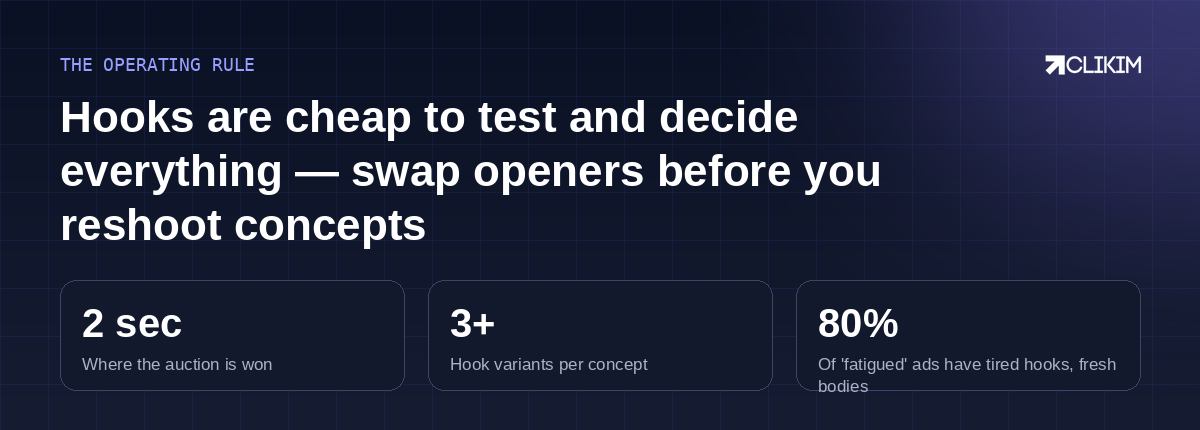
Twenty-five doorways, five mechanisms, one rule: adapt the structure, load your specifics, test three at a time.
Frequently asked questions
What makes a good Facebook ad hook in 2026?+
How many hooks should I test per ad concept?+
What is a good hook rate on Facebook ads?+
Should the hook be spoken, on-screen text, or both?+
Can I just copy these hooks word for word?+
Why did my winning ad stop working — do I need new creative?+
Are these hooks compliant for supplements/CBD/finance?+
Do hooks matter for static image ads too?+
How do I find hooks specific to my niche?+
What's the fastest way to test hooks on a small budget?+
Which hook family should I try first?+
Test every doorway properly
Three hooks per concept at honest budgets needs headroom — uncapped, managed whitelisted infrastructure keeps the testing lane moving. Operated on BM2500 infrastructure.