
The 7 Best Facebook Ad Spy & Research Tools (2026)
Reviewed as a workflow, not a shopping list: the free official Ad Library for ground truth, the paid archives for history and filters, the swipe-file layer that turns research into briefs — plus the four signals that actually read a competitor's account, and why copying creatives copies nothing that matters.
Build the stack in three layers: Meta Ad Library (free, official — every live ad from any advertiser) for ground truth; one paid archive for history and filters — AdSpy (~$149+, deepest Meta database) or Minea (AI text-in-image search), with BigSpy/PowerAdSpy as budget multi-platform options; and Foreplay (~$49+) to turn finds into tagged swipe files and briefs (teams add Atria). Read ads by longevity (60+ days running = paying) and iteration density (15 variations = winning concept). Steal structures — hooks, angles, objection order — never creatives: copied ads inherit none of the offer, signal or account context that made the original work.
• Start free: the Meta Ad Library shows every active ad from any advertiser — official, current, and sufficient for most competitor questions. • Paid spy tools add what the Library withholds: history, filters, and scale-signals — with ad longevity as the only honest public proxy for performance. • The workflow that compounds: map in the Library → mine patterns in a spy tool → systematize in Foreplay-style swipe files. • Steal angles, hooks and structures — never creatives: copied ads inherit zero of the signal, offer and landing context that made the original work. • Budget guidance: most operators need one paid tool, not four — $50–150/mo covers a serious research habit. • Watch iteration patterns, not single ads: when a competitor cuts 15 variations of one concept, that concept is paying. • Research fills the pipeline; only testing on your own account renders a verdict.
Start here: the Meta Ad Library (free, official, underrated)
Before any subscription, master the tool Meta gives away: the Ad Library shows every ad every page is currently running — creative, copy, start dates, format variations, and (for EU audiences) reach data. Search any competitor, filter by platform and media type, and you have ground truth that no scraper matches for freshness. Its two deliberate blind spots are the reason paid tools exist: no performance signals (no spend, no engagement) and no meaningful history — you see what runs now, not what ran and died. Even so: the single highest-value research habit in this article is checking your top three competitors' Libraries monthly and noting which ads persist. An ad still running after 60 days is paying for itself; nobody subsidizes losers for two months.
The seven, reviewed
Pricing verified at time of writing — confirm current rates. The pattern: the free official library for truth, one paid archive for depth, one workflow tool for turning finds into briefs.
1. Meta Ad Library — the baseline everything else extends
Covered above; in the stack it's the verification layer — whatever a paid tool claims, the Library confirms what's actually live today. Cost of skipping it: paying subscription money for questions the free tool answers.
2. Foreplay — where research becomes briefs
Foreplay is less a spy tool than the memory and workflow layer on top of them: save ads from the Library or anywhere into tagged swipe files, spot patterns across your collection, and turn a reference into a structured creative brief your UGC pipeline can execute. Teams that systematize here stop re-discovering the same insights every quarter — the compounding is the product. Honest limit: it organizes judgment; it doesn't supply it.
3. AdSpy — the deep archive
AdSpy remains the heavyweight Meta database: 200M+ archived creatives with surgical filters — country, demographic, CTA, comment text, affiliate network. This is where you answer "what has this niche tried over three years," not just "what runs today." The price (~$149–249/mo) buys depth serious buyers use daily and casual users waste; the database's affiliate-heavy corners also mean popularity ≠ compliance — filter accordingly, especially in restricted verticals.
4. Minea — AI search across creatives
Minea's edge is search modality: AI text-in-image and transcript search finds ads by what they say, not just how they're tagged — "find video ads mentioning 30-day trial in skincare" works. Product-research features skew dropshipping, but the creative-search core earns a slot for anyone mining hooks at volume.
5. BigSpy — the budget sweep
BigSpy trades depth for breadth: Facebook, Instagram, TikTok, Pinterest and more at budget pricing (with a $1 trial). Right choice when you need occasional cross-platform recon rather than a daily Meta research habit; wrong choice as your only tool if Meta is where you live.
6. PowerAdSpy — multi-channel on a budget
PowerAdSpy covers Meta plus Google, YouTube and Reddit from ~$69/mo — a sensible consolidation for teams running multiple channels who want one research surface. The UI shows its age and filter quality varies by network, but the value math holds.
7. Atria — analysis for in-house teams
Atria packages competitor analysis into team workflows — tracked brands, boards, insights built for weekly creative meetings rather than solo scrolling. It earns its seat where multiple people touch the creative process; solo operators get 80% of it from Foreplay + the Library.
How to actually read a competitor's ads (the skill the tools don't sell)
The tools deliver haystacks; these four signals find needles. Longevity: sort by start date — anything running 60+ days is a proven ad; anything at 6+ months is a franchise. Iteration density: fifteen variations of one concept means the concept prints; one lonely version of everything means they're still searching. The evolution trail: pull a brand's ads chronologically and watch which angles they abandoned and which they doubled — that's their testing budget donated to your research. The gap: the most valuable finding is usually the angle nobody in the niche runs — the teardown format from this month's trends report often wins precisely in niches where everyone else is still shouting discounts. Feed the findings into your testing framework as hypotheses, never as verdicts — their audience, offer and account history aren't yours.
A worked research sprint (90 minutes, real workflow)
What the stack looks like in motion — a home-fitness brand prepping next month's creative batch. Minutes 0–20, Ad Library: pull the three direct competitors; note that competitor A runs 40+ active ads (heavy tester), B runs six ads unchanged for four months (a stable franchise worth dissecting), C went dark (retreat or channel shift — check their TikTok). Minutes 20–50, the archive: AdSpy search across the niche's last 18 months, sorted by longevity; the pattern that emerges — every long-runner opens on a person mid-workout failing, not succeeding. Struggle-first hooks own this niche. Minutes 50–70, Foreplay: save the twelve best references into a tagged board ('struggle-open', 'floor-demo', 'before-the-before'), each with a one-line why. Minutes 70–90, the brief: two concepts × three hooks, struggle-first structure, written against the saved references and shipped to the UGC pipeline. One sprint, one testable hypothesis with evidence behind it — that's the entire promise of the category, and no tool on this list delivers it without the operator driving.
Inspiration vs theft (and why theft doesn't even work)
The line matters legally and practically. Ripping a competitor's creative — same footage, same script, logo swapped — is copyright exposure, and on a platform where quality signals follow the advertiser, running recognizably stolen assets invites reports from the one audience guaranteed to see them: the competitor. But the deeper reason pros don't bother: a copied ad inherits none of what made the original work — not the offer economics, not the landing page, not the audience history, not the account trust, not the comment section full of social proof. What transfers profitably is structure: the hook pattern, the angle, the objection sequence, the format. Steal like a strategist — take the skeleton, grow your own body.
The right stack by operator size
Solo buyer / first store: Ad Library + disciplined notes — $0, and honestly sufficient until you're testing weekly. Growing brand ($10–100k/mo spend): Ad Library + Foreplay + one archive (AdSpy if Meta-only and research-heavy; Minea if you want AI search) — call it $100–200/mo doing real work. Agency / multi-channel team: add Atria for the shared workflow and PowerAdSpy or BigSpy for cross-network sweeps. The universal rule: every tool must feed the same pipeline — research → swipe file → brief → test → verdict — or it's entertainment with a subscription fee. And the quiet dependency under the whole workflow: research volume only pays if your account can test at volume — a capped account turns a $200/mo research stack into a library of untested ideas, which is why serious research operations pair the stack with uncapped agency accounts.
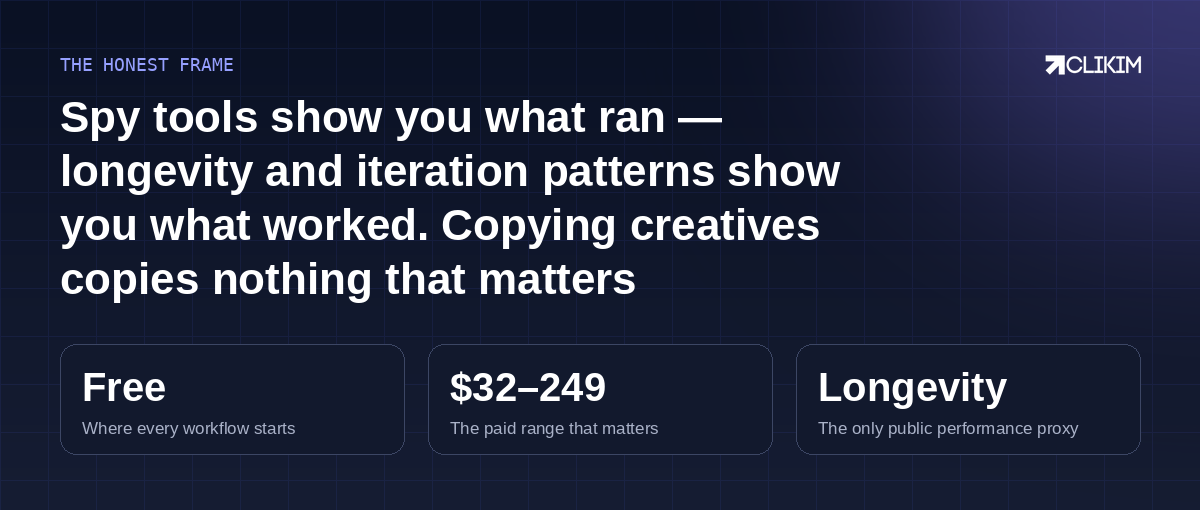
Free library for truth, one archive for depth, one workflow tool for memory — and your own account for verdicts.
Frequently asked questions
What's the best free Facebook ad spy tool?+
Is AdSpy worth $149+ a month?+
How can I tell if a competitor's ad is actually working?+
Can I just copy a winning ad I found?+
What is Foreplay and do I need it with a spy tool?+
Which spy tool is best for TikTok ads too?+
How do I research competitors in restricted niches like supplements?+
How often should I do competitor ad research?+
Do spy tools violate Meta's terms?+
What signals should I save into a swipe file?+
Why do my copied competitor angles fail on my account?+
What's the minimum viable research stack?+
Can spy tools tell me a competitor's budget or targeting?+
Research at library scale, test at account scale
Uncapped, whitelisted infrastructure — every hypothesis your research surfaces, actually tested. Operated on BM2500 infrastructure.