
Facebook Ads for Ecommerce: The 2026 Playbook
Facebook is still the dominant performance channel for ecommerce — but only if you run it right. Here's the modern stack: clean tracking, a product catalog, Advantage+ scaling, creative mapped to the funnel, retargeting, and why it's all won on unit economics.
Winning ecommerce on Facebook is a stack: accurate tracking (pixel + Conversions API), a product catalog, Advantage+ shopping as the scaling engine, strong creative mapped to the funnel, and retargeting to close cart abandoners. But it's ultimately won on unit economics — your AOV, margin and LTV set your break-even ROAS and decide what you can afford to spend. Fix tracking first, feed Advantage+ with varied creative, and lift AOV/LTV to widen what's profitable.
• Ecommerce ads are a stack: clean tracking, a product catalog, Advantage+ scaling, creative and retargeting. • Fix tracking first — pixel + Conversions API — or you optimise on undercounted sales. • Advantage+ shopping is the default scaling engine; feed it strong, varied creative. • Map creative to funnel stage: prospecting hooks, demos, cart-recovery offers, repeat-purchase nudges. • Win on unit economics — AOV, margin and LTV decide what you can afford to spend. • Lift AOV and LTV (bundles, upsells, retention) to widen what's profitable. • Scaling ecommerce needs an account that can absorb real spend without caps or bans.
Why Facebook still wins for ecommerce
Despite years of "Facebook ads are dead" headlines, Meta remains the dominant performance channel for most ecommerce brands — because nowhere else combines its reach, its buying intent signals, and its machine-learning delivery at the same scale. For a store trying to find new customers profitably, Facebook and Instagram are still where the volume and the tooling are. The brands that struggle usually aren't on the wrong platform; they're running the platform wrong.
This playbook lays out the modern, 2026 way to run ecommerce on Facebook: the technical stack that has to be in place, how Advantage+ has changed scaling, how to map creative to the funnel, and — most importantly — why the whole thing is won or lost on unit economics rather than ad-account tricks. Get these fundamentals right and Facebook is still a growth engine; get them wrong and no amount of tactical fiddling saves you.
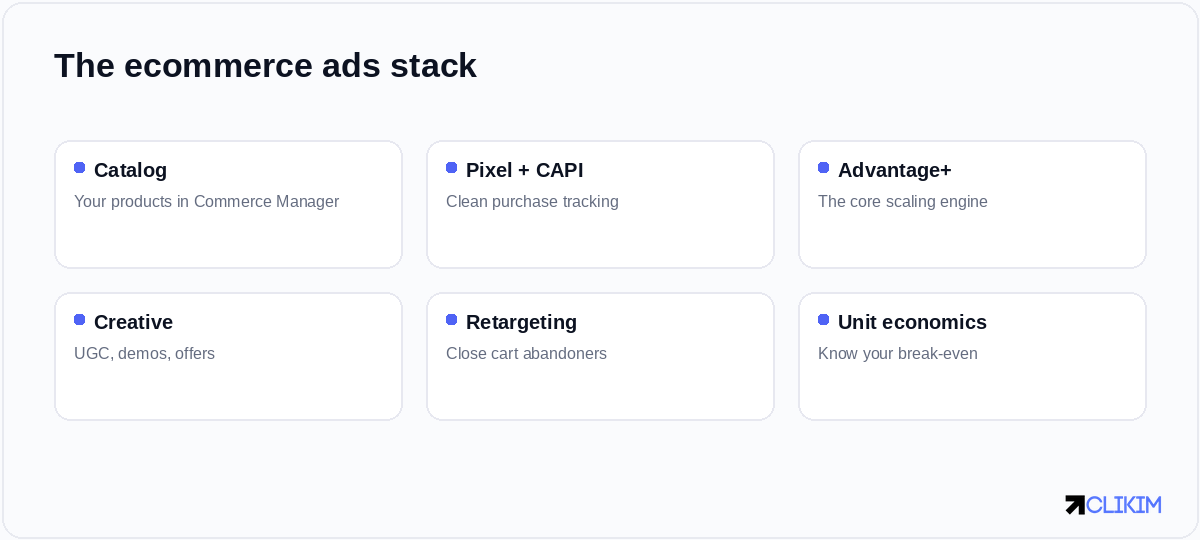
Ecommerce on Facebook is a stack — catalog, tracking, Advantage+, creative, retargeting and unit economics.
The ecommerce ads stack
Before tactics, get the foundations in place. Ecommerce advertising is a layered stack, and a weakness in any lower layer undercuts everything above it.
Ecommerce success on Facebook is a stack — weak tracking or no catalog undercuts everything built on top.
Clean tracking feeds accurate optimisation; a product catalog powers dynamic product ads and Advantage+; the scaling engine spends into winners; and retargeting closes the demand the rest creates. Skip the catalog and you can't run dynamic ads; neglect tracking and every layer above optimises on bad data. Build the stack bottom-up before you worry about clever campaign structures.
Get tracking right first
Nothing matters more than accurate conversion data, because everything Facebook optimises toward depends on the purchases it can see. In a privacy-degraded world the browser pixel alone undercounts sales, so the modern baseline is the pixel plus the Conversions API, sending purchase events server-side to recover what the browser loses. Without this, your campaigns learn from a distorted sample and your reported costs look worse than reality.
This is the single most common reason ecommerce accounts underperform: they're optimising on undercounted conversions, cutting winners that actually worked because the data didn't show the sales. Fixing tracking is unglamorous and often the highest-ROI thing you can do — it makes every downstream decision, from creative testing to scaling, run on truth instead of noise.
Set up your catalog and dynamic ads
Your product catalog, set up in Commerce Manager, is what lets Facebook show specific products to specific people — the engine behind dynamic product ads (DPAs) and a big part of Advantage+ shopping. A well-structured, accurate catalog with good titles, images and pricing means Meta can match the right product to the right shopper, especially in retargeting, where showing someone the exact item they viewed is enormously effective.
Invest in catalog quality the way you'd invest in creative: clean product data, correct availability, strong imagery. A neglected catalog quietly caps your performance because the system can only show what you've given it. For most stores, getting the catalog right is a one-time setup that pays off across every dynamic and Advantage+ campaign thereafter.
Scaling with Advantage+ shopping
Advantage+ shopping campaigns have become the default scaling vehicle for ecommerce, and for good reason: they hand audience selection and budget allocation to Meta's machine learning, which on broad, creative-led delivery now outperforms most manual setups. You provide the products, the creative and the budget; Advantage+ decides who sees what, blending prospecting and retargeting automatically.
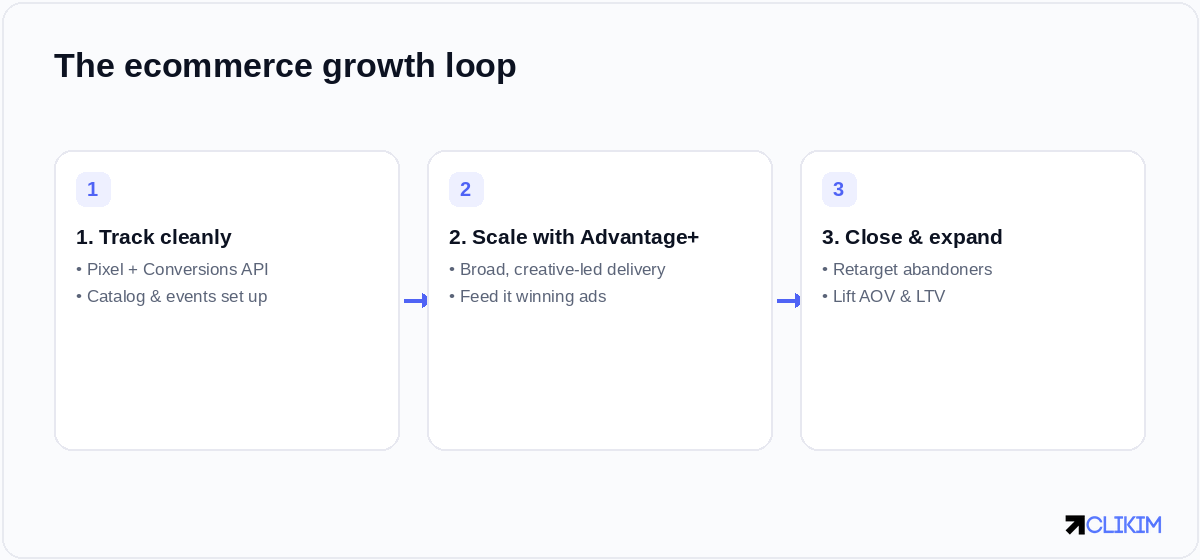
The ecommerce loop: track cleanly, scale with Advantage+, then close abandoners and expand customer value.
The implication is that your job shifts from micromanaging audiences to feeding the machine well — strong, varied creative and a clean catalog. As covered in our Advantage+ guide, the common mistake is trying to rebuild old-style hyper-segmentation inside it, which fights the automation. Let it run broad, and keep a lean manual testing campaign alongside for deliberately trialling new creative angles before feeding winners in.
Creative is your biggest lever
With targeting increasingly automated, creative is where ecommerce advertisers win or lose. The creative does the targeting on broad audiences — the right hook attracts the right buyer — so a continuous supply of strong, varied creative is the engine of growth. UGC, product demos, before-and-afters and offer-led ads each pull a different lever; the best stores run a portfolio and test relentlessly.
Match creative to the funnel stage rather than blasting one ad everywhere. Prospecting needs scroll-stopping hooks and problem-solution angles; consideration needs demos and reviews; closing needs urgency and reassurance. Mapping creative to intent is where a lot of hidden performance lives.
Map creative to funnel stage — a prospecting hook and a cart-recovery offer do completely different jobs.
Close the sale with retargeting
Ecommerce has a built-in leak: shoppers add to cart and don't check out. Retargeting is how you recover them — dynamic ads showing the exact products they viewed, paired with urgency or an offer, convert a meaningful share of otherwise-lost sales. It's the highest-efficiency spend in most stores precisely because the intent is already there.
But keep it in perspective: retargeting closes demand, it doesn't create it. Its flattering ROAS tempts brands to over-invest, which empties the warm audience and starves growth. Fund prospecting to fill the funnel, then let efficient retargeting harvest it — and always exclude recent purchasers so you're not paying to chase people who already bought.
Win on unit economics
Here's the truth that underpins everything: profitable ecommerce advertising is decided by your unit economics, not your ad-account cleverness. The ad account executes; the maths decides whether execution is profitable.
Profitable ecommerce advertising is decided by unit economics first — the ad account only executes the maths.
Your average order value and margin set your break-even ROAS; your customer lifetime value determines how much you can afford to pay to acquire a buyer. A store with a $30 AOV and thin margins has almost no room to advertise profitably, while one with a $120 AOV or strong repeat purchase can outbid everyone. Before blaming your ads, do the maths — often the constraint is the economics, not the campaigns.
Lift AOV and LTV to widen what's profitable
Because economics set the ceiling, the most powerful "ad" optimisation is often outside the ad account entirely: raising average order value and lifetime value. Bundles, upsells, volume discounts and free-shipping thresholds lift AOV, giving you more margin to spend on acquisition. Email, retention and repeat-purchase flows lift LTV, letting you profitably "lose" on the first order to win over time.
Brands that win on Facebook at scale almost always have strong AOV or LTV doing the heavy lifting — it's what lets them outbid competitors in the auction and still profit. If your ads feel stuck, improving the economics often unlocks more growth than any campaign tweak, because it changes the maximum you can afford to pay for a customer.
Planning for seasonality
Ecommerce lives and dies by seasonality, and Facebook costs move with it. Q4 — Black Friday through the holidays — floods the auction with advertisers, pushing CPMs and costs up sharply, while demand and conversion rates also spike. The brands that win Q4 don't improvise in November; they build their winning creative, warm their audiences, and prove their funnel in the quieter months, so they arrive at peak season with a tested machine ready to scale rather than a cold start.
The practical move is to treat the calendar as part of your strategy. Budget for higher CPMs during peaks and plan promotions around them, but also exploit the cheaper, calmer periods to test creative and build the retargeting pools you'll harvest later. A store that enters Q4 with full warm audiences and a backlog of proven creative spends its peak-season budget far more efficiently than one scrambling to find winners while CPMs are at their highest.
Common ecommerce ad mistakes
A handful of mistakes sink most underperforming ecommerce accounts. The first is launching before tracking is solid, so the whole account optimises on undercounted sales from day one. The second is starving the catalog and creative — running a thin set of ads against a neglected product feed and wondering why dynamic ads underdeliver. The third is over-segmenting into many tiny ad sets and campaigns, fragmenting the data Advantage+ and the learning phase need to work.
The fourth, and most seductive, is chasing retargeting's flattering ROAS at the expense of prospecting, which slowly empties the funnel until growth stalls. And the fifth is ignoring the economics entirely — pouring effort into campaign tweaks when the real constraint is an AOV or margin that leaves no room to advertise. Avoid these five and you're already ahead of most stores running Facebook ads, because each one is a self-inflicted ceiling rather than a platform limitation.
Scaling ecommerce needs account headroom
Get the stack, creative and economics right and you'll want to scale — which is exactly where the account itself becomes the bottleneck. A new or low-trust account capped near $250/day can't absorb the spend a growing store needs, and the aggressive scaling that ecommerce demands is precisely what gets fragile accounts throttled or banned.
That's why scaling ecommerce brands run on a high-trust agency ad account with no preset cap — so when the funnel is working, the account can actually pour fuel on it without falling over. You've done the hard work of building a profitable machine; the infrastructure should let you run it as hard as the economics allow, not throttle you at the moment of success.
Ecommerce wins on tracking, creative and economics — then needs an account with the headroom to scale it.
the Shopify reconciliation guide — when Meta says 105 and Shopify says 30. purchase-value audit — the silent ROAS distorter in most stores. native CAPI vs tracking apps — who actually needs to pay for tracking.
Frequently asked questions
Are Facebook ads still good for ecommerce in 2026?+
What do I need to run Facebook ads for my store?+
Why is tracking so important for ecommerce ads?+
What is Advantage+ shopping and should I use it?+
What is a product catalog and why do I need one?+
What creative works best for ecommerce?+
How does retargeting fit ecommerce?+
What ROAS do I need for ecommerce?+
How do I make Facebook ads more profitable?+
Why are my ecommerce ads not profitable?+
Do I need a special ad account to scale my store?+
Should I use one campaign or many for ecommerce?+
Built a profitable machine? Don't let a $250 cap throttle it
Scaling ecommerce needs an account that can absorb real spend. Run on high-trust managed infrastructure with no preset cap and a dedicated rep. Operated on BM2500 infrastructure.