
ABO vs CBO: Which Should You Use in 2026?
The oldest argument in media buying has a boring, reliable answer: it's not a religion, it's a division of labour. Here's what each budget mode is actually good at, why testing wants ABO and scaling wants CBO, and the hybrid setup most scaled accounts run.
ABO (ad set budgets) means you allocate spend; CBO (campaign budget, now 'Advantage campaign budget') lets Meta allocate it across ad sets. The rule that wins in 2026: test in ABO, scale in CBO — testing needs fair, even budgets so ideas can be compared, while scaling benefits from the algorithm pouring budget into proven winners. Judge CBO at the campaign level, don't strangle it with min/max limits, and move budgets in 20–30% steps either way.
• ABO = you set each ad set's budget. CBO = Meta allocates one campaign budget across ad sets. • The rule that wins in 2026: test in ABO, scale in CBO. • ABO gives fair comparisons — every test gets the spend you intended. • CBO gives efficient scaling — budget flows to what's already winning. • Judge a CBO campaign at the campaign level, not by which ad set spent. • Don't strangle CBO with min/max limits — if you need that much control, use ABO. • Whichever you pick, budget changes reset learning — move in 20–30% steps.
ABO and CBO, defined
ABO (ad set budget optimization) and CBO (campaign budget optimization — now officially "Advantage campaign budget") answer one question: who decides how your money is split between ad sets? With ABO, you set a budget on each ad set and Meta must spend it there, whether that ad set is winning or losing. With CBO, you set one budget at the campaign level and Meta's algorithm continuously shifts it toward the ad sets it predicts will deliver the best results.
That's the entire mechanical difference — same auction, same ads, same targeting options. But this one lever changes how you test, how you scale, and how you diagnose problems, which is why "ABO or CBO?" remains one of the most-argued questions in media buying. The honest answer isn't a religion for either side; it's a division of labour, and this guide lays it out.
Same auction, same ads — the only difference is who decides where the money goes.
What ABO is actually good at
ABO's superpower is fairness and control. When you're testing three creative angles against each other, you need each to receive a meaningful, equal budget — otherwise you haven't run a test, you've run a race with a rigged start. ABO guarantees every ad set gets exactly the spend you intended, so at the end of the week you can compare results knowing each idea got its fair shot.
Control matters beyond testing too. If you have hard rules — "retargeting never gets more than $50/day", "this geo must get exactly $100" — ABO enforces them by design. Agencies managing client mandates, accounts with strict budget lines per product, and buyers who simply want deterministic spend all lean ABO for exactly this reason. The cost of that control is efficiency: nothing stops budget sitting on an ad set that's clearly losing while a winner elsewhere is capped.
What CBO is actually good at
CBO's superpower is letting the machine chase performance in real time. Meta's delivery system sees signals faster than any human — which ad set is converting this hour, which audience is fatiguing — and CBO lets it act on them, shifting budget continuously toward the strongest performer. Across a campaign of proven ad sets, that reallocation typically beats any manual schedule a buyer could maintain.
This is why CBO shines at scale. Once you know your winners, your job is to feed them, and CBO does the feeding automatically — including the intraday adjustments you'd never make by hand. It also concentrates spend rather than fragmenting it, which helps ad sets clear the learning phase and stay stable. The cost is control: Meta decides, and sometimes it decides in ways that look wrong from the outside.
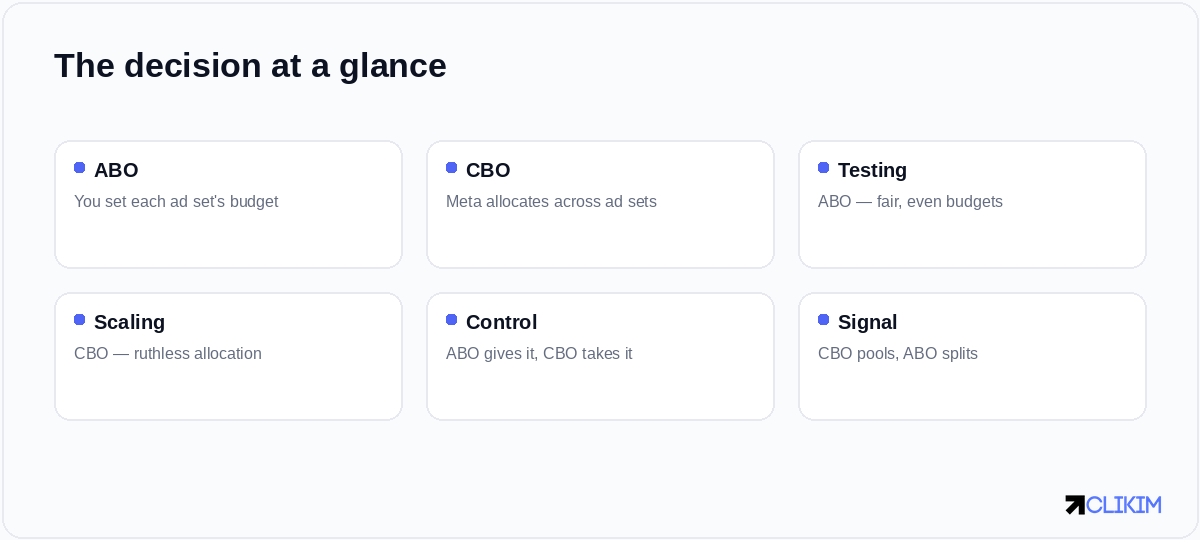
ABO gives you control and fair tests; CBO gives you algorithmic allocation and efficient scale.
Why testing wants ABO
Run a test inside CBO and a familiar disaster unfolds: one ad set gets early conversions, the algorithm piles budget into it, and your other test cells starve at $3/day. Was the "winner" genuinely better, or just lucky first? You can't know — the test contaminated itself. This is the single most common testing mistake on Facebook, and it quietly wastes more budget than any bad creative ever did.
ABO removes the contamination. Every new angle, audience or format gets the same fixed budget, runs for the same window, and is judged on the same spend. Our creative testing approach depends on this fairness: kill the losers on data, graduate the winners with confidence. Testing is a controlled experiment, and controlled experiments need controlled budgets.
Why scaling wants CBO
Once ad sets have proven themselves, the calculus flips. You no longer need fairness — you need throughput. A scaling campaign's job is to spend as much as possible at an acceptable cost, and reallocating budget toward whichever winner is strongest right now is precisely what CBO automates. The buyers who resist this usually end up doing worse manual reallocation on a slower clock.
CBO also handles winner decay gracefully. When a previously strong ad set fatigues, budget drains away from it automatically instead of burning at full spend until you notice. In a well-built scaling campaign — few, consolidated, proven ad sets, per our account structure guide — CBO is closer to a portfolio manager than a budget setting.
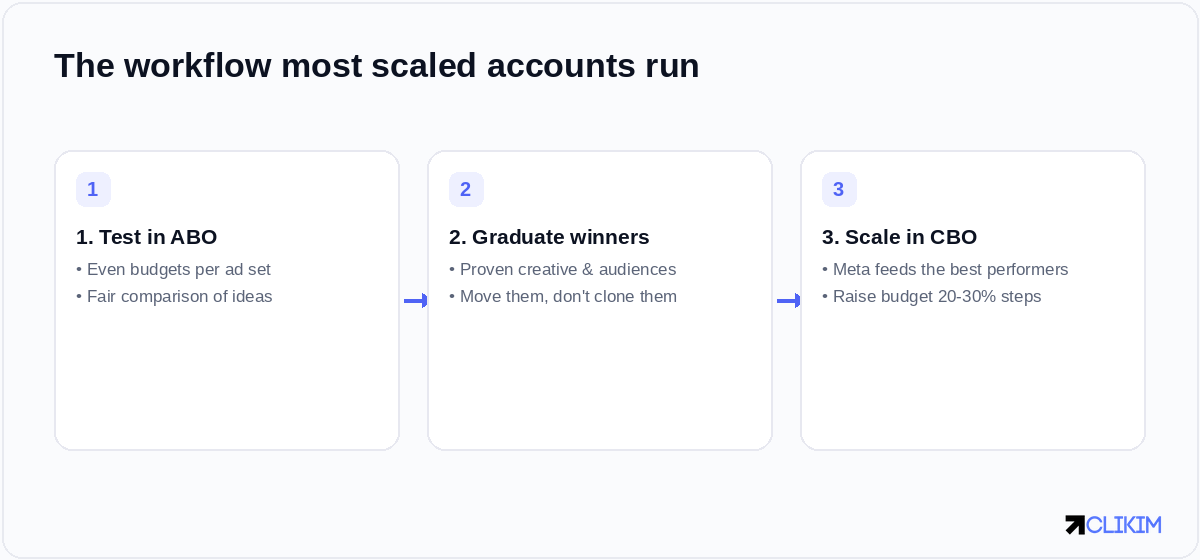
The hybrid workflow: test fairly in ABO, graduate winners, scale them in CBO with gradual budget raises.
The hybrid setup most pros run
Put the two strengths together and you get the structure most scaled accounts converge on: an ABO testing campaign where every new idea gets a fair budget, and a CBO scaling campaign containing only graduated winners. New concepts prove themselves under controlled conditions, then move into the environment built to pour fuel on them.
Two practical notes on the graduation step. First, move or rebuild winners into the scaling campaign deliberately — don't leave the same ad competing against itself in both. Second, expect a fresh learning phase when a winner lands in the CBO; that's normal, not a sign the ad "broke". Give it the events it needs before judging.
The rule that survives every algorithm update: control while you learn, automation once you know.
How to judge a CBO campaign (most people do it wrong)
The most common CBO complaint — "it spent everything on one ad set!" — is usually a misunderstanding of what you bought. CBO optimizes the campaign total, and uneven allocation is the mechanism, not a malfunction. If the campaign's blended cost per result is at target, CBO is doing its job, even if one ad set took 80% of the spend.
So judge CBO at the campaign level: total spend, total results, blended CPA/ROAS. Only dig into ad-set allocation when the campaign number is off. And before blaming the mechanism, check the inputs — a "starved" ad set inside a CBO usually lost the internal auction for a reason visible in its own metrics (weak hook rate, high CPM, poor early conversion signal).
Min/max spend limits: the CBO escape hatch (use sparingly)
CBO offers per-ad-set minimum and maximum spend limits, and they're the most misused feature in the system. Buyers who don't trust the algorithm clamp every ad set with mins and maxes — at which point they've rebuilt ABO with extra steps and none of its clarity, while preventing CBO from doing the reallocation they're paying for.
The sane use is surgical: a minimum on a strategically-required ad set (a must-run geo, a brand-safety line), or a maximum on an audience you're deliberately limiting. If you find yourself capping everything, listen to that instinct — you want control, and the honest tool for control is ABO.
Changing budgets without breaking things
Whichever mode you run, budget changes are not free. Significant jumps can throw ad sets back into learning, destabilising the very performance you were scaling. The discipline is the same one from our scaling guide: raise in roughly 20–30% steps, let delivery re-stabilise, then step again. In CBO you make that change once at campaign level; in ABO you make it per ad set — one more reason scaling is less error-prone under CBO.
And resist the daily fiddle. Constant nudges keep campaigns perpetually re-learning, which reads as "instability" and gets blamed on whichever budget mode you happen to be using. Batch your changes, make them deliberately, and give the system room to settle.
Most CBO complaints are actually misuse — forcing manual control onto a system built for automation.
What if you're small? (Under ~$100/day)
At small budgets the ABO-vs-CBO debate matters less than people think, because the real constraint is signal: you need each active ad set to gather enough conversions to learn, and splitting $50/day across six ad sets guarantees none of them do. Consolidation is the priority — one or two ad sets, broad audiences, your best creative.
With so few ad sets, ABO and CBO behave almost identically, so pick for workflow: a single CBO campaign with one or two ad sets is simple and future-proof; a single ABO ad set is equally fine. Your leverage at this stage is creative quality and clean tracking via the Conversions API, not budget-allocation mechanics.
Where Advantage+ shopping fits
If you run ecommerce, note that Advantage+ shopping campaigns sit outside this debate entirely — ASC manages budget, audiences and allocation itself, functioning like CBO taken to its logical conclusion. The modern ecommerce pattern is ASC as the scaling engine plus a lean ABO campaign for deliberate creative testing, which is the same test-manual/scale-automated logic wearing different clothes.
The through-line across all of it: control while you learn, automation once you know. That principle survives every rename and algorithm update Meta ships.
The decision only matters if the account can spend
One final reality check: ABO vs CBO optimises how budget is allocated, but the ceiling on how much budget you can deploy is set by the account itself. A new account throttled near the $250/day cap gets little benefit from perfect CBO mechanics — there's nothing to allocate. And an account that keeps getting restricted resets every learning gain either mode accumulated.
Serious spenders pair clean campaign mechanics with infrastructure that can absorb them: a whitelisted agency ad account with no preset cap, so the test-then-scale machine actually has headroom to run. Get the mechanics right, then make sure the account lets them matter.
The verdict hasn't changed because it's structural: fairness for experiments, automation for exploitation.
Frequently asked questions
What is the difference between ABO and CBO?+
Is ABO or CBO better in 2026?+
Should I test ads in CBO?+
Why does CBO spend everything on one ad set?+
What is Advantage campaign budget?+
Should I use minimum and maximum spend limits in CBO?+
Do budget changes reset the learning phase?+
How do I move a winning ad set from ABO testing into CBO scaling?+
Does ABO vs CBO matter on a small budget?+
How does Advantage+ shopping relate to CBO?+
How should I judge CBO performance?+
Does the account matter more than the budget mode?+
Built the machine? Give it headroom
Test in ABO, scale in CBO — on managed whitelisted infrastructure with no preset spend cap, so the winners you find can actually scale. Operated on BM2500 infrastructure.