
TikTok Ads vs Facebook Ads (The 2026 Scorecard)
Seven rounds, honest verdicts, real 2026 numbers. TikTok buys attention at half price; Facebook converts it twice as well — here's exactly where the curves cross, which platform deserves your first dollar, and how serious brands end up running both.
Neither platform “wins” — they're different machines. TikTok buys attention at roughly half Facebook's CPMs ($5–10 vs $10–18 US) and dominates under-30, impulse-friendly offers under ~$60 — but demands 8–15 native videos a month and burns creative in days. Facebook has the deeper signal graph, far stronger retargeting, and wins considered purchases and 30+ demos. Start on the platform your buyer and offer favor, reach stable CPA first, then expand and run ~70/30 weighted by blended CPA. On both platforms, fresh accounts face caps and ban risk — account infrastructure is the tiebreaker round.
• TikTok wins on cost of attention (CPMs roughly half of Facebook's); Facebook wins on signal, conversion depth and scaling ceilings. • The crossover is your offer: impulse products under ~$60 and under-30 audiences favor TikTok; considered purchases and 30+ demos favor Facebook. • TikTok's hidden tax is creative velocity — native video only, with ads fatiguing in days, not weeks. • Facebook's retargeting and custom-audience machinery is still the deepest in adtech; TikTok's is catching up but younger. • Don't split budgets 50/50 on day one — win one platform first, then port proven creative and offers to the second. • Both platforms are brutal on fresh ad accounts: caps, review friction, ban waves. Account infrastructure decides who stays live. • The 2026 end state for most serious ecom brands is both platforms, weighted by where their unit economics actually clear.
Stop asking which is better
"TikTok or Facebook" is the wrong question in 2026 the way "Google or Facebook" was the wrong question in 2019. They're different machines: Facebook is a signal engine — fifteen years of purchase data, the deepest pixel/CAPI graph in advertising, retargeting that borders on unfair. TikTok is an attention engine — the cheapest large-scale reach in Western markets and a feed culture where an ad that looks like an ad dies instantly, but one that doesn't can outperform anything Facebook serves.
So this article is built as a scorecard: seven rounds, honest verdicts, real 2026 numbers — then a decision framework for which platform gets your first dollar, and when you graduate to both. If you want the platform-by-platform mechanics, the deep dives live in our TikTok ads guide and across the Facebook series; this is the head-to-head.
The scorecard: seven rounds
Seven rounds. Facebook takes four, TikTok takes one outright, two depend on your offer — which is why the real answer is sequencing, not allegiance.
Round 1 — Reach & audience
Facebook (with Instagram bundled through Meta's placements) reaches over 3 billion monthly users across every demographic that has money — including the 35–65+ cohorts that carry most high-AOV categories. TikTok's ~1.6 billion skews hard under 30, and while its 30+ share grows every year, media habits are stickier than platform PR suggests. If your buyer is a 45-year-old homeowner, she is on Facebook tonight; she might be on TikTok. Facebook for breadth, TikTok if your buyer is young.
Round 2 — CPMs and the cost of attention
TikTok's structural advantage: ad load is lighter and inventory younger, so US CPMs typically run $5–10 against Facebook's $10–18. Attention on TikTok costs roughly half. That advantage is real but decaying — TikTok CPMs have climbed every year since 2022 as more advertisers arrive, the same inflation curve Facebook rode a decade earlier. Round to TikTok, with a countdown clock.
Round 3 — Creative demands
Here's TikTok's hidden tax. Facebook still monetizes statics, carousels and polished video; a good static can run profitably for months. TikTok monetizes exactly one thing — native-feeling vertical video — and burns it fast: creative fatigue on TikTok is measured in days-to-a-couple-weeks, not months. Competing seriously means a pipeline producing 8–15 new videos a month, ideally creator-style, forever. Brands without that engine quietly lose on TikTok regardless of what the CPMs promise. Facebook, for carrying a lighter load.
Round 4 — Targeting & signal
Meta's data graph is the product of fifteen years and trillions of purchase events; feed it conversions through pixel + CAPI and its delivery system finds buyers with a precision TikTok's younger graph can't yet match — especially for retargeting and custom-audience plays, where Meta remains the deepest machine in adtech. TikTok's Smart Performance campaigns close the gap yearly, but the gap is real. Facebook, still clearly.
Round 5 — Learning & scaling
Facebook's learning system is mature and predictable: feed it ~50 events a week and it stabilizes; winners scale to five figures a day on known playbooks. TikTok learning is more volatile — performance whipsaws harder, winning ads die faster, and scaling is mostly a function of how fast you can replace creative. Ceilings exist on TikTok, but the ladder is shakier. Facebook.
Round 6 — Buyer intent & offer fit
The panel above shows the real shape: TikTok's cheap attention converts at roughly half Facebook's rate, so the platforms often land within dollars of each other on CPA — and which one wins is decided by the offer. Impulse-friendly products under ~$60 (beauty, gadgets, snacks, novelty) ride TikTok's discovery culture beautifully. Considered purchases — $150+ AOVs, B2B, services, anything with a research cycle — close on Facebook, where retargeting can chaperone a two-week decision. Round goes to your unit economics.
Round 7 — Account stability
The round nobody scores until it scores them. Both platforms are ruthless with fresh, low-trust ad accounts: Facebook's new-account caps and ban waves are well documented across this series, and TikTok mirrors the pattern with aggressive review friction and a less mature appeals process. On either platform, the advertisers who compound are the ones whose accounts don't disappear mid-scale. A tie — and the strongest argument for agency-level account infrastructure on both.
The 2026 cost table
The pattern behind every line: TikTok buys attention cheaper, Facebook converts it better. Where those curves cross is your product's price point and consideration cycle.
Read the table as two curves, not twelve numbers. TikTok is cheaper at the top of the funnel on every line; Facebook is stronger at the bottom on every line. Your product's price point and consideration cycle decide where the curves cross — which is why a $34 lip stain and a $900 standing desk should never copy each other's channel mix. Benchmarks for your specific vertical are in our industry benchmark tables and CVR guide.
Which platform gets your first dollar
The flow above compresses the decision to three questions. First: who buys, and how old are they? A 30+ buyer or any considered purchase starts on Facebook — the signal depth and retargeting do heavy lifting while you learn. An under-30 impulse buyer starts on TikTok, where reach is half price. Second: can you feed the creative machine? If you can't produce native vertical video at volume yet, TikTok will spend your budget warming its algorithm while your two statics fatigue — start on Facebook and build the video pipeline in parallel. Third: what does the offer cost? Under ~$60 and impulse-friendly leans TikTok; above ~$150 or research-heavy leans Facebook.
Then sequence, don't split. Take one platform to consistent profitability — stable CPA at meaningful spend for 4–6 weeks — before opening the second. When you do expand, port what's proven: your winning angles, offers and hooks travel across platforms even when the exact assets don't. Most brands land at a 70/30 weighting toward whichever platform their economics favor, rebalanced quarterly on blended CPA, not on platform-reported numbers alone.
Running both without doubling your workload
The compounding trick of running both is asymmetric learning. TikTok is the best creative-testing lab in advertising: cheap CPMs and a brutal feed give you fast, honest reads on hooks and angles. Facebook is the best harvesting machine: whatever message survives TikTok gets rebuilt as Facebook creative and pointed at deeper-signal audiences with real retargeting behind it. Plenty of 2026 media plans run exactly that loop — test on the cheap platform, scale on the deep one.
Operationally, keep the stacks parallel: separate tracking (TikTok Events API mirrors Meta's CAPI), separate creative calendars honoring each feed's culture, and separate account infrastructure. Both platforms' official starting points — TikTok for Business and Meta for Business — cover setup mechanics; what they don't cover is the account-trust problem below.
Three brands, three different right answers
A $38 skincare brand, buyers 18–34: TikTok first, no contest — impulse price point, native demo, creator-style content already in-house. It reached a stable $27 CPA in five weeks, then opened Facebook for retargeting and 30+ expansion; today it runs 65/35 TikTok-weighted. A $220 ergonomic-chair store, buyers 30–55: Facebook first — a two-week consideration cycle needs retargeting depth, and the demo skews past TikTok's core. TikTok now runs as a 20% testing lab whose winning hooks get rebuilt as Facebook video. A B2B SaaS at $99/month: Facebook effectively alone — lead forms, lookalikes from closed-won lists, and a demo that TikTok reaches only thinly. The pattern in all three: the scorecard didn't pick the platform, the offer did.
The part both platforms share: account fragility
Here's the pattern that surprises advertisers expanding to a second platform: the account problems follow you. A fresh TikTok ad account hits review friction, conservative limits and abrupt suspensions exactly the way a fresh Facebook account hits spending caps and ban waves — new-account distrust is a platform-independent tax. It's why serious operators run whitelisted Facebook agency accounts and TikTok agency accounts as a matched pair: aged, high-trust, uncapped infrastructure on both sides, so the scorecard above gets decided by economics instead of by which platform's risk system flinched first. The comparison of that route versus self-serve is in our agency vs self-serve breakdown.
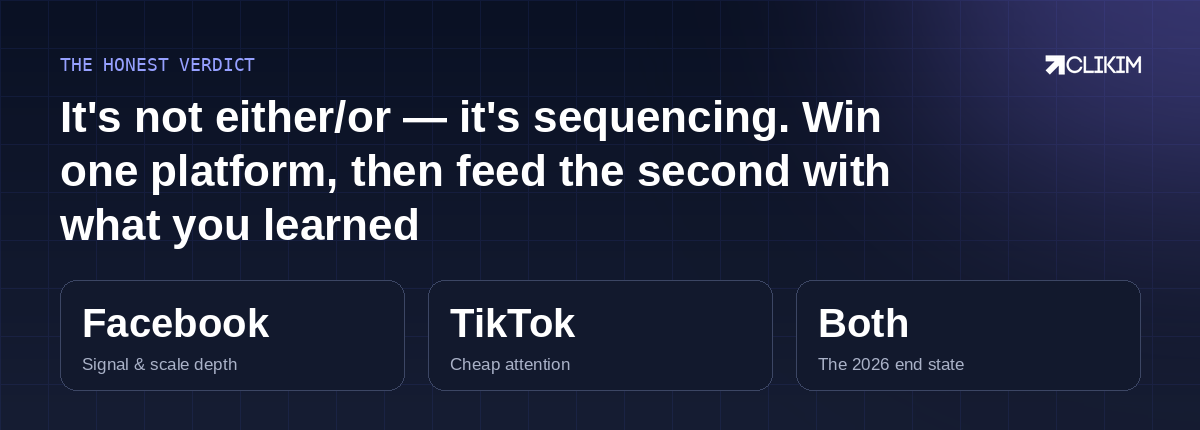
Sequencing beats allegiance: win one platform, port the learnings, weight by CPA.
Frequently asked questions
Are TikTok ads cheaper than Facebook ads?+
Which platform is better for ecommerce?+
Which is better for lead generation and B2B?+
How many creatives do I need for TikTok vs Facebook?+
Is TikTok's targeting as good as Facebook's?+
Should I split my budget 50/50 between them?+
Do the same creatives work on both platforms?+
Which platform has a better learning phase?+
What about attribution differences between the two?+
Are TikTok ad accounts as fragile as Facebook accounts?+
What's the fastest way to run both platforms without cap problems?+
Run both platforms on accounts that can actually scale
Whitelisted Facebook and TikTok infrastructure — aged, high-trust, no preset caps, under a BM2500. The tiebreaker round, solved.