
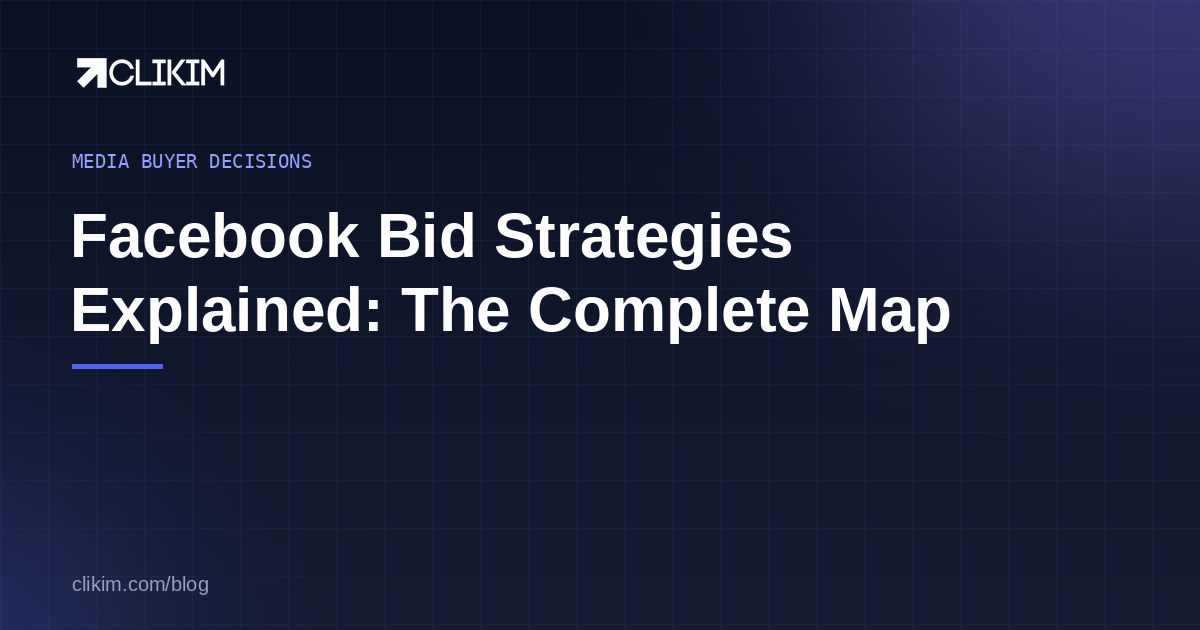
Facebook Bid Strategies Explained: The Complete Map
Strip away the renamed menus and every bid strategy answers one question: which number do you fix, and which floats? The full map — highest volume, cost goal, ROAS goal, bid cap — with who should use each and the five failure modes that cause most of the pain.
Facebook offers four real bid strategies. Highest volume (the default): spend the budget at market prices — right for testing, learning and growth. Cost per result goal: anchor your average CPA, volume floats — for proven fixed-value offers. ROAS goal: anchor your revenue multiple — for ecommerce with varied cart sizes. Bid cap: cap every individual bid — a specialist tool most buyers should skip. Set goals from 30-day actuals with 10–20% headroom, tune in 10–15% steps, loosen as you scale, and never constrain a test.
• Four real choices: highest volume (default), cost per result goal, ROAS goal, bid cap. • Every constraint trades volume for certainty — you fix one number, delivery floats. • Test on highest volume, always. Constraints starve the spend that learning needs. • Fixed-price offers scale on cost goals; varied-AOV ecommerce scales on ROAS goals. • Bid cap constrains every single auction with zero forgiveness — a specialist tool most buyers should skip. • Set goals from 30-day actuals (10–20% headroom), tune in 10–15% steps, loosen as you scale. • A goal anchored to undercounted data is anchored to a lie — fix tracking first.
The map: four strategies, one spectrum
Meta's bid strategy menu looks more complicated than it is. Strip the naming history away ("lowest cost" became "highest volume"; "cost cap" became "cost per result goal") and every option answers a single question: which number are you fixing, and which are you letting float? Fix nothing and you get maximum volume at market price. Fix your CPA and volume floats. Fix your revenue multiple and volume floats differently. Fix the raw bid itself and you've taken manual control of the one variable the algorithm handles best.
Every strategy is one question: which number must stay fixed, and how much volume will you trade to fix it?
The spectrum runs from full delegation (highest volume) to full control (bid cap), and the honest rule of the whole guide is: move toward control only as your data earns it. Constraints built on solid numbers are guardrails; constraints built on wishes are delivery killers.
Highest volume: the default that's usually right
Highest volume tells Meta: spend my budget, get me the most results available at the best prices available. No constraint, no floor, no ceiling — which is exactly why it's the correct home for testing, learning phases, new pixels, and growth pushes. Everything that needs spend and signal gets it; your CPA is whatever the market and your creative deserve that week.
Its weakness is the mirror of its strength: no protection. In volatile auctions your costs swing with competition, and at scale a bad creative week passes straight through to your CPA. That's not a flaw to fix with settings — it's the trade you accepted for maximum volume, and for most accounts most of the time, it's the right trade. Our cost cap deep-dive covers when it stops being right.
Highest value: the ecommerce sibling
One wrinkle before the constraints: campaigns optimizing for purchase value (not count) can run highest value — same "spend it all" logic, but the system chases bigger carts instead of more orders. If your products range from $20 to $400, a value-optimized campaign steers toward the $400 buyers. It pairs naturally with Advantage+ shopping and is the unconstrained counterpart of the ROAS goal below.
Requirements: purchase values flowing cleanly through the pixel + Conversions API, and enough purchase volume for value predictions to mean something. Without both, stick to count-based optimization.
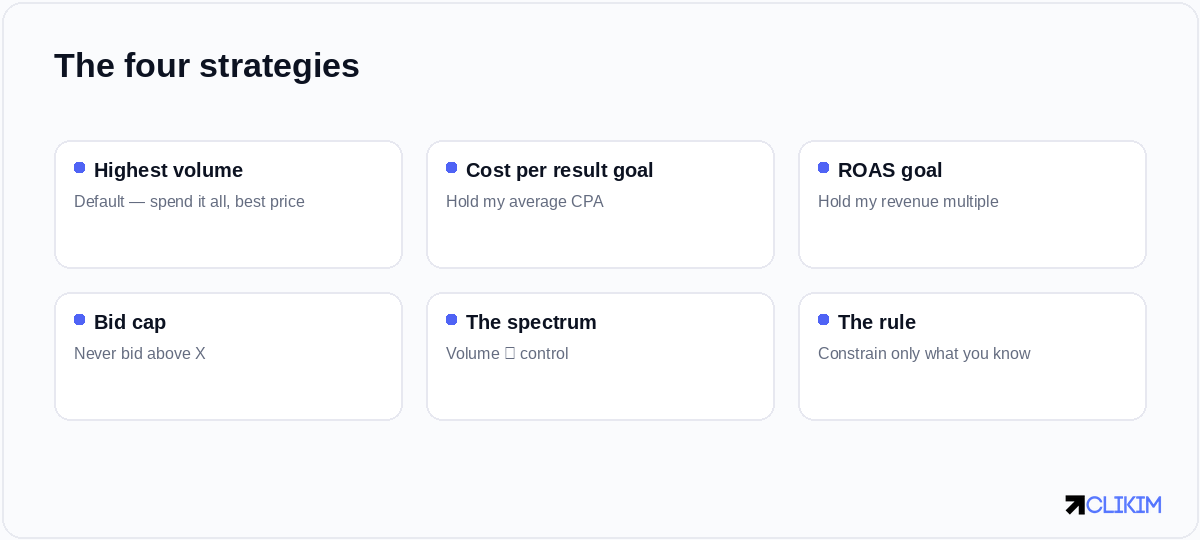
Four strategies, one spectrum: from full delegation to full control — earn each step with data.
Cost per result goal: anchor the CPA
The cost goal instructs the system to hold your average cost per result at or under your number, bidding flexibly per auction to manage that average. It's the workhorse constraint for proven, fixed-value offers — lead gen at a known allowable, subscriptions, single-SKU stores — once you're scaling and predictability starts mattering more than squeezing the last drops of volume.
The operating manual is short: set it from your real 30-day CPA plus 10–20% headroom, judge on 7-day averages (never single days — the system manages a window, and attribution lag distorts daily reads), tune in 10–15% steps, and expect to loosen it as you scale, because marginal conversions cost more than average ones. Set it to the CPA you wish you had, and delivery simply stops — the too-tight death spiral from the cost cap guide.
ROAS goal: anchor the multiple
For ecommerce with real AOV spread, CPA is the wrong thing to anchor — a $28 acquisition is great for a $120 cart and terrible for a $35 one. The ROAS goal fixes the ratio instead: "hold my return at 2.5× or better," letting the system balance cheap small orders and pricier big ones around your multiple. It's the constraint that matches how ecommerce P&Ls actually work, which is why it's the standard scaling constraint for stores.
Same disciplines apply, plus one: your floor comes from your break-even ROAS (1 ÷ margin, per our ROAS guide) with headroom above it — not from a screenshot you saw on Twitter. And because the goal consumes value data, dirty revenue tracking doesn't just blur reporting; it steers bidding. Clean signal is a prerequisite, not a nicety.
Bid cap: the specialist tool
Bid cap is different in kind, not degree. The goals above constrain outcomes averaged over time; bid cap constrains every individual auction entry — the system may never bid above your number, period. There's no averaging to forgive a tight setting, which is why misconfigured bid caps are the fastest way in the platform to buy zero delivery.
Who actually benefits: buyers who model auction economics — arbitrage operations, lead resellers with hard per-lead maximums at the auction level, sophisticated shops steering delivery timing. If you don't know your predicted conversion rates well enough to compute what a bid should be, you don't need bid cap; you need a cost goal. The honest population for this tool is a low single-digit percentage of advertisers, and that's fine.
The constraints, side by side
The two 'goal' strategies manage averages and forgive noise; bid cap constrains every single auction and forgives nothing.
The five failure modes (90% of all bid-strategy pain)
Five failure modes cause ~90% of bid-strategy pain — all preventable, none the algorithm's fault.
Every row traces to the same root: treating constraints as magic instead of trades. The system can hold a number the auction can actually deliver; it cannot conjure cheap results, rescue starved tests, or metabolise daily fiddling. Per the kill-rules discipline: decide settings from data, change them rarely, and judge them on windows.
Two worked examples
Lead-gen at a known allowable. A solar-leads operation sells leads at $55 and needs them under $40 all-in. Ninety days of highest-volume history shows a $34 average CPA on clean tracking. The move: scaling campaigns adopt a cost goal at $38 (real CPA plus ~12% headroom), testing stays unconstrained. Result profile: volume dips ~15% versus unconstrained, but the monthly CPA variance collapses from ±$9 to ±$2 — and the business can finally forecast. That variance collapse, not a lower average, is what the constraint actually bought.
Ecommerce with a $30–$300 catalog. A store with 45% margins computes break-even ROAS at 2.2×. Its scaling ASC and CBO campaigns take a ROAS goal of 2.5× — headroom above break-even, below the 3.1× the account averages in calm months so delivery doesn't choke. In November, when CPMs spike, the team consciously drops the goal to 2.3× to keep volume flowing through peak demand, then restores it in January. The goal moved with the market — which is precisely how a guardrail should behave.
The account-level playbook
Put it together and a clean account runs a two-speed system: an ABO testing campaign on highest volume — unconstrained spend, fair verdicts, fast learning — feeding a scaling layer where proven winners run under the constraint that matches the business: cost goal for fixed-value offers, ROAS goal for varied-cart ecommerce, nothing for pure growth pushes. Constraints live only where knowledge lives.
Quarterly, revisit every constraint against fresh 30-day data: markets move, creative ages, seasons inflate. A goal that was headroom in March is a strangle in November — the Q4 auction alone (per our benchmarks) moves costs 30–60%, and your constraints should move with it.
Strategy sets the price; the account sets the ceiling
Bid strategies decide what you pay per result. What they cannot decide is how much the platform lets you spend at all. A new account pinned at the $250/day cap runs the same strategies in miniature — your perfectly tuned ROAS goal manages a trickle. And every restriction that interrupts delivery discards the bidding history your goals were calibrated against.
Scaled bidding assumes scaled infrastructure: a whitelisted agency ad account with mature trust and no preset ceiling, so the strategy you chose — not the probation you're under — determines what the account delivers.
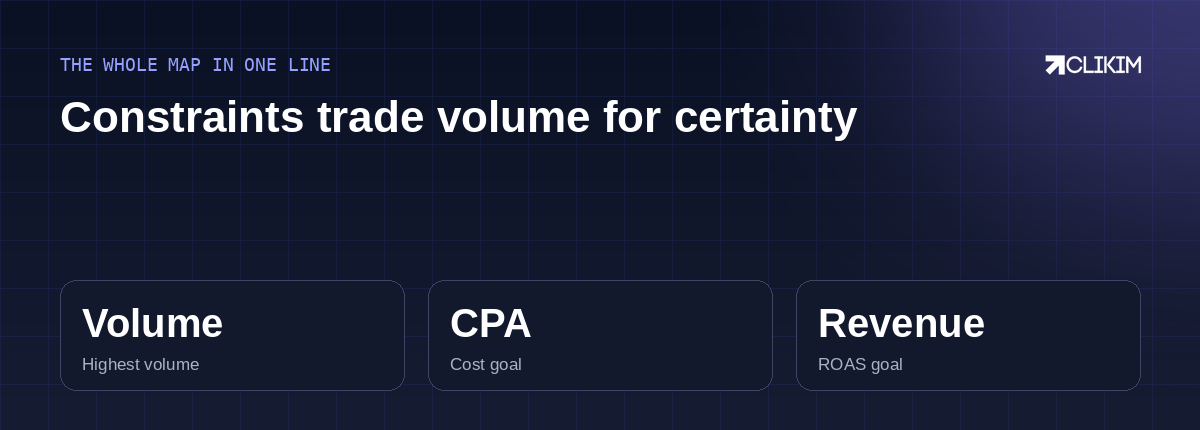
Fix the number you know, float the rest — and constrain nothing you haven't measured.
Frequently asked questions
What are the Facebook bid strategies?+
What is the default Facebook bid strategy?+
What's the difference between cost cap and cost per result goal?+
Should I use ROAS goal or cost per result goal?+
What ROAS goal should I set?+
When should I use bid cap?+
Why did my ads stop delivering after I set a goal?+
Should I use a bid strategy constraint while testing?+
How often should I adjust my bid strategy goals?+
Do bid strategy goals need to change when scaling?+
Does my bid strategy affect the learning phase?+
Does a bid strategy control how much I can spend?+
Pick the constraint — remove the ceiling
Run cost and ROAS goals on managed whitelisted infrastructure with no preset spend cap, so your bid strategy manages price while the account delivers throughput. Operated on BM2500 infrastructure.