
Facebook Custom Audiences: The Complete Guide
Their role changed: broad delivery took over discovery, and custom audiences became surgical instruments — retargeting, exclusions, seeds. Here are the six sources, the windows, the list hygiene that decides match rates, and the dozen-audience library scaled accounts actually keep.
Custom audiences are groups Meta rebuilds from your data — website visitors (pixel+CAPI), customer lists, on-platform engagement, video viewers, app and offline events.
Their 2026 jobs in order: retargeting by recency × intent, exclusions (purchasers-180d out of all prospecting — the half everyone underuses), and seeding lookalikes/value models.
Build three temperature tiers per source, keep a 365-day engagement pool as pixel-loss insurance, refresh customer lists monthly-to-quarterly with full identifier columns, and maintain ~a dozen clean audiences rather than forty rotting ones.
- Custom audiences are people who already touched you — site, list, engagement, app, store.
- Their 2026 jobs, in order: retargeting, exclusions, seeds — prospecting fuel is now the algorithm's job.
- Value = recency × intent: a 7-day cart abandoner outguns a 180-day visitor every time.
- Engagement audiences are pixel-proof — build them as insurance against signal loss.
- Customer lists need hygiene: hashed uploads, fresh exports, matched columns — match rates decide usefulness.
- Exclusions are half the value: never pay to prospect people who already bought.
- Audiences are infrastructure — they compound for whoever maintains a clean library.
What custom audiences are (and what they're for now)
A custom audience is any group Meta can rebuild from your data: people who visited your site, appear on your customer list, engaged with your page or videos, used your app, or bought in your store. They’re the warm layer of the account — and their role has quietly shifted.
In the interest-targeting era they were prospecting fuel; in 2026, with broad delivery handling discovery, custom audiences earn their keep in three narrower, sharper jobs: retargeting known intent, excluding people you shouldn’t pay to reach, and seeding lookalikes and value models.
That reframe matters because it changes what "good" looks like. You're not hoarding audiences anymore — you're maintaining a small, clean library of surgical instruments. This guide walks the sources, the windows, the hygiene, and the library structure that scaled accounts actually keep.
The six sources, and when each earns its place
Six sources, one currency: how recently and how strongly someone signaled intent.
Website audiences are the workhorses — visitors, viewers of specific pages, add-to-carts, checkout-starters — each a rung on the intent ladder, powered by your pixel + Conversions API (and only as complete as that tracking is; a leaky pixel builds leaky audiences).
Customer lists are the asset you fully own: uploaded emails and phone numbers, hashed before they leave your machine, matched against Meta’s users. Their superpower is independence — no pixel required — which makes them the backbone of exclusions and lookalike seeds. Meta’s own documentation on customer list custom audiences covers the formatting details that quietly decide your match rate.
Engagement audiences — page engagers, Instagram interactors, video viewers by watch-time, lead-form openers — are built from on-platform behavior, which makes them pixel-proof: ad blockers and browser privacy can’t touch them. Every account should maintain a 365-day engagement audience as insurance; when browser signal degrades, it’s the warm pool that still works.
Video viewer audiences deserve special mention as the cheapest warm-audience builder on the platform: run inexpensive video reach, then retarget the 50–75% watchers — people who voluntarily gave you thirty seconds are not strangers anymore.
Recency windows: temperature dials
Shorter windows are hotter and smaller — build several and let budget follow temperature.
The window is the intent dial, and the arithmetic from our retargeting guide applies directly: shorter windows are hotter, smaller, and worth more per impression. A practical library builds three tiers per source — hot (1–14d), warm (30d), cooling (90–180d) — and lets budget concentrate on heat. One warning from the delivery clinic: tiny hot windows on low-traffic sites produce audiences too small to deliver; if your 7-day pool is 2,000 people, run the 30-day and segment with creative instead.
Exclusions: the half everyone underuses
Ask what custom audiences are for and everyone says retargeting; almost nobody says the second job that saves just as much money: not showing ads to the wrong people. Recent purchasers excluded from acquisition campaigns. Current customers excluded from cold offers meant for strangers. Converted leads excluded from lead gen. Your own staff excluded from everything. Every one of those impressions was budget spent annoying someone who already said yes.
The standard exclusion stack: a rolling purchasers-180d audience excluded from all prospecting; a converters exclusion per funnel stage (leads excluded from lead campaigns, subscribers from subscription pushes); and where Advantage+ runs the show, its existing-customer list wired in so the automation knows who's already yours. Ten minutes of setup, permanently less waste — and better measurement, since your "prospecting" numbers stop being decorated by loyal customers who'd have bought anyway.
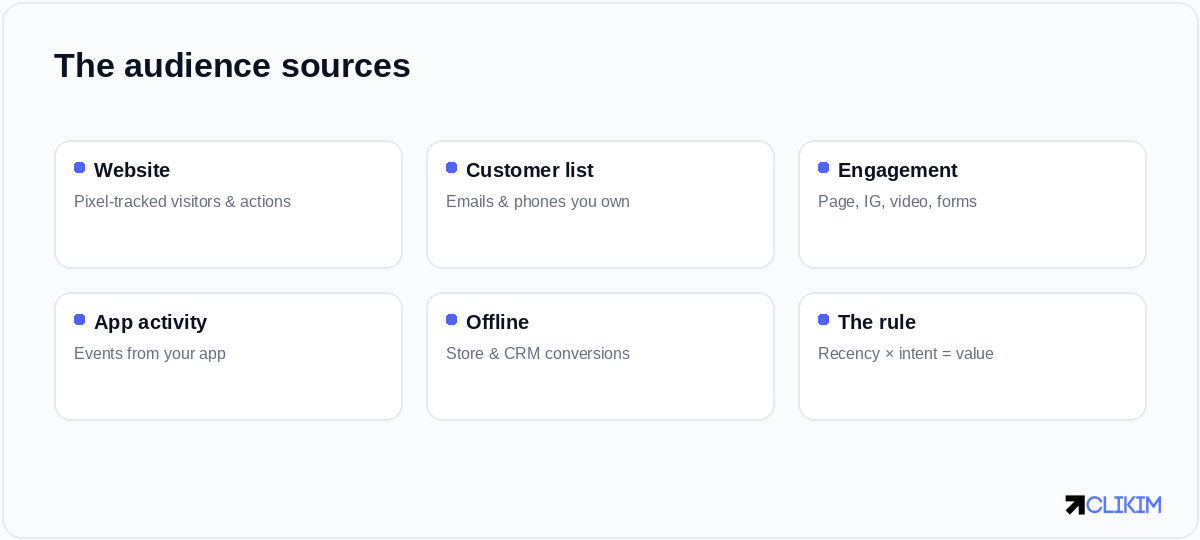
Six sources, three jobs: retarget the warm, exclude the converted, seed the models.
Customer list hygiene (where match rates are won)
A customer list is only as useful as its match rate — the share of rows Meta can connect to real users. The levers are unglamorous:
- Include as many identifier columns as you have — email and phone and name/zip beat email alone.
- Format them the way the uploader expects.
- Refresh the export on a schedule — quarterly minimum, monthly for active stores. A stale list is a portrait of a customer base that no longer exists.
Uploads are hashed client-side before transmission; you’re sharing fingerprints, not the address book, as Meta’s custom audience overview documents.
Two list moves that punch above their weight: a high-LTV segment (top 20–30% of customers by value) as the seed for value-based lookalikes and the model's picture of "good"; and a lapsed-customer segment (no purchase in 6–12 months) as a dedicated win-back audience with its own offer — routinely the cheapest revenue in the account, because these people already trusted you once.
Building the intent ladder on your own site
The default “all website visitors” audience wastes most of what the pixel knows. Your site already sorts people by intent — they just need audiences that respect the sorting. The ladder, bottom to top:
- Blog readers — curiosity: cheap to re-engage, slow to convert.
- Category browsers — shopping mode.
- Product-page viewers — evaluating something specific; capture the product via dynamic retargeting.
- Add-to-carts — decided, then hesitated.
- Checkout-starters — interrupted mid-yes: the most valuable pixels on the internet.
Each rung converts at a multiple of the one below it, and each deserves different pressure: soft proof for browsers, urgency and objection-handling for the top rungs.
Two rungs people forget to build: high-engagement readers (visitors who hit 2+ pages or 60+ seconds — a quality filter that turns junk "all visitors" pools into something worth paying for) and search users (anyone who used your site search — self-declared intent, tiny audience, absurd conversion rates). Ten minutes in the audience builder each; permanent upgrades to the library.
Privacy, consent, and what 2026 actually requires
Custom audiences sit exactly where advertising meets privacy law, and the operating rules have settled into something manageable: have a lawful basis for the data you upload (your customer relationship, your consent flows — not purchased lists, which violate both law and Meta’s terms), disclose retargeting in your privacy policy, and honor opt-outs by refreshing uploads.
Respect that consent-mode gaps mean your website audiences under-represent European traffic. None of this is optional garnish; list-quality complaints and audience rejections increasingly trace to consent shortcuts.
Can I upload a purchased email list as a custom audience?
No — purchased lists violate Meta’s terms and most privacy laws, and their match behavior gets accounts flagged. Custom audiences require data you collected with a lawful basis: your customers, your subscribers, your consent flows.
The strategic consequence cuts the other way too: as browser signal keeps eroding, first-party data becomes the moat. The brands investing in owned capture — email/SMS at every touchpoint, purchase data flowing cleanly to CRM, engagement audiences accumulating on-platform — are building targeting infrastructure that privacy changes strengthen rather than threaten. Custom audiences are where that investment cashes out.
The library a scaled account actually keeps
Not forty audiences — about a dozen, named so anyone can read them: three website tiers (hot/warm/cooling), the purchasers-180d exclusion, the converters exclusions, a 365-day engagement pool, video watchers 50%+, the full customer list plus high-LTV and lapsed segments, and whatever seeds your prospecting still uses.
Review it quarterly with the same discipline as the testing log: delete duplicates, refresh lists, confirm the exclusions are still wired into every live campaign. Audiences rot silently; the review is what keeps the instruments sharp.
Do custom audiences survive an ad account ban?
Largely yes — customer lists live in your CRM, engagement audiences rebuild from your page, and pixel data sits at the business level. The maintained data layer is what makes account recovery fast.
And one structural note from consolidation: resist giving every audience its own ad set. The library exists to serve a few well-fed campaigns — hot retargeting, one warm pool, exclusions everywhere — not to justify fourteen containers that starve each other.
The asset that outlives campaigns
Here's the quiet truth about custom audiences: they're the closest thing to owned infrastructure inside a rented platform. Campaigns die, creative fatigues, algorithms shift — but a maintained library of purchaser lists, engagement pools and intent tiers transfers across all of it. It even survives account trouble: lists live in your CRM, engagement audiences rebuild from your page, and per our ban-recovery guides, the data layer is what makes recovery fast.
The compounding is real and measurable: each quarter of maintained lists, accumulating engagement pools and clean exclusions makes every campaign — including ones you haven't invented yet — start warmer than the last. Competitors can copy an ad in an afternoon; nobody can copy two years of your intent ladder.
What it can't survive is an account that can't spend against it. A warm library on a capped account is a race car in a garage — which is why the operators who invest most in audience infrastructure run it on uncapped, high-trust agency accounts: the asset compounds fastest where the spend can follow it.
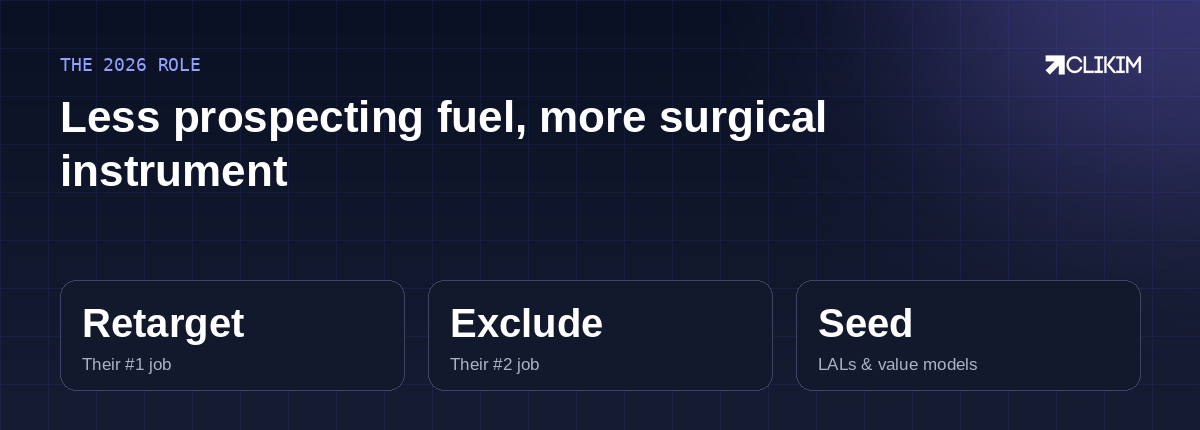
Retarget, exclude, seed — a dozen clean audiences beat forty rotting ones.
iOS 26 and the fbclid — the Safari change shrinking website custom audiences.
Frequently asked questions
What is a Facebook custom audience?+
What are custom audiences best used for in 2026?+
What recency windows should I use?+
How do I improve my customer list match rate?+
Which audiences should I exclude from prospecting?+
What are engagement audiences and why keep them?+
My website custom audiences are too small — what now?+
How many custom audiences should I maintain?+
What are value-based custom audiences?+
How often should I rebuild or refresh my audiences?+
Warm assets deserve full-speed spend
A maintained audience library compounds fastest on an account with no ceiling. Managed whitelisted infrastructure keeps the spend flowing where the intent is. Operated on BM2500 infrastructure.