
Facebook Lookalike Audiences: Do They Still Work in 2026?
The default prospecting audience of an era became a specialist tool — not because it broke, but because broad delivery started doing the same trick continuously. Here's how seeds decide everything, where lookalikes still win, and the head-to-head that settles it.
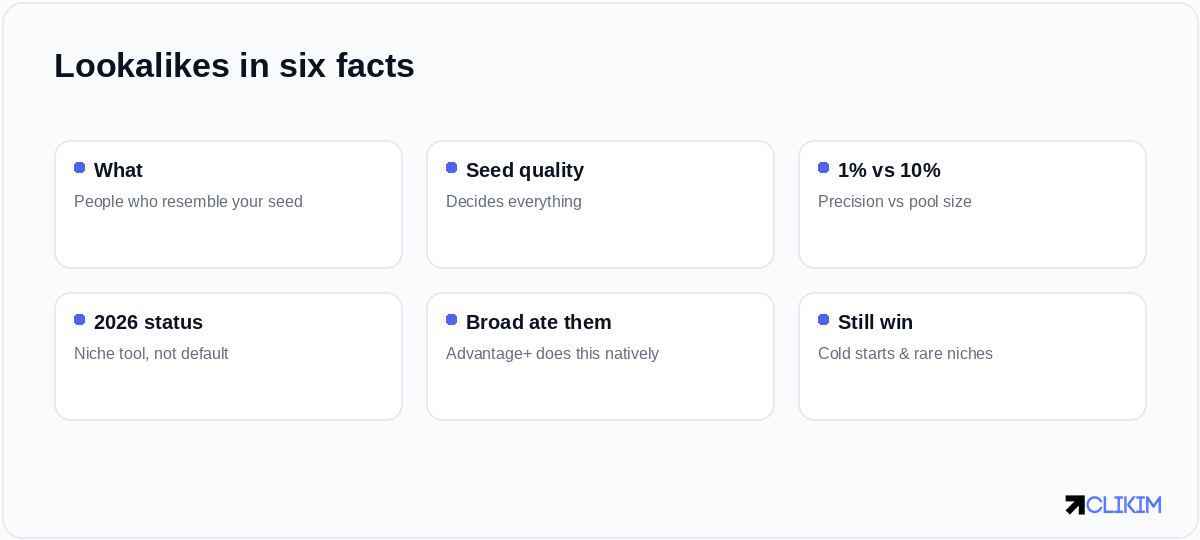
A lookalike clones your seed's statistical profile — so seed quality decides everything: purchasers and high-LTV lists (500–5,000 strong, rolling 90–180d windows) make golden seeds; engagers make junk. The % is a resemblance dial (past ~5% you've rebuilt broad). In 2026, broad + Advantage+ usually wins on established pixels — delivery is a living lookalike machine — but LALs still earn it for cold starts with customer lists, rare niches, geo expansion and value-based whale-hunting. Settle it with an ABO head-to-head.
• A lookalike clones your seed audience's statistical profile — seed quality decides everything. • Best seeds: purchasers and high-LTV lists (500–5,000 strong); engagers and visitors make weak twins. • The % is a resemblance dial: 1% = tightest; past ~5% you've mostly rebuilt broad targeting. • In 2026, broad + Advantage+ usually beats LALs on established pixels — the model builds lookalikes internally. • LALs still win at cold starts, rare niches, geo expansion and value-tier hunting. • Always settle it with a head-to-head: LAL vs broad, same creative, ABO, spend gates. • Refresh seeds quarterly — a lookalike of 2024's customers targets a memory.
What a lookalike actually is
You hand Meta a seed — say, your last 1,000 purchasers — and ask for the 1% of a country's users who most resemble them across the thousands of behavioral dimensions the platform observes. The output is a lookalike audience: strangers with your customers' statistical fingerprint. For half a decade this was the closest thing performance marketing had to magic, and "LAL 1% purchasers" was the default prospecting audience of an era.
That era ended quietly. Not because lookalikes broke — the mechanism works exactly as always — but because the delivery system started doing the same trick continuously and internally. Understanding when the standalone tool still beats the built-in version is the entire 2026 question, and the answer starts with what you feed it.
Seed quality: the whole ballgame
A lookalike is a photocopy of its seed — copy buyers, get buyer-shaped reach; copy scrollers, get scrollers.
A lookalike is a photocopy — it amplifies whatever pattern the seed contains. Seed with purchasers and the twins share purchase-correlated traits; seed with page engagers and you've built an audience of people statistically inclined to like things, wallets not included. Size matters less than density: 500–5,000 genuinely valuable members beats 50,000 lukewarm ones, and below a few hundred the pattern gets noisy. Keep seeds fresh via custom audiences on rolling windows (90–180 day purchasers), because a lookalike of 2024's customers prospects for a business that no longer exists.
The percentage dial
The percentage is a resemblance dial — and past ~5%, you've mostly rebuilt broad targeting with extra steps.
The percentage answers one question: how strict is "resembles"? At 1% you get the tightest twins and the smallest pool; each step wider trades resemblance for reach. The dirty secret of the bigger sizes: by 10% you've included so much of the population that the audience behaves like broad targeting wearing a lanyard. If your winning "lookalike" is a 10%, you've already proven broad works — drop the ceremony.
Seed in, twins out, dial for breadth — and an honest check on whether broad already does it better.
Why broad ate the lookalike's lunch
Here's what changed: modern delivery is a lookalike machine. Given a conversion objective and clean pixel signal, the system continuously models who resembles your converters and steers spend toward them — a rolling, self-updating lookalike rebuilt with every conversion, no manual seed required. A static LAL snapshot competes against that living model and, on established pixels, usually loses: it's the same idea, frozen quarterly instead of updated hourly.
That's the mechanism behind the pattern every tester keeps finding — and behind Meta's own push toward Advantage+ audience and broad defaults. The lookalike didn't get worse; the baseline got better. Which reframes the question from "do LALs work?" to "where does a manual snapshot still beat the living model?"
Where lookalikes still win
The pattern: lookalikes shine where signal must be imported or concentrated — not where the pixel already teaches broad.
The unifying logic: LALs win where signal must be imported or concentrated. A cold-start account with no pixel history but a strong customer list can seed a lookalike and skip weeks of expensive learning — importing offline proof the model can't see. Rare-buyer businesses concentrate scarce signal the broad model would dilute. Geo expansion ports a proven profile into a market where your pixel knows nobody. And value-based lookalikes — seeded from LTV-weighted lists — hunt whales specifically, something count-based optimization won't do unprompted. Outside these zones, run the head-to-head below and let broad earn its keep.
The only argument that matters: the head-to-head
Same structure as every targeting dispute: an ABO test — LAL 1–3% vs broad, identical creative, equal budgets sized for learning, gates honored, verdict on CPA/ROAS after 2–3 weeks. On established consumer pixels, expect broad to win or tie most runs; in the exception zones above, expect the LAL to justify itself. Either way you've replaced a debate with a receipt — and per the testing framework, log it so next quarter's you doesn't re-litigate.
One honest caveat: don't run the test with a weak seed and conclude lookalikes failed. A LAL from 90 mixed-quality buyers loses to broad because the seed lost, not the mechanism.
Two receipts from the field
The cold start that worked. A DTC brand entering Facebook with zero pixel history but 3,800 customers from two years of marketplace sales. Broad-only launch: two weeks of expensive wandering while the model guessed. Parallel LAL 2% from the customer list: profitable in week one, because the seed imported two years of buyer-shaped signal the pixel didn't have. By month three — with real conversion history accumulated — broad caught up and passed it, exactly on schedule. The LAL was scaffolding, and scaffolding that pays for itself is good scaffolding.
The legacy LAL that wouldn't die. An established supplement brand clinging to its historic "LAL 1% purchasers" stack ran the honest head-to-head: broad won by 22% on CPA with identical creative, and the losing ad sets' overlap had been quietly taxing delivery for months. The uncomfortable part wasn't the result — it was discovering the LAL had been losing for a year while nobody re-tested a 2021 conclusion. Receipts expire; re-run them.
The special-ad-category variant
Housing, employment and credit advertisers lose standard lookalikes entirely — replaced by special ad audiences, which mimic the mechanism with the protected-category dimensions stripped out. They're coarser by design but still functional as signal concentrators; the seeds-and-testing logic above applies unchanged. Details in our special ad categories guide.
The 2026 lookalike playbook, compressed
Default: broad + Advantage+ audience, strong creative, clean signal — per the modern structure. Add LALs when: cold-starting with a customer list, hunting rare buyers, expanding geos, or whale-hunting with value-based seeds. Always: purchase-grade seeds (500–5,000, rolling windows), start 1–3%, head-to-head against broad before adopting, refresh quarterly, retire losers without sentiment. Never: engager seeds, stale seeds, or five stacked LAL ad sets fragmenting your signal like it's 2019.
That last habit deserves its own funeral: LAL 1% + 2% + 5% as parallel ad sets is the overlap machine we dismantled in scaling mechanics — one consolidated audience beats three siblings bidding against each other.
The quiet prerequisite
Every path here assumes an account that can afford the test: budget headroom for honest head-to-heads, uninterrupted delivery so seeds and learnings accumulate, and history the model can build on. A capped or repeatedly-restricted account gets neither the living model's benefits (broken signal) nor clean LAL tests (starved cells) — the targeting debate becomes academic when infrastructure keeps resetting the evidence.
A stable agency ad account keeps the signal continuous and the tests affordable — which, in 2026, is worth more than any audience recipe.
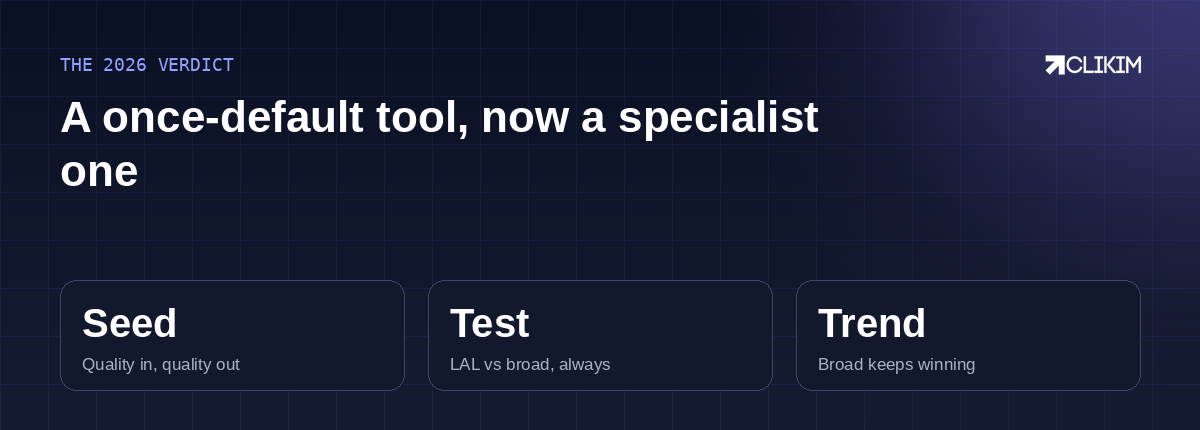
Seed well, dial modestly, test against broad, and let receipts retire the folklore.
iOS 26 and the fbclid — why Safari quietly shrank your retargeting and seed pools.
Frequently asked questions
What is a Facebook lookalike audience?+
Do lookalike audiences still work in 2026?+
What is the best seed for a lookalike audience?+
What lookalike percentage should I use?+
Why does broad targeting beat my lookalikes?+
When are lookalikes clearly the right choice?+
How big should my seed audience be?+
How often should I refresh lookalike seeds?+
Should I run multiple lookalike percentages as separate ad sets?+
What are special ad audiences?+
What are value-based lookalikes?+
How do I test lookalikes against broad properly?+
Test audiences on solid ground
Head-to-heads need budget headroom and unbroken signal. Managed whitelisted infrastructure keeps both intact. Operated on BM2500 infrastructure.