
Facebook Ads Active But Not Delivering? 12 Causes & Fixes
A green 'Active' next to zero impressions isn't a contradiction — Active means eligible, not competitive. Here's the 13-minute diagnostic: five mechanical blockers to clear first, six auction-side causes with their signatures, and the fixes in order.
'Active' only means your ad is eligible — approved and unpaused. Delivery must be won in the auction. Diagnose in two passes: first the mechanical blockers — account spend limit (delivery stops the same hour daily), billing failures, ad schedules, passed end dates, and bid/cost caps set below market (the #1 self-inflicted cause). If those are clean, you're losing auctions: audience too narrow, ad-set overlap, creative fatigue, quality penalties, or a too-rare optimization event (Learning Limited). Fix one thing at a time and give each change 24 hours.
• 'Active' only means eligible — approved and running. Delivery requires winning auctions. • Check the five mechanical blockers first: spend limit, billing, schedule, end date, bid caps. • A cost/bid cap below market is the #1 self-inflicted cause — the ad is fine, the constraint is impossible. • No blockers? You're losing auctions: narrow audiences, overlap, fatigue, or quality penalties. • Learning Limited ad sets deliver poorly forever — consolidate or change the optimization event. • Make one change at a time and give it 24 hours; shotgun edits reset learning and hide the cause. • If delivery halts at the same hour daily, it's your account spend cap, not your ads.
"Active" is not the promise you think it is
The most confusing status in Ads Manager is a green "Active" next to an ad spending nothing. It feels like a contradiction — the platform accepted the ad, so why isn't it running? Because Active only means eligible: the ad passed review and nothing has paused it. Delivery is a separate achievement, earned impression-by-impression in the auction. An eligible ad that loses every auction it enters shows exactly what you're seeing: active, and invisible.
This differs from ads not spending at all (usually account-level: billing, limits, review queues) — here we're diagnosing the quieter failure where some trickle of impressions exists but real delivery never arrives. The good news: the causes sort cleanly into two families — mechanical blockers you can fix in minutes, and auction losses you fix with structure and creative. Work them in order.
Family one: the five mechanical blockers
Check the five mechanical blockers first — they're binary, obvious in settings, and fixed in minutes.
Three of these deserve a paragraph. The account spend limit is the sneakiest: delivery runs normally, then stops at the same time every day when the cap is reached — buyers stare at their creative for weeks before noticing the pattern. New accounts sit near the $250/day trust cap, and campaigns whose combined budgets exceed it simply share the shortage. Bid and cost caps set below what conversions actually cost are the top self-inflicted wound — per our cost cap guide, a cap the auction can't clear doesn't buy cheaper results; it buys nothing. And schedules: dayparting configured months ago quietly strangles a campaign someone else is now debugging.
All five are binary and visible in settings. Clear them before touching anything creative — nothing is more common than rebuilding ads for a campaign whose real problem was a $9 cost cap.
Family two: losing the auction
If the mechanics are clean, your ad is entering auctions and losing them. Meta won't say this directly — there's no "your total value is too low" banner — but the causes are enumerable and each has a signature.
If nothing mechanical blocks you, you're losing auctions — every fix here raises your total value.
Narrow audiences and overlap: starving by design
An audience of 30,000 people sounds targeted; to the delivery system it's a desert. Small pools mean few auctions, tight competition for the same users, and not enough conversion volume to exit the learning phase — the ad set limps at 50 impressions a day forever. Stacked interest filters ("women, 25–34, yoga AND organic food AND premium brands") compound it. The 2026 fix is structural: go broader and let creative do the selecting.
Overlap is the same starvation split across your own ad sets: five audiences sharing 60% of their users divide each other's signal, so all five learn slowly and deliver weakly. The Audiences tool shows overlap directly; the cure is consolidation, per our structure guide — fewer, broader ad sets that each gather enough signal to compete.
Fatigue and quality penalties: the slow strangle
Delivery that was healthy and slid over weeks points at the creative side. Rising frequency means the same users are seeing the same ad again; their engagement drops, the ad's estimated action rate drops with it, and it starts losing auctions it used to win — a decay you experience as "Facebook turned off my reach". The fix is rotation, not bids: fresh creative re-enters the auction with a clean estimate.
Check the quality columns too (quality / engagement / conversion rankings). "Below average" across the board is the auction's quality tax made visible — and ads that collect negative feedback (hides, reports) or smell like engagement bait get throttled regardless of budget. Rebuild the ad; you cannot outbid a quality penalty.
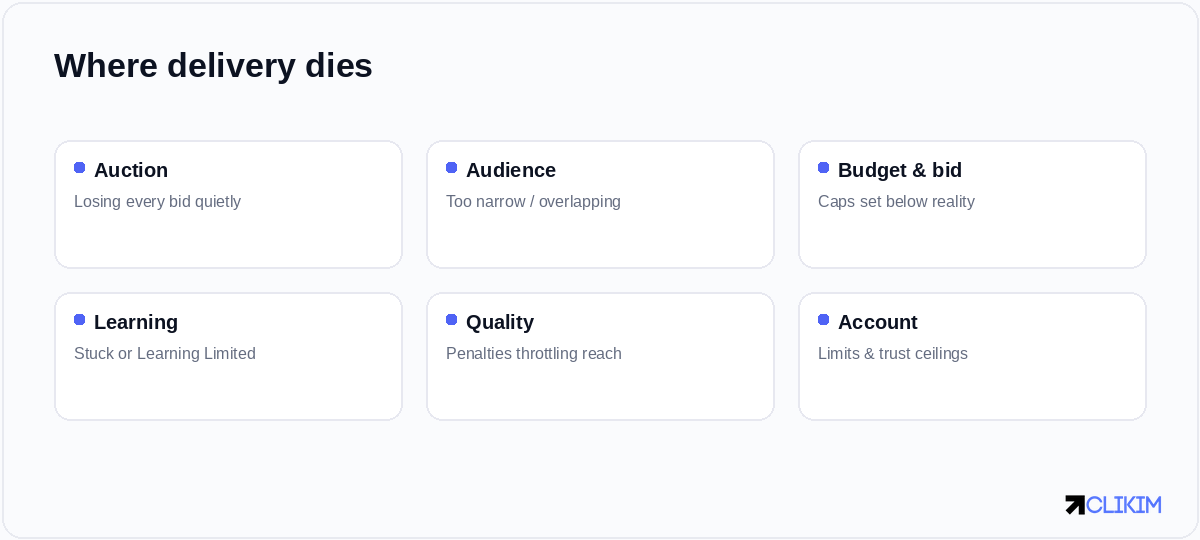
Two families of causes: mechanical blockers you clear in minutes, and auction losses you fix with structure and creative.
Learning Limited: the chronic version
An ad set flagged Learning Limited is the platform telling you it cannot gather ~50 optimization events a week at current settings — and delivery will stay weak until something structural changes. The levers, in order of effectiveness: consolidate ad sets (pool the signal), broaden the audience, raise the budget, or optimize for a more frequent event (add-to-cart instead of purchase) until volume justifies moving down-funnel.
What doesn't work: waiting. Learning Limited is not a phase that passes; it's an equilibrium. Treat it as a design problem, and if your conversion volume is genuinely tiny, fix tracking first — many "low volume" accounts are really undercounting the conversions they already get.
The 13-minute diagnostic order
Thirteen minutes, in this order, finds the cause in nearly every 'active but not delivering' case.
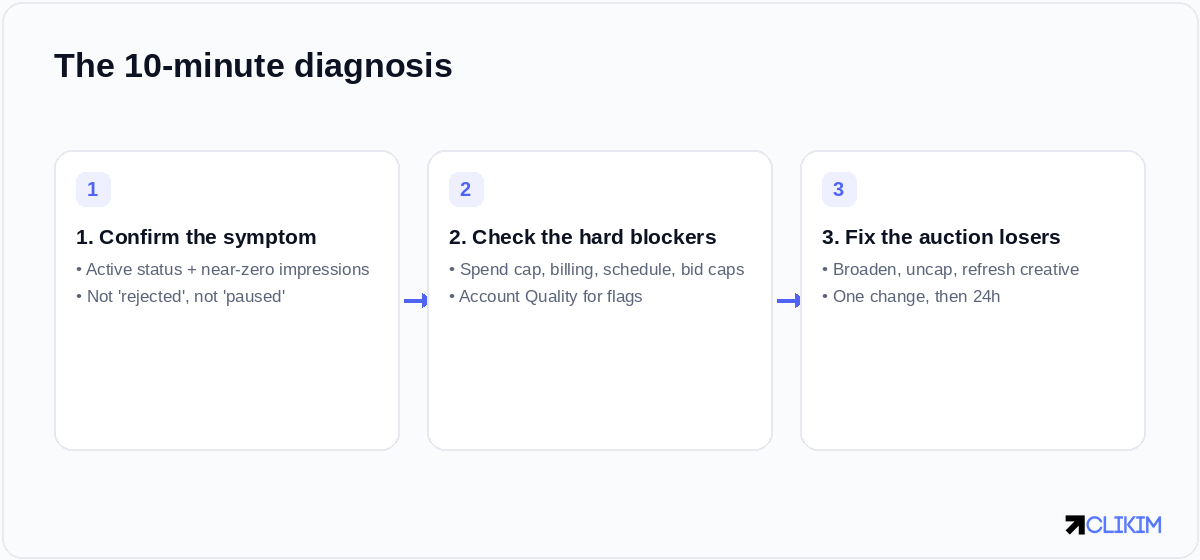
Confirm the symptom, clear the mechanical blockers, then fix the auction losers — one change at a time.
Two rules make the checklist work. One change at a time: shotgun edits (new audience + new budget + new creative in one afternoon) reset learning, blur causality, and usually leave you worse. Change the most likely culprit, wait 24 hours, read the result. And respect the learning cost of edits: every significant change restarts the clock, so batch what must change and then leave it alone.
Three real-world patterns (and their one-line fixes)
The Monday launch that never started. Campaign built Friday, active all weekend, 60 impressions total. Diagnosis order found it in minute four: a bid cap of $8 copied from an old campaign in a market where clicks now clear $2.40 and CPAs run $35. Removed the cap; delivery arrived within the hour. Nothing else was wrong — nothing else had ever been wrong.
The account that "died at lunch". Every day, healthy morning delivery, dead afternoons. The buyer suspected dayparting, then fatigue, then a shadow-ban. It was the spend limit: five campaigns whose combined budgets hit the account's $250 cap by 1pm. The campaigns took turns starving. One infrastructure change — an uncapped account — retired a "delivery bug" three weeks of creative changes hadn't touched.
The retargeting set stuck in Learning Limited for a month. A 14-day website audience of 9,000 people, optimized for purchases. No setting was wrong — the pool was simply too small to generate 50 purchases a week. Widening to 180 days and merging with engagers tripled the pool; the flag cleared in five days. Learning Limited is arithmetic, not misfortune.
Preventing the next one
Accounts that rarely hit delivery mysteries share habits: broad, consolidated audiences that clear learning fast; a creative pipeline that rotates before fatigue (weekly review of frequency and hook rate per our optimization routine); caps used surgically and reviewed monthly; and billing/limits checked as part of setup, not as archaeology during a crisis. Delivery problems are usually structure problems wearing a disguise.
The deeper prevention is signal quality: clean CAPI tracking and sensible optimization events keep the machine's estimates confident, and confident estimates keep you winning auctions at sane prices even when competition moves.
When it's the account, not the ads
Sometimes every checklist item passes and delivery still crawls — same-hour daily stops, chronic Learning Limited despite sane structure, CPMs far above vertical benchmarks with solid creative. That pattern points above the campaign layer: a low-trust account operating with conservative delivery, tight caps, and a handicap in every auction it enters. Check Account Quality for flags, but know that new-account probation itself throttles you with no flag at all.
That's the case for infrastructure: a whitelisted agency ad account starts with mature trust, no preset spend ceiling, and stable delivery — so when your ads are active, they're actually competing, and your diagnostics measure your marketing instead of your probation.
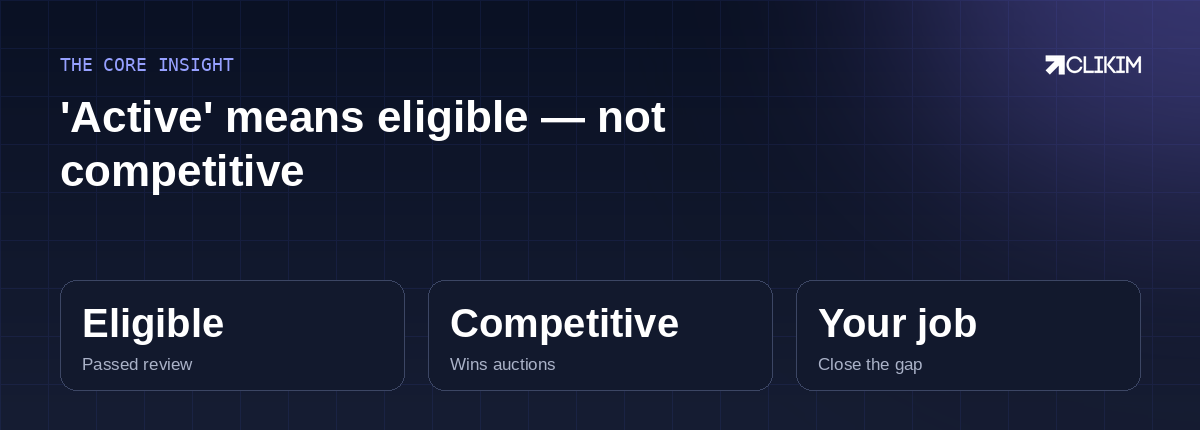
Eligible is free; competitive is earned — in the auction, or through the account you run on.
Frequently asked questions
Why are my Facebook ads active but not delivering?+
Why do my ads stop delivering at the same time every day?+
Can a cost cap stop my ads from delivering?+
How small is too small for a Facebook audience?+
What is audience overlap and why does it kill delivery?+
What does Learning Limited mean?+
Do quality rankings affect delivery?+
Why did delivery decline after weeks of running fine?+
Should I delete and relaunch a non-delivering ad set?+
How long should I wait after making a fix?+
Could weak delivery be my account rather than my ads?+
Ads not spending at ALL — same problem?+
Active should mean actually delivering
Run on managed whitelisted infrastructure with mature trust and no preset spend cap — so your ads compete in every auction instead of queueing behind a probation ceiling. Operated on BM2500 infrastructure.