
Broad vs Interest Targeting: What Wins in 2026?
The interest-stacking era built careers — and then quietly ended. Here's why the playbook flipped, what broad targeting actually does under the hood, the two honest exceptions where interests still win, and the three-week test that settles it for your account.
For most advertisers in 2026, broad targeting beats interest stacking: Meta's models predict buyers from conversion signal better than human-picked menus, while narrow audiences pay a scarcity tax — higher CPMs, slower learning, faster fatigue. On broad delivery, creative does the targeting: the hook selects who stops. Interests keep two honest jobs — bootstrapping brand-new pixels and concentrating genuinely rare niches. Prerequisites for broad: clean CAPI signal, a portfolio of sharp creative, and budgets that reach ~50 events/week. Then settle it with a head-to-head ABO test.
• In 2026, broad targeting beats interest stacking for most advertisers — Meta's models predict buyers better than menus. • Narrow targeting now pays a scarcity tax: higher CPMs, slower learning, faster fatigue. • On broad delivery, creative is the targeting — the hook selects who stops. • Interests still earn keep in two cases: bootstrapping brand-new pixels, and genuinely rare niches. • Advantage+ audience treats your inputs as suggestions, not fences — the platform's own direction. • Migrate by testing, not faith: broad vs your best stack, same creative, equal ABO budgets, 2–3 weeks. • Broad needs fuel: clean signal (CAPI) and creative volume are prerequisites, not extras.
The playbook flipped — here's why
For years, skill in Facebook advertising meant skill in the targeting menus: stacking interests, layering behaviors, slicing demographics until the audience felt "precise". That era produced real wins — and then quietly ended. Today the same moves mostly buy you higher CPMs, ad sets stuck in learning, and audiences that fatigue in a fortnight, while the boring setup — age floor, country, nothing else — outperforms.
The flip wasn't fashion — the machine's predictions outgrew the accuracy of human-picked interest menus.
Three forces drove the flip. Meta's prediction models got good enough to find likely buyers from conversion signal alone — your pixel history teaches the machine who converts far more precisely than "interested in: fitness" ever did. Privacy changes thinned the behavioral data behind interest labels, making the menus blunter exactly as the models sharpened. And the auction reprices the trade: narrow pools mean fewer auctions and scarcer supply — a structural tax that broad pools don't pay.
What "broad" actually does
Broad targeting doesn't mean showing your ad to everyone — it means letting the delivery system choose who from a maximal pool. Given a conversion objective and honest signal, the system spends its budget probing, finds responsive pockets, and concentrates delivery there — effectively building a bespoke, self-updating audience around your actual buyers. The targeting still happens; it just happens in the model instead of the menu.
The catch: the system optimizes toward whoever responds to the creative you gave it. A vague, everyone-ish ad on broad targeting finds vague, everyone-ish clickers. A sharp ad that opens "if your ad account keeps getting banned…" recruits exactly the afflicted — the ad is the interest filter now. This is why our creative playbook insists creative is the targeting: on broad, your hook does the job the interest menu used to pretend to do.
The scarcity tax on narrow audiences
Run the same creative to a 400k interest stack and a 20-million broad pool and the mechanics diverge immediately. The narrow set competes for scarce impressions (CPM premium), gathers conversion events slowly (hello, Learning Limited), recycles its audience fast (hello, fatigue), and hands the model a cramped space to optimize in. The broad set pays less per impression, learns faster, fatigues slower, and gives the optimizer room to work.
Stack several narrow ad sets side by side and you add the self-inflicted version: overlap, where your own audiences share users and split each other's signal — the delivery-killer we cover in active-but-not-delivering. Consolidation isn't tidiness; it's arithmetic.
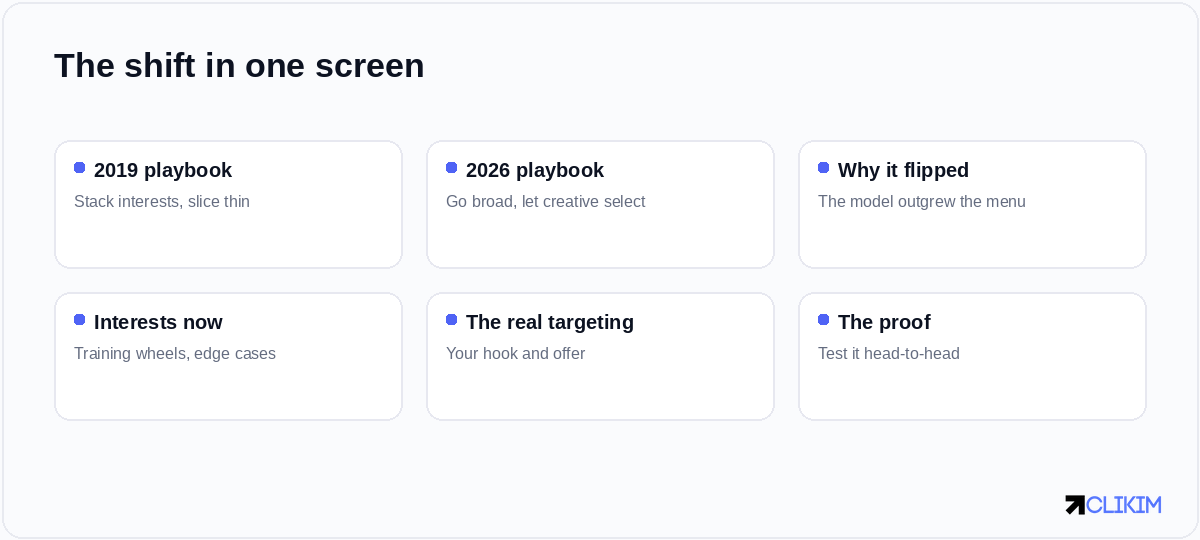
The menus lost to the model: broad + sharp creative is the 2026 default, with two honest exceptions.
Where interests still earn their keep
Broad is the default; interests survive as a bootstrapping tool and a niche-hunting tool — not a strategy.
The two live exceptions deserve honesty. Cold-start pixels: a brand-new account with zero conversion history gives the model nothing to predict from; a sensible interest audience for the first few dozen conversions acts as training wheels — then comes off. Genuinely rare buyers: if your customer is one person in ten thousand (niche B2B, specialized professions), a broad pool can drown the signal; interests, lookalikes from a strong seed, or list-based audiences concentrate it. Note what's not on the list: "my product is for a specific type of person." Almost every consumer product believes that, and the model finds those people anyway.
Advantage+ audience: the platform's own vote
Meta's direction of travel is written into the interface: Advantage+ audience treats any interests and demographics you enter as suggestions — starting points the system may expand past whenever it predicts results outside your fence. And Advantage+ shopping skips the menus entirely. You can still force hard constraints, but you're increasingly opting out of the default rather than into an option. When the platform's own money-making machinery bets on breadth, the burden of proof sits on the fence-builders.
Practical stance: give Advantage+ audience your best 2–3 suggestions where offered, keep genuine exclusions (existing customers, per retargeting hygiene), and let the expansion do its work.
Don't believe anyone — run the test
Don't take anyone's word for it — including ours. The head-to-head takes two ad sets and three weeks.
The migration argument settles itself in one ABO test: your best interest stack versus plain broad, identical creative, equal budgets sized so each can reach ~50 weekly events, verdict on CPA/ROAS after 2–3 weeks. Most accounts watch broad pull ahead by week two — and the ones where interests genuinely win have learned something real about their niche instead of inheriting a habit. Judge by kill-rule discipline, not day-three vibes.
Migrating a legacy account without breaking it
If your account is a museum of interest stacks that still produce, don't torch it — migrate it. Week one: consolidate the overlapping stacks into two or three merged ad sets, keeping the proven creative untouched; this alone usually improves learning. Week two: launch broad alongside — same creative, equal budget, the head-to-head above running in production. Weeks three and four: shift budget toward the winner in 20–30% steps as the evidence lands, letting the losing structure wind down rather than executing it.
Two guardrails: never migrate everything in one dramatic weekend (you'll reset all learning simultaneously and blame broad for the chaos), and keep any interest ad set that genuinely keeps winning its head-to-head — the goal is performance, not ideological purity. Most accounts finish the migration in a month with CPA improving before it's even complete.
What "creative does the targeting" means in practice
Concretely: on broad delivery, the first two seconds of your ad perform the audience selection that checkboxes used to approximate. "POV: your third ad account ban this month" recruits banned advertisers from a pool of millions — no interest called "recently banned from Meta" exists, yet the hook finds them, because the people who stop and watch teach the model who to find next. Each distinct angle in your portfolio recruits a different pocket: the price-led hook finds bargain hunters, the durability demo finds researchers, the founder story finds brand-buyers.
This is why broad accounts want a small portfolio of genuinely different angles rather than five re-colorings of one concept — every new angle is, functionally, a new audience. Targeting didn't die; it moved into the brief.
Broad's prerequisites (skip these and it "doesn't work")
Broad targeting fails predictably when its inputs are missing. Signal: the model optimizes on the conversions it can see — an account without pixel + Conversions API feeding clean purchase events is asking the machine to aim blind. Creative that selects: one generic ad gives the model nothing to route with; a small portfolio of sharp angles (per the UGC playbook) gives it hooks for different buyer pockets. Budget adequacy: broad works through learning volume — an ad set funded below the events threshold underperforms on any targeting.
Most "we tried broad and it flopped" stories are missing one of the three. Fix the prerequisite, rerun the test, and the verdict usually flips.
Breadth needs headroom
A quiet dependency: broad strategies reward accounts that can actually fund them. Probing a 20-million pool to find your buyers takes learning spend that a $250/day-capped account struggles to afford next to its existing campaigns — which is exactly how capped buyers get pushed back into narrow "efficient" audiences and their scarcity taxes. The targeting strategy and the infrastructure are one decision wearing two hats.
An uncapped agency ad account makes the broad-first playbook affordable: room to learn, room to scale the pockets the model finds, and no forced retreat into the stacks you just escaped.
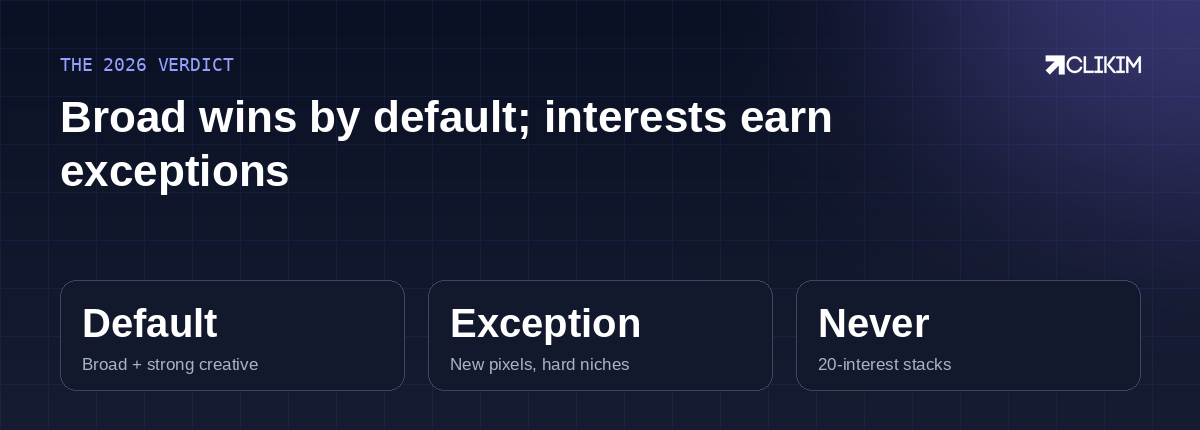
Menus lost, models won — give the machine signal, creative and room, and let it do the targeting.
Frequently asked questions
Is broad targeting better than interest targeting in 2026?+
What does broad targeting mean on Facebook?+
Why did interest targeting stop working as well?+
How does Facebook know who to show my ads to on broad?+
When should I still use interest targeting?+
What is Advantage+ audience?+
Does broad targeting work for small budgets?+
Why are my broad campaigns not working?+
How do I test broad vs interests properly?+
Does broad targeting increase ad fatigue?+
Should I still use exclusions with broad targeting?+
Do interests matter in special ad categories?+
Go broad with the fuel to learn
Broad-first strategies need learning spend and scaling headroom. Run them on managed whitelisted infrastructure with no preset cap. Operated on BM2500 infrastructure.