
Cost Caps or Lowest Cost? When Capping Actually Pays
A cost cap isn't a discount button — it's a trade: your average CPA gets anchored, and volume floats. Here's what caps actually do, when they beat the default, how to set your first one from real data, and the too-tight death spiral that sours everyone on them.
Lowest cost spends your budget at the best available price — CPA floats, volume is maximised. Cost cap anchors your average CPA — volume floats instead. Caps pay off on proven offers with stable, honestly-tracked economics, especially at scale or in volatile auctions; they hurt during testing and learning, where they starve spend and signal. Set your first cap 10–20% above your real 30-day CPA, judge on weekly averages, tune in 10–15% moves, and loosen the cap as you scale.
• Lowest cost spends your budget at the best available price — CPA floats. Cost cap anchors your average CPA — volume floats. • Caps are a guardrail for known economics, not a discount button — they can't force cheap results into existence. • Test and learn on lowest cost; cap once you know your real CPA and need it held. • Set your first cap ~10–20% above your 30-day average CPA, then tighten gradually. • A cap that's too tight doesn't 'save money' — it stops delivery. • Judge caps on weekly averages, not single days — the system optimizes an average, not each result. • Caps need clean data: fix tracking before trusting any number you cap against.
What cost cap actually does
Every Facebook campaign runs on a bid strategy, and most run the default: lowest cost ("highest volume"), which tells Meta to spend your budget getting the most results at the best price available — whatever that price turns out to be. Cost cap changes the instruction: get me results, but keep my average cost per result at or under this number. Meta then bids dynamically, paying more for some conversions and less for others, managing to your average.
Two words in that sentence do all the work: average, and available. A cap manages your average CPA — individual results will land above and below it. And it can only buy what the auction actually offers: if conversions genuinely cost $50 in your market, a $25 cap doesn't negotiate them down to $25. It just stops buying. Understanding those two facts prevents nearly every cost-cap disaster.
Lowest cost buys volume and lets price float; cost cap buys price and lets volume float. Pick which side you need fixed.
The real trade: efficiency vs volume
Cost cap is not "lowest cost but cheaper". It's a different deal. With lowest cost, volume is fixed (your budget spends) and price floats. With a cap, price is fixed (your average holds) and volume floats — some days the auction clears your cap and you get plenty; some days it doesn't and delivery quietly shrinks. You are choosing which variable you need to control, and surrendering the other.
That's why the "should I cap?" question is really a business question: what hurts you more — a week of expensive conversions, or a week of missing volume? A cash-tight store at break-even wants the CPA anchored and accepts lumpy delivery. A brand racing for market share wants every conversion available and accepts CPA noise. Neither is wrong; they're different priorities, and the bid strategy should match yours.
When lowest cost is the right call
Testing and learning. New creative, new audiences, fresh pixels, and anything in the learning phase all need one thing: spend that generates signal. A cap throttles exactly that spend at exactly the wrong time — ad sets that can't deliver can't learn, and tests that can't spend can't conclude. Run discovery on lowest cost, judge it with the ABO testing structure, and keep caps away from experiments.
Small budgets. Under roughly $50/day there isn't enough volume for the averaging math to work — a cap needs a stream of auctions to manage an average across. And growth pushes: when the goal is maximum new customers this quarter and the economics have slack, lowest cost simply buys more. The default is the default for a reason; most accounts should live there most of the time.
When cost caps genuinely pay
Known unit economics at scale. You've run the offer for months, your 30-day CPA is stable, you know your break-even from our ROAS math — and you're pushing spend into ranges where auction noise gets expensive. A cap turns "hope the CPA holds" into "the CPA holds, volume varies", which is usually the right risk to hold at scale.
Hard guardrails. Client mandates ("never above $40 a lead"), thin-margin products, finance teams that need predictable acquisition costs — a cap encodes the rule into delivery itself instead of relying on a human noticing overspend on Tuesday. And volatile auctions: during Q4, when CPMs spike, a slightly loose cap acts as insurance against paying panic prices while everyone else bids emotionally.
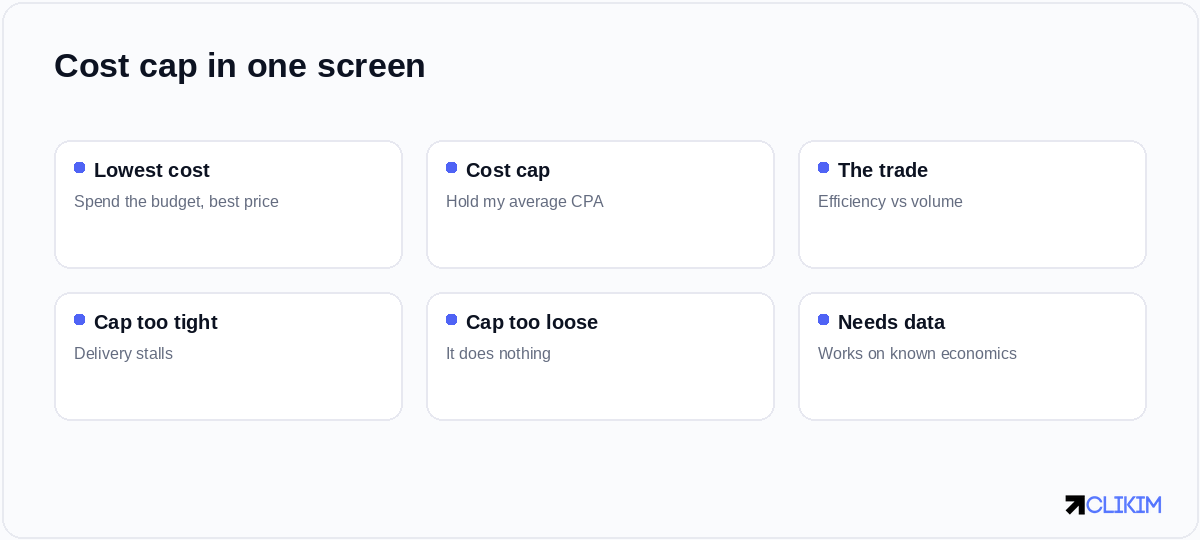
Lowest cost fixes volume and floats price; a cap fixes price and floats volume. Choose which you need held.
Setting your first cap (the 10–20% rule)
The classic mistake is capping at the CPA you want. The auction doesn't care what you want; it cares what conversions cost. Start from your actual 30-day average CPA — from clean data, which means pixel + Conversions API, because undercounted conversions inflate your apparent CPA and you'll cap against a lie.
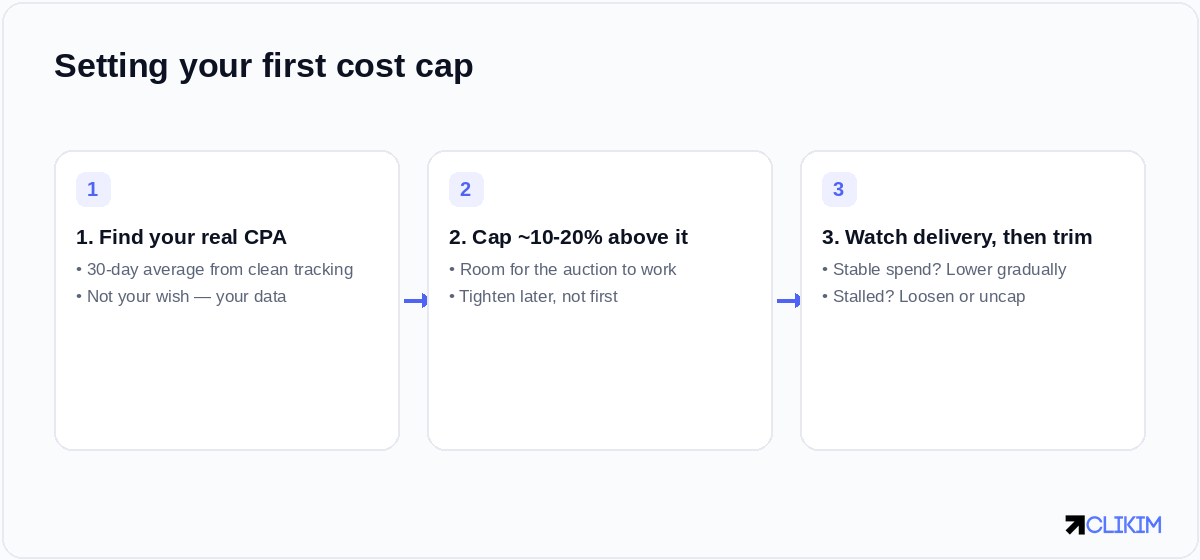
Anchor on your real 30-day CPA, cap 10–20% above it, then tighten gradually while delivery stays healthy.
Set the first cap 10–20% above that average. Yes, above. The headroom lets delivery keep flowing while the system learns to manage your average — you can tighten a working cap next week, but a strangled campaign gives you nothing to tune. From there it's a dial: trim 10–15%, watch delivery for several days, repeat until you find the tension point between your economics and the auction's reality.
The "cap too tight" death spiral
Here's the failure mode that sours most buyers on caps: set $25 on a $45 market, delivery stalls, spend drops to pennies — and it feels like Facebook is punishing you. It isn't. The system simply found no auctions it could win within your constraint, so it bought nothing. No spend, no learning, no data, and the ad set drifts toward Learning Limited. The campaign isn't broken; the instruction is impossible.
The tell is unmistakable: healthy on lowest cost, dead the moment you cap. The fix is equally simple — raise the cap into contact with reality, or uncap and address the actual problem, which is usually that your creative or offer can't buy conversions at the price you need. A cap exposes uncompetitive economics; it can't fix them.
Judging a capped campaign properly
Caps manage an average over time, so judge them on windows, not days. A Tuesday at $38 against a $32 cap is not a crisis — it's the system paying up for conversions it expects to balance with cheaper ones. Look at 7-day blended CPA against the cap, alongside the volume you're getting. Those two numbers together are the whole story: average held, volume acceptable → working; average held, volume starved → cap too tight for your growth goal; average drifting above → attribution lag or a cap the auction is fighting.
Remember attribution timing too: conversions report on the click date, so a capped campaign can look over-cap mid-week and settle under it as delayed conversions land. React on the weekly read, not the daily flinch.
Tuning a cap is a dial, not a switch: move 10-15% at a time and let delivery answer before the next move.
Caps and scaling: friends, with one warning
Caps genuinely shine when scaling proven winners — inside a CBO scaling campaign, a sane cap lets you push budget hard while the strategy holds your average, which is exactly the predictability you want at high spend. Raise budgets in the usual 20–30% steps and let the cap absorb the auction noise.
The warning: as you scale, you exhaust the cheapest conversions first. The marginal customer costs more than the average one, so a cap tuned for $10k/month may quietly strangle delivery at $50k/month. Scaling with caps means periodically loosening them as volume grows — treating the cap as a moving guardrail, not a fixed vow. Buyers who forget this conclude "caps don't scale"; really, their cap didn't move.
Bid cap and ROAS goal, briefly
Two siblings complete the family. Bid cap limits the bid itself, not your average cost — a precision tool for buyers who model auction values, and overkill for nearly everyone else. ROAS goal (minimum return on ad spend) is cost cap's ecommerce cousin: instead of holding a CPA, it holds a revenue multiple, useful when order values vary widely. The full map lives in our bid strategies guide, but the logic transfers: every constraint trades volume for control, and every constraint needs clean data underneath it.
If you're choosing between them: CPA-led businesses (leads, fixed-price offers) cap costs; AOV-varied ecommerce holds ROAS; and almost nobody needs bid cap. Start there.
The decision, compressed
Run lowest cost when: testing anything, learning phase, small budgets, growth-first goals, or your CPA history is too noisy to trust. Run cost cap when: the offer is proven, your 30-day CPA is stable and honestly tracked, you're scaling into volatile auctions, or someone downstream needs costs predictable. Set caps 10–20% above reality, tune in 10–15% moves on weekly reads, and loosen as you scale.
And keep the two jobs in separate campaigns — uncapped discovery feeding capped exploitation mirrors the test-in-ABO, scale-in-CBO split, because it's the same principle: freedom while you learn, constraints once you know.
One more constraint the cap can't manage
A cost cap controls what you pay per result; it does nothing about how much the account lets you spend. On a fresh account throttled near the $250/day limit, your carefully tuned cap is managing a trickle — and every restriction that interrupts delivery resets the learning your capped campaigns accumulated.
Buyers running caps seriously are usually the same buyers with real unit economics and real volume — exactly who benefits from a whitelisted agency ad account with no preset cap: the bid strategy manages price, the infrastructure guarantees throughput, and neither undermines the other.

Caps buy predictability and pay for it with volume — the right trade once your numbers are real.
Frequently asked questions
What is cost cap bidding on Facebook?+
What's the difference between cost cap and lowest cost?+
When should I use cost cap instead of lowest cost?+
How do I set my first cost cap?+
Why is my cost cap campaign not spending?+
Does cost cap make my ads cheaper?+
Should I use cost cap while testing?+
Why is my CPA above my cost cap?+
Do cost caps work with CBO?+
How do cost caps behave when scaling?+
What about bid cap and ROAS goal?+
Does a cost cap control how much I can spend?+
Hold your CPA — without capping your growth
Run capped, predictable campaigns on managed whitelisted infrastructure with no preset spend limit, so the guardrail is on the price, not the throughput. Operated on BM2500 infrastructure.