
The Facebook Ad Testing Framework That Actually Finds Winners
Sporadic testing teaches nothing — it just spends like it does. Here's the engine: what to test in leverage order, the fair-fight ABO design, spend-gated verdicts, graduation into scaling, and the log that turns 52 rounds a year into a moat.
Test in leverage order: angles (3–10× swings) before formats before hooks before copy — never cosmetics. Run every round in a dedicated ABO campaign: 3–5 cells, equal budgets sized to reach a 1–3× target-CPA spend gate, identical broad audiences, one variable, no mid-test edits. Verdicts follow the kill rules (gate → funnel read → kill/iterate/keep); winners graduate to the scaling CBO and become testbeds for hook iterations. Log every round — the accumulated verdicts are the real moat.
• Test angles before hooks before copy — leverage order, not curiosity order. • Run tests in a dedicated ABO campaign: 3–5 cells, equal budgets, identical broad audience. • One variable per test. Two changes = zero learnings, whatever the result. • Judge at spend gates (1–3× target CPA), past learning, on 48–72h minimum — then verdict. • Graduate winners into scaling CBO; give partial winners surgery, not funerals. • Keep a testing log — 52 compounding rounds a year is the moat competitors can't copy. • Volume matters: the framework is an engine, and creative supply is its fuel.
Why you need a framework, not a habit
Most accounts "test" the way most people diet: sporadically, emotionally, and with creative accounting about the results. A new ad goes live next to old ones in a CBO, gets whatever budget the algorithm feels like giving it, gets judged in thirty-six hours against incumbents with months of learning, and dies — teaching nobody anything. Multiply by a year and the account has spent a fortune on tests while accumulating zero transferable knowledge.
A framework replaces that with an engine: a fixed structure where every idea gets a fair fight, every round produces a logged verdict, and every verdict sharpens the next brief. The compounding is the point — an account running 40–50 disciplined rounds a year builds an angle-and-hook playbook competitors literally cannot copy, because it's derived from your buyers, not from anyone's best-practices post. Including this one.
What to test, in leverage order
Test in order of leverage: a new angle can 5× results; a new button color can't — most accounts test backwards.
The hierarchy exists because variables differ wildly in blast radius. An angle — the core promise ("stop getting banned" vs "scale past $250/day" vs "0% top-up fees") — can move results several-fold, because different angles recruit different buyer pockets entirely. A hook swaps who stops scrolling; per our creative playbook it's the highest-frequency test because iterations are nearly free. Cosmetics sit at the bottom: nobody's purchase decision hinges on your border radius, yet accounts burn whole rounds on them because they're easy to produce.
Rule of thumb: never test downstream of an unvalidated upstream. Polishing copy on an angle nobody wants is optimizing the deck chairs; find the angle that moves people first, then descend the hierarchy while it keeps paying.
The test design (boring on purpose)
The design is boring on purpose — every clever shortcut reintroduces the bias the framework exists to remove.
The design enforces one thing: fairness. The ABO structure guarantees each cell its budget — inside CBO, an early leader starves the rest and the "test" measures luck. Identical broad audiences isolate creative as the only variable. And the no-touching rule exists because every mid-test edit resets learning and voids the round; if you spot a typo, fix it and restart the cell's clock honestly.
Budget sizing is where most frameworks quietly die. Each cell must be able to reach its spend gate — 1–3× target CPA — within the round. Five cells at a $30 CPA target means roughly $450–900 of honest testing budget per round; if that's not affordable, run three cells, not five underfunded ones. An underfunded test isn't a cheaper test; it's an expensive coin-flip.
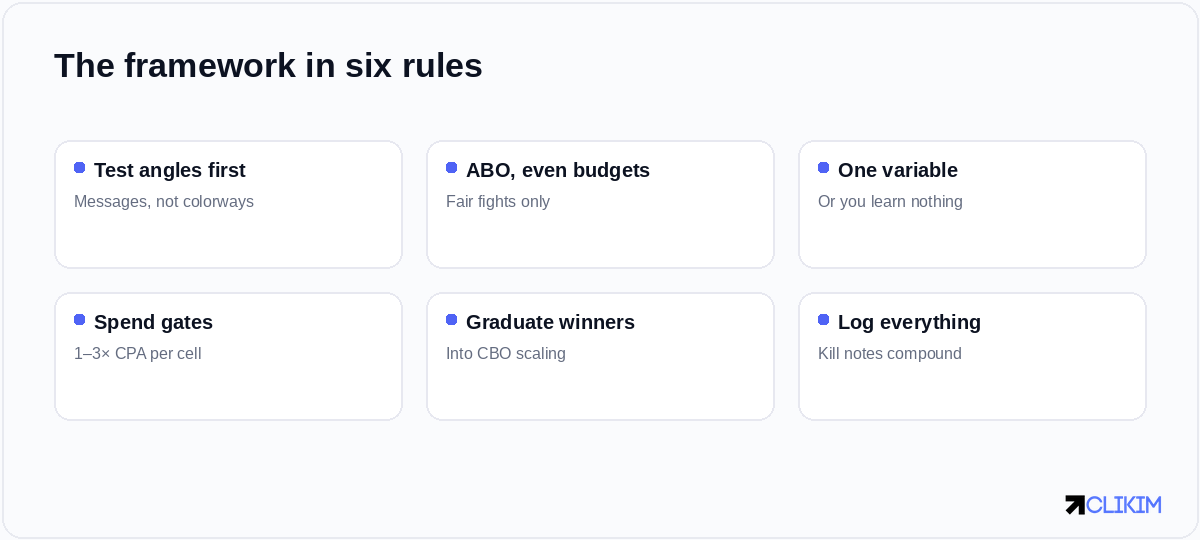
Six rules that remove the bias: leverage order, fair fights, single variables, gates, graduation, and the log.
Reading the round
Every round ends in a logged verdict — even flat rounds teach the next brief what not to repeat.
Verdicts follow the kill-rules discipline: gates first, funnel read second (hook rate → CTR → CVR), then one of three outcomes per cell. The table adds round-level reads: a flat round where everything performs identically usually means your "different angles" were the same idea in different shirts — diverge harder. And a challenger that beats the control by single digits isn't a new champion; switching costs (learning resets, creative production) eat margins that thin.
Graduation: from test to scale
Winners don't scale inside the testing campaign — testing budgets and structures are built for verdicts, not throughput. Graduate the proven ad into your scaling CBO (or Advantage+ stack), expect a fresh learning phase there, and resist judging it against its testing numbers for the first week — different campaign, different delivery context.
Then close the loop: the winner immediately becomes the control for hook iterations. A validated angle typically supports 3–6 hook variants before exhausting, each a cheap test cell, each extending the winner's lifespan against fatigue. This winner-becomes-testbed cycle is where the framework pays compound interest: you're never testing from zero again.
A full round, hour by hour
Monday 9am: brief goes out — the log says pain-led angles have won three straight rounds, so this round tests three new pain territories (wasted spend, ban anxiety, agency churn) against the reigning control. Wednesday: four cells live in the testing ABO at $35/day each, broad audience, gates pre-written: $70 or 72 hours. Thursday's temptation: cell two looks dead at $38 spent — nobody touches it; gates are gates. Saturday: gates cleared. Cell two finished strongest ($26 CPA vs $31 target) after its slow start — the exact winner impatience would have executed on Thursday.
Sunday: verdicts logged in six minutes — one graduate, one hook-worthy partial (great hold rate, weak CTA), two clean kills with causes noted. The graduate enters the scaling CBO Monday; the partial gets two new CTAs in next week's round. Total cost: ~$500. Total output: one scaler, one iteration path, two angles retired forever. That's the machine working as designed — undramatic, repeatable, compounding.
What about Meta's built-in A/B test tool?
Ads Manager's Experiments/A-B test feature runs true split tests with audience isolation — genuinely useful for big, binary questions: landing page A vs B, broad vs interests, one bid strategy vs another. For weekly creative rounds it's usually overkill: slower to configure, demanding of budget, and rigid where the ABO framework is fluid. The working split most teams land on: Experiments for structural questions once a quarter, the ABO engine for creative every week.
What matters isn't the tool — it's that some structure guarantees fairness. The framework above delivers that with nothing but campaign settings and discipline.
The testing log: your actual moat
Every round ends with two minutes of writing: date, angle tested, cells, spend, funnel numbers, verdict, and one sentence of interpretation — "pain-led beat aspiration 2:1 again; audience responds to problem language" travels into every future brief. Without the log, teams re-test dead angles quarterly and re-discover the same hooks annually; with it, briefs start from accumulated evidence and the hit rate climbs round over round.
Keep it dumb and durable: a spreadsheet with ten columns outlives every fancy tool. The discipline is the writing, not the software.
Cadence and volume: the fuel problem
The framework is an engine that runs on creative supply. A sustainable cadence for most Meta accounts is a round per week or fortnight — 3–5 new concepts each — which demands a production pipeline, not heroic one-off shoots. This is precisely where UGC economics matter: briefs to creators, multiple hooks per body, iterations on winners — volume at a cost that makes weekly testing rational. Accounts that produce monthly test monthly, learn monthly, and lose to accounts that learn weekly.
Match cadence to budget honestly: better a disciplined round every two weeks than a sloppy one every three days. The framework compounds on verdicts, not launches.
Testing needs room to breathe
Do the arithmetic from the design section and a real testing program needs $500–1,000/round beside your scaling spend — headroom a $250/day-capped account simply doesn't have. Capped buyers systematically underfund cells, judge on garbage data, and conclude "testing doesn't work"; the framework didn't fail, the infrastructure did. Restrictions compound it: an account interruption mid-round voids every in-flight verdict at once.
An uncapped, stable agency ad account is what makes the weekly engine affordable: full budgets for every cell, uninterrupted rounds, and scaling spend that never has to cannibalize the learning that feeds it.
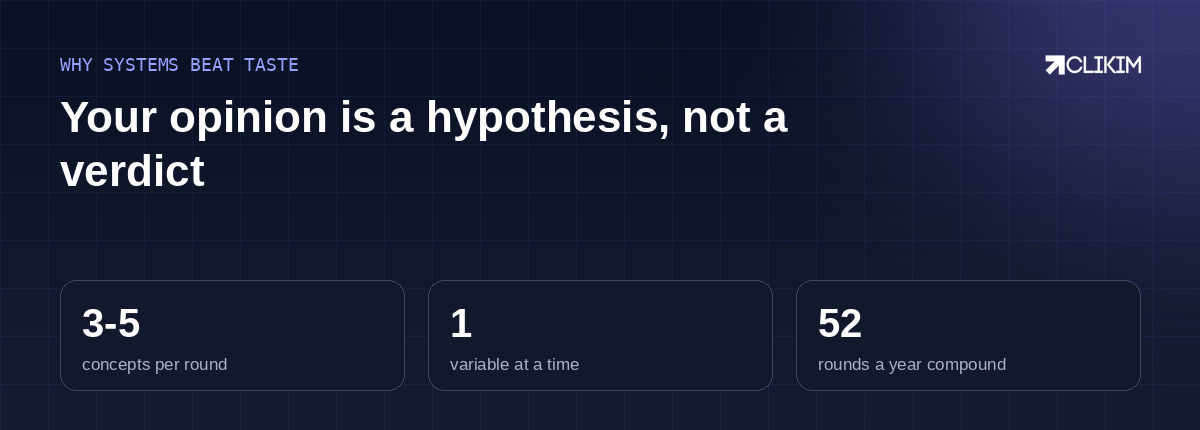
Taste starts the brief; the framework delivers the verdict — and 52 logged rounds a year become the moat.
Frequently asked questions
How do I test Facebook ads properly?+
Should I test ads in ABO or CBO?+
What should I test first in Facebook ads?+
How many ads should I test at once?+
How much budget does ad testing need?+
How long should a Facebook ad test run?+
Can I edit ads during a test?+
What is a testing log and why keep one?+
What do I do with a winning test ad?+
What if every ad in a round loses?+
How often should I run test rounds?+
Why do my tests keep getting interrupted?+
Run the engine at full budget
Real testing needs real cell budgets beside your scaling spend. Managed whitelisted infrastructure with no preset cap funds both. Operated on BM2500 infrastructure.