
Advantage+ vs Manual Campaigns: The Honest Split
The automation-vs-control debate has a boring, profitable answer: it's a division of labour. Where ASC's blended delivery genuinely wins, where manual structure still earns its keep, the hybrid scaled accounts actually run — and the five mistakes that make automation look broken.
Advantage+ (ASC) hands audiences, placements and budget allocation to the algorithm — and with real fuel (50+ weekly purchases, clean CAPI signal, 6–15 fresh creatives) it usually out-scales hand-built structures. Manual keeps winning at testing (fair ABO budgets), surgical jobs (strict exclusions, geo offers, hard cost guardrails) and thin-signal starts. The working answer is the hybrid: test in ABO → feed winners to ASC (60–80% of spend) → keep one manual scalpel. Judge ASC at the account level — it cannibalizes retargeting by design.
• Advantage+ (ASC) is Meta's automation-first campaign: blended audiences, algorithmic budgets, creative as the only real input. • ASC wins at scaling with volume signal (50+ weekly purchases); manual wins at testing, exclusions, surgical jobs. • The working answer is the hybrid: test in ABO → feed winners to ASC → keep one manual scalpel. • ASC needs fuel: 6–15 live creatives, refreshed, on clean CAPI signal. • Don't leash the automation with tight caps — loose reins or manual, not both. • Judge ASC at the account level (blended CPA/MER) — it cannibalizes retargeting by design. • Either path, your levers are the same: creative quality, signal quality, headroom.
What Advantage+ actually is
Advantage+ shopping campaigns (ASC) — and the widening Advantage+ suite around them — are Meta's answer to a decade of structural folklore: hand over audiences, placements, and budget allocation to the machine, keep creative and a budget as the human inputs, and let delivery blend prospecting and retargeting however the model predicts best. No ad set architecture, no audience debates, no ABO/CBO chess — one container, many creatives, an algorithm with the keys.
Manual campaigns are everything that isn't that: you define the audiences, split the funnel stages, allocate budgets under your own rules, and keep every scalpel — exclusions, geos, schedules, bid constraints. The 2026 question isn't which philosophy is correct; it's which jobs each one actually does better. And that split turns out to be crisp.
The capabilities, side by side
ASC trades your controls for the model's freedom — a good trade exactly where the model has enough to work with.
Where Advantage+ genuinely wins
ASC is a scaling engine, and its fuel is signal volume. Give it an ecommerce account doing 50+ weekly purchases, clean CAPI events, a healthy catalog, and 6–15 genuinely different creatives, and it typically outruns hand-built structures — the blended audience model finds pockets human segmentation misses, budget flows to winners at machine speed, and the endless structural questions (which audience? which stage? which split?) simply stop consuming your week.
The reports of its success aren't hype mechanics: ASC concentrates all that signal in one container instead of fragmenting it across a dozen ad sets — the same consolidation math from our structure guide, taken to its logical end. For most established stores, ASC-as-main-scaler is now the default that manual setups must beat, not the other way round.
Where manual still earns its keep
Testing is the big one: fair verdicts need fair budgets, and ASC allocates by performance-prediction, not fairness — an ABO test bench remains non-negotiable. Surgical requirements follow: strict exclusion of existing customers (ASC only offers a soft budget cap for them), geo-specific offers, compliance-driven schedules, hard cost guardrails. And thin-signal situations — new pixels, low-volume high-ticket funnels, most lead gen — feed the automation too little to blend with; manual structure with deliberate audiences wanders less expensively there.
Notice the pattern: manual wins wherever your constraints or your scarcity are the binding factor. ASC wins wherever the model's freedom is.
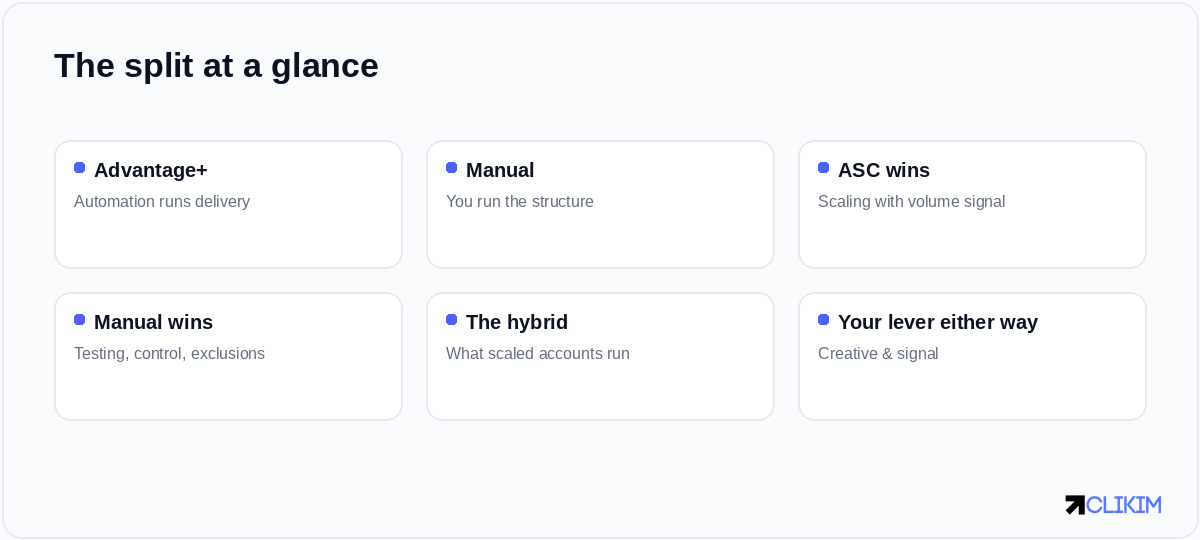
An automation engine and a manual scalpel — the split follows signal volume and surgical need.
The decision table
Neither side sweeps — the split follows signal volume and how surgical your requirements are.
The hybrid most scaled accounts converge on
Put the strengths together and the architecture writes itself: an ABO testing campaign proving angles and hooks under fair conditions → ASC as the main scaler, fed the graduates plus catalog and budget → one manual campaign kept for the scalpel work (excluded-customer remarketing, geo offers, capped guardrail spend). Three moving parts, each doing the job it's built for — the same test-then-scale logic as ABO-then-CBO, with ASC absorbing the CBO role for ecommerce.
Budget split varies by maturity, but scaled stores commonly run 60–80% through ASC, 10–20% testing, and the remainder on the manual scalpel. The ratio matters less than the flow: winners move one direction, learnings move back, and nobody tests inside the scaler.
The five hybrid mistakes
Most 'ASC failed' stories are one of these five — the automation was fine; the setup starved it.
The last row deserves its paragraph: ASC optimizing toward miscounted conversions doesn't fail loudly — it succeeds at the wrong thing quietly, scaling toward whatever your broken tracking says converts. Automation amplifies signal quality in both directions, which is why CAPI with deduplication stops being hygiene and becomes a prerequisite the day you hand the keys to the machine.
Judging ASC fairly
ASC blends prospecting and retargeting by design, which breaks campaign-level comparisons: it will happily absorb conversions your manual retargeting used to claim, look brilliant, and leave your remarketing campaign looking gutted — net change possibly zero. Judge it at the account level: blended CPA, total volume, MER trend over 3–4 weeks, against the account's prior baseline. And give it a real learning runway — the blended model takes longer to settle than a single ad set, and week-one verdicts on ASC are the classic false negative.
Use the existing-customer budget cap honestly too: set it near your true retention share, or ASC's "prospecting" numbers are partly your loyal buyers wearing new-customer costumes.
Migrating to the hybrid without a cliff
Accounts arriving from a fully-manual world shouldn't cut over in a weekend. Week one: launch ASC beside the existing structure at 20–30% of spend, fed your current proven winners — no new variables. Weeks two and three: watch account-level blended CPA as ASC's learning settles; expect your manual retargeting numbers to sag as it absorbs their conversions (that's redistribution, not loss). Weeks three to five: shift budget toward whichever architecture the blended numbers favor, in 20–30% steps, retiring manual campaigns as ASC proves it covers their job.
What survives the migration on purpose: the ABO test bench (permanently), the exclusion-critical remarketing scalpel, and any geo/offer campaigns automation can't express. What should not survive: the twelve-ad-set prospecting museum ASC just made redundant. Most accounts complete the shift in five to six weeks with blended CPA improving before it's done.
A note for lead gen
The Advantage+ suite increasingly covers lead objectives, but the ecommerce logic transfers incompletely: lead quality tiers, sales-team feedback loops, and compliance filters are exactly the surgical requirements automation can't see. Most lead-gen accounts in 2026 still run manual-first structures with Advantage+ components (placements, audience expansion) selectively enabled — automation as seasoning, not the meal. The exception: high-volume, low-qualification funnels (newsletter, app installs), where the full automation math works like ecommerce's.
Both paths meet the same wall
ASC scaling and manual scaling share a dependency neither can automate away: account headroom. ASC pushing spend into a $250/day cap is a Ferrari in a parking garage, and the velocity automation naturally produces is exactly what flags fragile accounts mid-ramp — resetting the blended learning that took weeks to settle. The trust arithmetic doesn't care which campaign type generated the spend curve.
Which is why the hybrid's quiet third component is infrastructure: an uncapped, high-trust agency ad account that lets the automation run at the speed it was built for — and keeps the manual scalpel funded beside it.
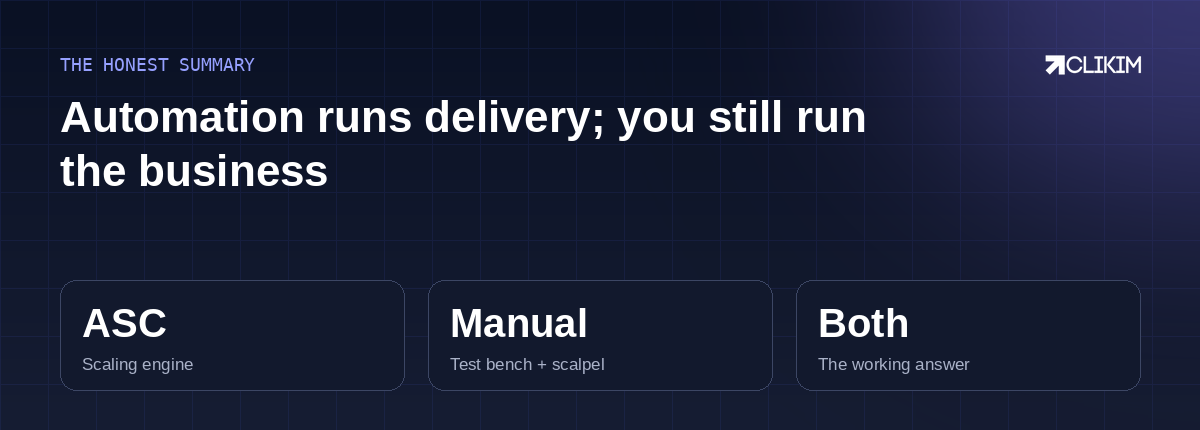
Feed the engine, keep the scalpel, and give both the headroom to matter.
the 2026 attribution changes — the window changes that reshaped what campaigns report. the ROAS-drop diagnostic — the decision tree for a number that suddenly moved.
Frequently asked questions
What is an Advantage+ shopping campaign?+
Is Advantage+ better than manual campaigns?+
What does Advantage+ need to perform?+
Can I test creative inside Advantage+?+
How much of my budget should go to Advantage+?+
Why did my retargeting die after launching ASC?+
How do I stop Advantage+ targeting existing customers?+
How long before I judge an ASC campaign?+
Does Advantage+ work for lead generation?+
Should I run multiple ASC campaigns?+
Why does ASC 'fail' for some accounts?+
Does automation remove the need for account headroom?+
Give the automation a runway
ASC scales at machine speed — on accounts with the headroom to allow it. Managed whitelisted infrastructure, no preset caps, dedicated rep. Operated on BM2500 infrastructure.