
Top 5 Viral Angles & UGC Styles (Meta Ads · August 2026)
The monthly creative report: five angles actually carrying spend right now — the skeptic conversion, street interviews, the teardown, the belief flip and the 30-day log — with the hook library behind them, an honest obituary for what died, and the August-to-Q4 testing plan.
August 2026's five: (1) the skeptic conversion (“I fully expected to return this”) for objection-heavy cold traffic; (2) street interviews — vox-pop social proof that pattern-interrupts a feed full of talking heads; (3) the teardown — ingredients, margins or competitor labels opened on camera; (4) the belief flip — defensible contrarianism from a credible expert; (5) the 30-day log — serialized daily-use experiments feeding retargeting sequences. Specs that keep winning: 15–30s vertical, captioned, hook by second 2 — UGC-style still beats polish by 15–25% on thumb-stop. Dead: scripted-feeling testimonials. Job for the month: test 2 angles × 3 hooks each at August's cheap CPMs, so Q4 scales proven creative.
• UGC-style vertical video keeps beating polished production on cold audiences — 15–25% higher thumb-stop rates — but the bar for 'feels native' rises every month. • August's five: skeptic conversion, street interviews, the teardown, the belief flip, and the 30-day log — each with a specific job in the funnel. • Scripted-feeling testimonial UGC is dying: the feed learned to smell it. Performance now comes from formats that carry real information or real reactions. • August is the cheapest testing window before Q4 — the whole point of this month is finding the 2–3 angles you'll scale into peak-season CPMs. • Rotate hooks before concepts: three first-2-second variations per angle, judged on thumb-stop and CPA over full windows. • Every angle here works within policy — including in restricted verticals — if the claims discipline holds. • This list re-issues monthly; angles fatigue platform-wide, not just in your account.
Why this month's list is different (and why August at all)
Creative angles fatigue platform-wide, not just inside your account: when ten thousand advertisers copy the same winning format, users learn to scroll past it as a class. That's why "what's working" is a dated question — and why this list carries a month in its title and gets re-issued when the answer changes. The patterns below are compiled from what we see across client accounts, what performance communities are converging on, and the format data Meta itself publishes in its ads guide.
And August specifically is the most valuable testing month of the year: CPMs sit near their summer floor while Q4 sits eleven weeks out. The sequence written in the flow above is the whole strategy — test angles cheap in August, cut to winners in September, scale proven creative into Q4 — because nobody sane runs creative experiments at Black Friday CPMs. Which is also why this edition leans toward testable formats over production-heavy ones.
1. The skeptic conversion — “I fully expected to return this”
The strongest objection-handler in the format library right now. The creator opens by voicing genuine doubt — the exact doubt your viewer holds — then documents what actually happened. It works because it pre-empts the objection instead of arguing with it: the viewer's internal “yeah right” gets said out loud in second one, which buys the next twenty seconds of attention. Execution notes: the doubt must be specific (“I've bought four of these off TikTok and returned three”), the turn must be shown rather than claimed (the moment of surprise on camera outperforms any voiceover), and the ending should stay measured — a 9/10 with one honest gripe converts better than an 11/10 rave, because the gripe is what makes the rest believable. Funnel slot: cold traffic, especially audiences burned by category overpromises. In restricted verticals, keep the turn experiential (“I actually look forward to taking it”) rather than outcome-claiming — the supplements claim ladder applies to creators too.
2. Street interviews — social proof with a pattern interrupt
The vox-pop format — mic in hand, “excuse me, can I ask you something?” — has migrated from organic TikTok into paid and it's carrying August. Three reasons: it pattern-interrupts (feeds are full of solo talking heads; two strangers on a street corner reads as content), it manufactures social proof at scale (five real reactions in thirty seconds), and reactions are unscripted by construction — the thing scripted UGC can't fake. Execution: real locations and real strangers (staged versions get sniffed out in the comments, and comments are part of the creative), a first question that doubles as the hook (“would you drink this if I told you what's in it?”), rapid cuts between reactions, captions throughout. Budget note: this is the priciest format on the list to produce — one shoot day yields 10–15 cuttable moments, so brief it as a library shoot, not a single ad.
3. The teardown — “here's what's actually inside”
Transparency as spectacle: the creator opens the product, the label, the supply chain or the price structure and explains what's actually there — “this is what $80 gets you from us vs them”, “reading my competitor's ingredient list on camera”, “here's our actual margin.” It rides two currents at once: the authenticity premium (audiences reward brands that show receipts) and the behind-the-scenes hook family, which is out-pulling almost everything this summer. The information must be real and checkable — a teardown that rounds up gets torn down in the comments. Works unusually well for considered purchases where the viewer is already comparison-shopping; pairs naturally with a competitive-research habit and gives your retargeting pool something substantive to remember you by.
4. The belief flip — “you've been doing this backwards”
The contrarian-expert format: open by contradicting something the audience believes (“cold plunges are wrecking your recovery”, “your CAC problem is actually an AOV problem”), then earn the claim with a credible explanation. The hook mechanic is mild outrage — disagreement compels the rewatch and, crucially, the comment, and Meta's delivery system reads argumentative comment sections as engagement gold. Two guardrails: the flip must be defensible (contrarian-and-wrong burns brand trust at scale), and the expert must plausibly be one — founder, formulator, practitioner — because the format collapses when a hired face reads a contrarian script. This is also the angle that pairs best with expert commentary styles for B2B and services, where “everyone tells you to do X; here's why we don't” routinely beats case-study ads on cold traffic.
5. The 30-day log — the serialized experiment
“Day 1 of replacing my office chair with this” → “Day 14” → “Day 30, final verdict.” Documented daily-use experiments convert the timeframe-promise hook into a series, and series mechanics are the quiet edge: return viewership, escalating retargeting sequences (day-1 viewers get the day-14 ad), and watch-time signals delivery loves. The discipline is honesty about the arc — flat days and small annoyances belong in the log; a 30-day montage of pure delight is just a long testimonial. Policy note for restricted verticals: timeframes attached to body outcomes trip restricted-claims rules — log the habit and the experience, not the measurements. Funnel slot: warm audiences and retargeting first; the series structure is wasted on one-impression cold reach.
The hook library for all five
The five hook families carrying August. Rotate hooks before rotating concepts — most 'fatigued' ads have a tired first two seconds and a perfectly good body.
Operational rule worth stealing: when a winning ad fades, replace the first two seconds before you replace the ad. Most fatigue lives in the hook — the body of a proven ad usually has weeks of life left behind a fresh opener, and hook-swaps cost an edit, not a shoot. Three openers per concept is the minimum test; the testing framework covers budgets and verdicts.
What stopped working (the honest obituary section)
Three formats to stop paying for. Scripted-feeling testimonial UGC — the “I was struggling with X until I found Y” monologue with marketplace-perfect lighting — has crossed from native to recognizable; thumb-stop rates on the format have been sliding all year and the feed now reads it as an ad on sight. Over-produced brand anthems on cold traffic: beautiful, expensive, skipped. Fake-reaction duets and staged pranks: the engagement is real but low-intent, and comment sections calling out the staging poison the conversion math. The common thread: audiences aren't punishing polish or UGC per se — they're punishing performed authenticity. Whatever the format, the question that predicts survival is “does this carry real information or a real reaction?”
Running the August test correctly
The plan that turns this list into Q4 ammunition: pick two angles that fit your product's funnel position (skeptic + teardown for considered purchases; street interview + 30-day log for impulse), produce three hooks per angle via your UGC pipeline, and judge on thumb-stop rate plus CPA over full attribution windows — never day-one reads. Kill losers by the kill criteria, promote winners into your evergreen structure, and re-test the survivors' hooks once more in September. And mind the infrastructure math: an August testing program wants budget headroom exactly when a capped account can't give it — uncapped agency accounts exist for precisely this month.
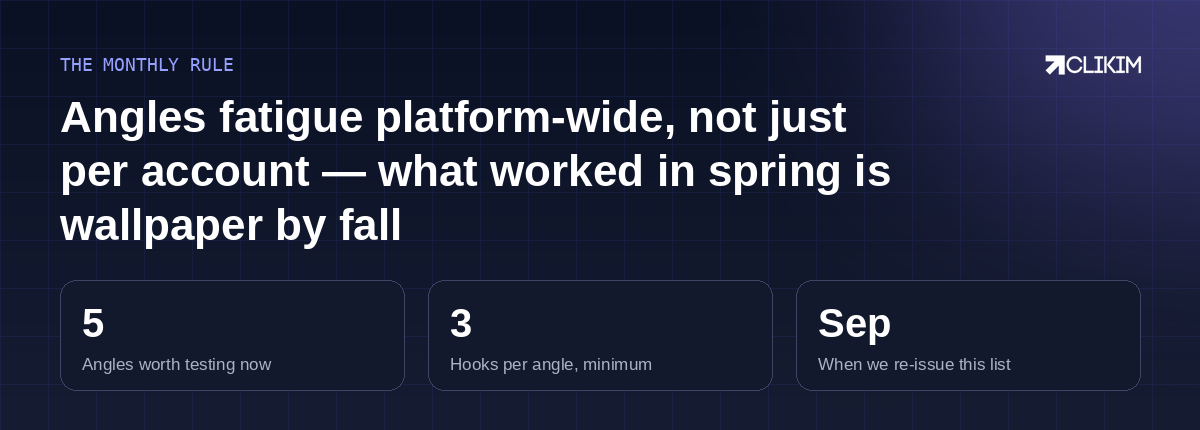
Test in August's cheap auction, cut in September, harvest in Q4 — see you in the September edition.
Frequently asked questions
What UGC style is performing best on Meta right now (August 2026)?+
Is UGC still better than polished ads in 2026?+
How long should a Meta ad video be in 2026?+
What ad hooks are working right now?+
Are street interview ads worth the production cost?+
Why are my testimonial UGC ads fatiguing faster than before?+
Do these angles work for restricted verticals like supplements?+
How many creatives should I test in August?+
What's the difference between an angle and a hook?+
Should I use AI-generated UGC creators?+
When does this list update?+
Which of the five angles should ecommerce brands start with?+
How do I know an angle is fatiguing platform-wide vs just in my account?+
Test the angles on an account with headroom
August's cheap CPMs are wasted on a capped account. Whitelisted infrastructure — uncapped testing now, proven creative scaled into Q4.