
Choosing the Right Facebook Campaign Objective (Sales vs Leads vs Traffic)
The objective isn't a label — it's the instruction that decides which humans see your ads. Here's what each of the six families really optimizes toward, the Traffic trap that eats beginner budgets, and the chain (objective → event → volume → tracking → budget) that has to hold end-to-end.
The objective tells Meta who to hunt — it finds people statistically likely to do the exact thing you named. So name the action that pays you: stores run Sales, services and B2B run Leads, apps run App promotion — and Traffic almost never (cheap clicks come from people who click everything and buy nothing). Then hold the chain: pick the optimization event, confirm you can feed it ~50 events/week (step up-funnel temporarily if not), verify tracking sees the event, and size budget to the math. Switching objectives = new campaign + fresh learning, so decide early.
• The objective tells Meta who to hunt: it finds people statistically likely to do the thing you named. • The classic mistake: Traffic campaigns for sales goals — cheap clicks from people who click everything and buy nothing. • Default mapping: stores → Sales, services/B2B → Leads, apps → App promotion. Traffic almost never. • The objective is a chain: objective → optimization event → 50 events/week → tracking → budget. • Can't feed Purchase with ~50 weekly events? Step one event up-funnel (ATC, initiate checkout) — temporarily. • Changing objectives means a new campaign and fresh learning — decide early, not often. • Awareness and Engagement are tools with jobs (launches, warm pools), not lesser versions of Sales.
What the objective actually does
The campaign objective looks like a labeling choice — it's actually the single most consequential instruction in the account. It tells Meta's delivery system which people to hunt: pick Sales, and the auction machinery searches your audience for people whose behavior predicts purchasing; pick Traffic, and it searches for people who click links. Same budget, same creative, same audience — completely different humans see the ad, because the system optimizes toward exactly what you named and nothing else.
That precision is the trap. Meta is exceptionally good at delivering the literal thing requested, and "link clicks" names a behavior performed enthusiastically by people who click everything and buy nothing. The system isn't misfiring when your traffic campaign produces zero sales — it's succeeding, at the wrong assignment. The whole discipline of this choice is asking for the action that pays you, then making that request feedable.
The six objectives, mapped honestly
Six families, one logic: the system finds people likely to do whatever the objective names — so name the thing that pays.
The 2026 menu (post-ODAX consolidation) runs six families. Sales is the default for anything transacted — it optimizes toward purchase events and powers catalog and Advantage+ shopping machinery. Leads is the service-business workhorse: instant forms, calls, registrations — with lead quality managed through form friction, per the dial in our CVR guide. Awareness buys the cheapest possible eyeballs for launches and saturation plays; Engagement builds the warm pools that custom audiences harvest; App promotion is its own SDK-driven world. And Traffic… deserves its own section.
The Traffic trap (a case study in literalism)
Traffic is the most-misused objective on the platform because it sounds like the reasonable first step: get people to the site, let the site convert them. But recall how delivery works — the system finds people likely to do the named action, and serial clickers are a real, identifiable population: bored scrollers, accidental tappers, people who click ads the way others skim headlines. A Traffic campaign dutifully rounds them up at 30 cents each, your dashboard celebrates the cheap clicks, and your store records silence.
The legitimate uses are narrow: distributing content where the visit itself is the goal, feeding retargeting pools cheaply on thin budgets, and pre-warming brand-new pixels. For anything with a conversion downstream, run the conversion objective even though the clicks cost more — the panel above shows the arithmetic every store eventually learns: $0.31 clicks that never buy are infinitely more expensive than $1.85 clicks that do.
A solid visual walkthrough of the current objective menu and where each campaign type fits.
The chain: objective → event → volume → tracking → budget
Objective → event → volume → tracking → budget: one chain, and the weakest link sets performance.
Choosing the objective is the first link in a chain that has to hold end-to-end. Inside Sales, which event do you optimize for — Purchase, Initiate Checkout, Add to Cart? The deeper the event, the better the buyer quality and the harder it is to feed: the learning system wants ~50 events per ad set per week, and a store doing 20 purchases weekly can't feed Purchase optimization no matter how correct it feels. The honest move is stepping one event up-funnel — optimize for Initiate Checkout until volume justifies moving down — a temporary trade of buyer-precision for learnable signal, using the same math as our consolidation formula.
Then the unglamorous links: tracking (an objective optimizing toward an event your pixel + CAPI doesn't reliably report is aiming blind — verify the event fires and dedupes before spending) and budget (sized so the event math works: 50 events at your CPA, per ad set, per week). Weakest link sets the ceiling; most "wrong objective" complaints are actually a broken link further down.
Switching objectives (and why you mostly shouldn't)
Objectives are set at campaign creation and can't be changed after — a "switch" means a new campaign, fresh learning, and a temporary performance dip while it stabilizes. That's by design: everything the old campaign learned was learned about the old target population. So decide deliberately at the start, and reserve switches for genuine strategy changes — a new pixel graduating from Traffic warm-up to Sales, a lead funnel moving from volume to quality events — executed as planned migrations with overlap, not panic swaps mid-quarter, per the transition discipline in our migration guides.
Meta's own reference on choosing the right objective is worth a bookmark for the current menu details — the names shuffle every couple of years; the logic here doesn't.
Three real decisions, walked through
Scenario one: a Shopify store doing ~30 purchases a week at a $42 CPA. Sales objective, obviously — but 30 purchases spread across three ad sets is 10 events each, deep in Learning Limited territory. The correct build is one consolidated ad set optimizing for Purchase (30 events/week is workable when concentrated), or Purchase optimization with Initiate Checkout as a bridge if volume dips. What it isn't: three Traffic campaigns "to warm things up." The store's problem is signal concentration, not audience temperature.
Scenario two: a B2B consultancy selling $8k engagements. Purchases happen twice a month — no objective can learn from 2 events. So the optimization target moves up the funnel to where volume lives: Leads objective, optimizing for qualified form submissions (with enough friction that "qualified" means something), 15–25 per week. The sale closes offline; the campaign's job is feeding the calendar. Optimizing for the rare final event would starve the system; optimizing for cheap unqualified volume would flood the pipeline with noise. The event choice, not the objective family, is where this business wins or loses.
Scenario three: an app with a free tier and paid upgrade. App promotion, but the same event logic applies one level down: optimizing for installs finds installers (plentiful, cheap, often worthless), optimizing for in-app purchase events finds upgraders — if the SDK reports them and volume permits. Most apps run the same up-funnel compromise as stores: optimize for a mid-funnel event (trial start, activation) that predicts revenue and actually hits 50/week.
Is the objective wrong, or is the chain broken?
Before blaming the objective, run the chain in order. Check the event first: open Events Manager and confirm the optimization event fires, dedupes, and roughly matches your platform-of-record counts — a Sales campaign optimizing toward an event that fires on half your purchases is aiming with one eye. Then volume: if the ad set shows Learning Limited, the objective isn't wrong, the event is too deep for your throughput. Then budget: multiply your CPA by 50 — if the weekly budget is below that number, the campaign is structurally underfed regardless of settings. Only when all three hold and results still miss is the objective itself the suspect — and even then, the more common truth is a creative or offer problem wearing an objective costume.
The tell that it genuinely is the objective: strong volume of the named action with near-zero downstream movement. Thousands of engaged video viewers who never click, cheap leads who never answer the phone, clicks that bounce in three seconds — the system is winning its assignment and the assignment is wrong. That's the cue to move the request closer to money.
Objectives are a portfolio, not a pick
Mature accounts run objectives the way the structure guide runs campaigns — as a small portfolio with jobs. The spine is always the money objective (Sales or Leads) carrying 80–90% of spend. Around it, situationally: an Engagement campaign cheaply building video-viewer pools that become retargeting fuel; an Awareness burst for a launch week; a Traffic trickle feeding content that ranks. Each auxiliary earns its slice only if it demonstrably feeds the spine — warm pools that convert cheaper, launch reach that lifts branded search. Auxiliary objectives that can't show their contribution are hobbies wearing KPI costumes.
The objective can't outrun the account
One last chain link that lives outside Ads Manager: everything above assumes an account that can spend enough to feed the event math. A Sales objective needing $200+/day to reach purchase-learning volume is a theory on a $250/day-capped account already running other campaigns — which is how new advertisers get quietly funneled toward weak events and weak objectives their cap can afford. The upstream fix is the usual one: an uncapped, high-trust agency ad account, so the objective you pick is the one your economics want, not the one your probation permits.
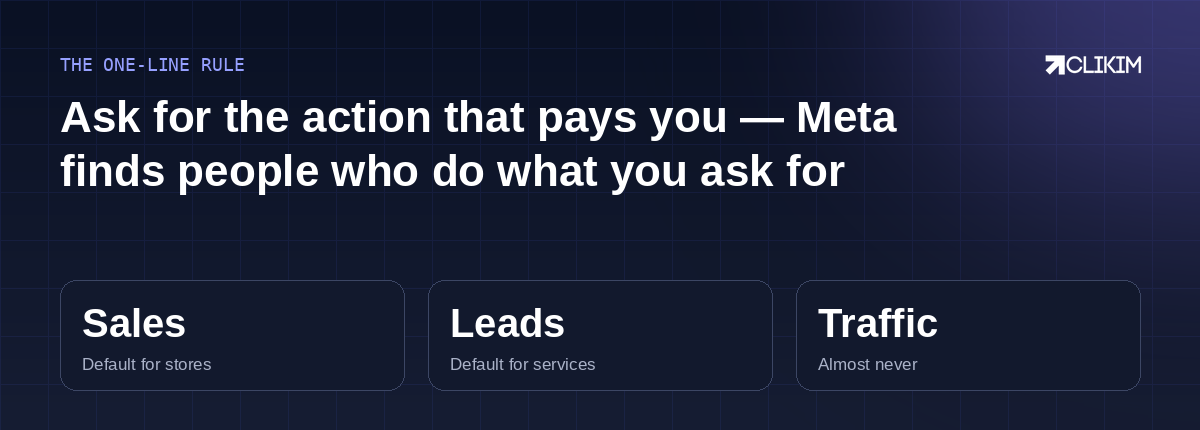
Name the action that pays, feed it 50 events a week, and let the system hunt the right humans.
first vs all conversions — the reporting setting that changes what your objective 'counts'.
Frequently asked questions
What Facebook campaign objective should I choose?+
Why are my Traffic campaigns getting clicks but no sales?+
What is an optimization event?+
What if I can't get 50 purchases a week?+
Can I change the objective of an existing campaign?+
Is the Awareness objective ever worth it for small advertisers?+
What's the Engagement objective actually for?+
Do objectives affect CPM?+
Which objective for lead generation with quality problems?+
Does my account limit which objective I can realistically run?+
Should I run multiple objectives at once?+
Run the objective your economics want
Purchase-level learning takes real budget headroom. Managed whitelisted infrastructure with no preset cap keeps the right objective affordable. Operated on BM2500 infrastructure.