
Duplicate the Ad Set or Raise the Budget? Scaling Mechanics Explained
Media-buying folklore says clone your winners; the mechanics say you're throwing away their learning and buying audience overlap with it. Here's why 20–30% raises win, what real horizontal scaling looks like, and the one case where duplication still earns its keep.
Raise, don't clone. A proven ad set's accumulated learning is an asset — budget raises of 20–30% every 2–3 days inherit it, while duplicates start learning from zero and split signal with the original in the same auctions (overlap). Expect marginal CPA drift as spend grows — that's economics, not malfunction. When raises hit real friction, scale horizontally into new pockets — new angles, audiences, geos, channels — not photocopies. Duplication survives only as a testing instrument (one variable, fair budgets, gates).
• Raising budget beats duplicating in almost every scaling situation — the winner's learning is an asset clones throw away. • Raise in 20–30% steps every 2–3 days; violent jumps can reset learning on the thing that was working. • Clones of the same audience fight themselves: overlap splits signal and both re-learn from zero. • Real horizontal scaling = new angles, audiences, geos — new pockets, not photocopies. • Expect marginal CPA drift as spend grows; that's economics, not malfunction. • Duplication survives as a testing tool (one variable, fair budgets), not a scaling one. • All mechanics hit the same wall: the account's spend ceiling decides how far any of it goes.
The question every winner forces
You found it: an ad set past learning, CPA stable for two weeks, room in the economics. Now every dollar it doesn't spend feels like a leak — and media-buying folklore offers two rituals: nudge the budget up, or duplicate the winner into clones at higher budgets. One of these preserves the asset you just built; the other quietly dismantles it. The industry default, inherited from a different platform era, is too often the wrong one.
The winner already earned its learning — cloning throws that asset away and buys audience overlap with it.
The core insight sits in the first row. A proven ad set carries accumulated learning — thousands of impressions of evidence about who responds, feeding the action-rate estimates that win it cheap auctions. A budget raise inherits all of it. A clone inherits none: it's a stranger with your winner's face, starting its learning phase from zero — in the same audience pool, where it now splits signal with the original.
Vertical scaling: the boring default that works
The mechanics of raising: increase the winner's budget 20–30%, wait 2–3 days of stable delivery, repeat. Small steps let the pacing and prediction systems absorb the change; violent jumps (2×, 5×) can shove the ad set back into learning — voluntarily destabilizing the thing you're trying to exploit. In a CBO scaling campaign you make this one change at campaign level, which is precisely why scaling lives better in CBO.
Expect the drift: each raise buys slightly more expensive marginal conversions, because the system spends your first dollars on the likeliest buyers and expansion reaches deeper. A creeping CPA under rising spend is the signature of correct scaling, not failure — your job is to keep total volume growing while blended CPA stays inside the economics (and to loosen any cost caps as you go, or the cap will do your throttling for you).
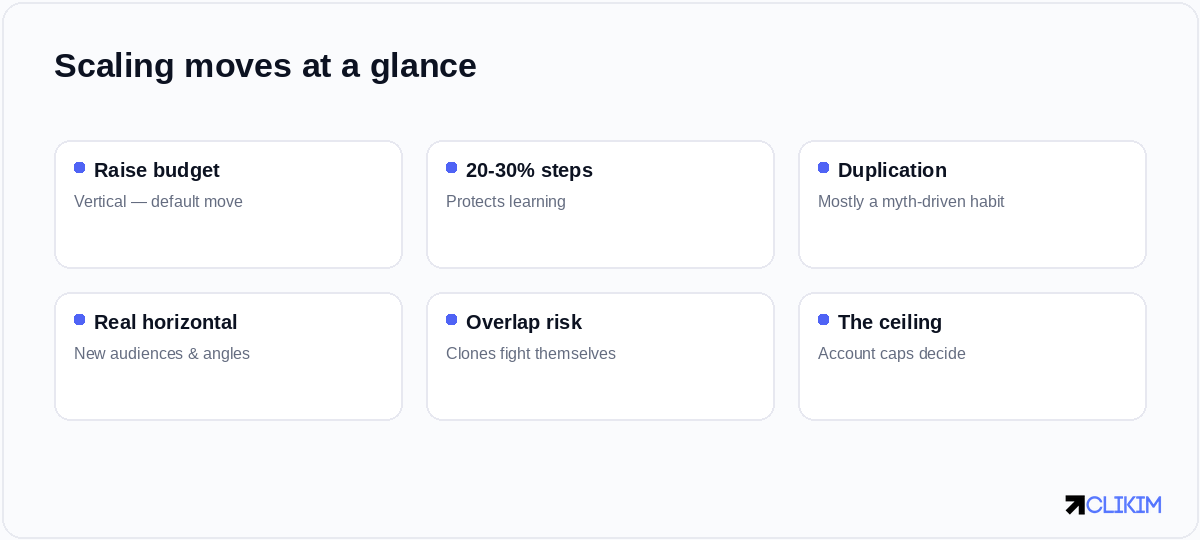
Vertical first, horizontal at friction, clones almost never — and the ceiling belongs to the account.
The duplication myths, examined
Duplication folklore comes from the pre-CBO era — the mechanics it assumed no longer exist.
The folklore isn't stupid — it's outdated. In the pre-CBO, interest-stacking era, many small ABO ad sets were how you bought delivery, and re-rolling a stubborn ad set occasionally seemed to help (variance being generous). Modern delivery inverted the physics: consolidated signal wins, broad pools replaced audience slicing, and clones of one winner now mostly buy you overlap — your own copies competing in the same auctions, splitting the same conversions, each too starved to learn. The ritual survived the mechanics that justified it.
Real horizontal scaling (what duplication pretends to be)
When vertical raises hit genuine friction — CPA drifting past tolerance despite stable creative — the answer isn't more copies of the same bet; it's new pockets. A different angle recruits a different buyer population. A new geo opens an uncontested pool. A new channel (hello, TikTok) opens a different auction entirely. Each of these deserves its own ad set or campaign — not because duplication is magic, but because the pocket is genuinely new, with its own signal to build.
That's the honest test for any "duplicate": what's different about the copy? New audience, new angle, new market — legitimate launch. Same audience, same creative, higher budget — you wanted a raise and performed a ritual instead.
The decision table
Every legitimate 'duplication' is really a new-pocket launch — the copy-paste ritual adds nothing.
One row deserves expansion: duplication as a test instrument is completely legitimate. Duplicating an ad set to trial a structural change — a different optimization event, a bid strategy, a landing page — with one variable changed and gates set is just proper testing that happens to start from a copy. The distinction is intent: a test seeks a verdict; scaling-by-clone seeks a miracle.
Where Advantage+ changes the calculus
For ecommerce, much of this chapter is being automated away: Advantage+ shopping handles audience expansion and budget allocation internally — you scale it by raising its budget and feeding it creative, and it performs the "horizontal" exploration inside the black box. The manual mechanics above still govern your testing structure and any manual scaling stack beside ASC, but the duplicate-vs-raise argument dissolves where ASC absorbs it: there's one big set, and you raise it.
The corresponding discipline: resist rebuilding clone-farms inside the automation era. One ASC + one testing campaign + one manual scaler where justified beats seven overlapping campaigns pretending to be a strategy.
The scaling week, operationalized
Monday: review winners against 7-day blended CPA and frequency trend. Stable and inside economics? Raise 20–30%. Tuesday–Wednesday: hands off; let pacing settle. Thursday: second read — stable again? Optionally step again; drifting? Hold and check whether it's marginal-cost drift (fine) or creative fatigue (rotate). Friday: if two consecutive raise-cycles hit friction, brief a horizontal move for next week's testing round — new angle or pocket, not a clone. Repeat. Scaling is a rhythm, not an event.
And through all of it: batch changes, touch nothing daily, judge on windows. The same discipline that protects tests protects scaling — the system rewards stable instructions.
A scaling month, by the numbers
A worked example makes the arithmetic vivid. A winner runs at $100/day, $28 CPA, target $35. The raise path: $100 → $130 → $165 → $210 → $270 over three weeks, CPA drifting $28 → $33 — inside tolerance, learning intact, one small hold after the third step when drift spiked. Ending state: 2.7× the spend at a CPA still under target, on one ad set the account fully understands.
The clone path (same starting winner): three duplicates at $100 each. Week one: all three in learning, blended CPA $41 while the original sags from split delivery. Week two: one clone dead, one Learning Limited, one converging back to… the original's performance, minus the weeks of history. Ending state: comparable spend, worse blended CPA, four fragmented signal pools, and a cleanup job. Same winner, same market — the only difference was which ritual the buyer performed.
The wall all mechanics share
Raise or clone, vertical or horizontal — every path terminates at the same ceiling: what the account is allowed to spend. A winner ready for $500/day is a theory on an account capped at $250; and the aggressive-looking growth that scaling produces is exactly the velocity pattern that gets fragile accounts flagged mid-ramp — resetting the learning that made the winner scalable at all.
Which is why scaled buyers pair the mechanics with infrastructure: a whitelisted agency ad account with no preset cap and mature trust, so the only question that governs growth is the one that should — do the economics support the next step?
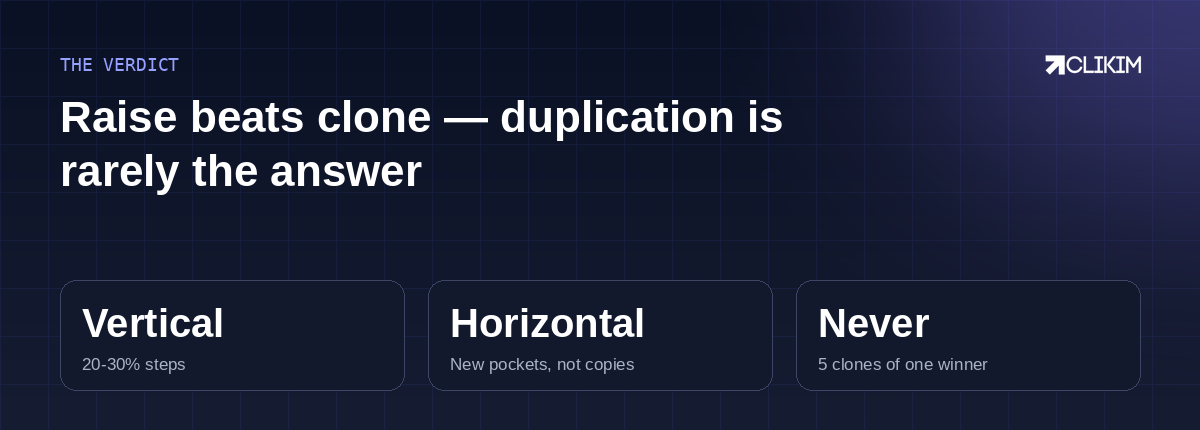
Preserve the learning, expand the pockets, respect the ceiling — scaling is three rules and a rhythm.
Frequently asked questions
Should I duplicate a winning ad set or raise its budget?+
How fast can I raise a Facebook ad set's budget?+
Why does duplicating ad sets hurt performance?+
Is the 'lucky duplicate' strategy real?+
Why does my CPA rise as I scale?+
What is horizontal scaling in Facebook ads?+
When should I scale horizontally instead of vertically?+
Is duplicating ad sets ever the right move?+
How does CBO affect the duplicate-vs-raise question?+
Does Advantage+ shopping change scaling mechanics?+
Should I pause the original when scaling a duplicate?+
What limits how far I can scale?+
Your winner is ready — is your account?
Scale proven ad sets on managed whitelisted infrastructure with no preset cap and mature trust, so the mechanics run to their economic limit. Operated on BM2500 infrastructure.