
Facebook Ads for Financial Services (Inside the Special Category)
Loans, insurance, investments and fintech run through three gates on Meta: the special ad category that rewires targeting, written authorization for regulated products, and a creative review tuned against the vertical's classic manipulations. What each gate demands, what still works inside them, and the worked launch that shows the compliant lane compounding.
Finance on Meta = three gates. Gate one, everyone: declare the financial special ad category — targeting locks to 18+ broad, loses gender/ZIP/interest precision (rebuild with creative self-selection + broad delivery + CAPI signal). Gate two, regulated products: written authorization with licenses matched to every advertised geo (loans, insurance, investments; crypto has its own tiered regime). Gate three, creative: promise processes, never outcomes — 'check your rate in 2 minutes' clears, 'guaranteed approval' dies; no urgency-to-borrow, no debt-shame, no implied knowledge of the viewer's finances. Trading signals and passive-income schemes have no lane at all. Run it on verified BMs and aged, high-trust accounts — this vertical multiplies infrastructure quality.
• Financial services run through three gates: special-ad-category declaration (everyone), written authorization (regulated products), and outcome-free creative review. • Categorization narrows targeting automatically — 18+, no gender splits, no ZIP precision, pruned interests — and miscategorizing to dodge it is an account-level offense. • Regulated products (loans, insurance, investments) need licenses matched to every advertised geography. • The creative line: promise processes, never outcomes — 'check your rate in 2 minutes' lives; 'guaranteed approval' dies. • Trading signals, passive-income schemes and get-rich framings have no compliant lane — no paperwork fixes the business model. • Post-targeting playbook: creative self-selection + broad delivery + clean signal replaced the lost levers. • Trust assets decide conversion here more than anywhere: licenses visible, disclosures native, account infrastructure boring and strong.
Why finance gets the special-category treatment
Financial advertising sits at the intersection of real regulatory exposure (lending discrimination law, securities rules, insurance licensing) and a decade of predatory-ad history — payday loan traps, fake investment schemes, credit-repair scams. Meta's answer is layered: the financial products special ad category, which every advertiser in the space must declare and which automatically strips discriminatory-capable targeting; written authorization requirements for regulated products; and creative policies tuned against the vertical's classic manipulations. The formal rules live in Meta's financial products and services standards; the operational reality — what each gate demands and what still works inside them — is this guide.
Orientation note: the special-ad-category mechanics (how declaration works, what happens to your audiences) are covered in our special ad categories explainer; the crypto regime is its own tiered system. This guide is the finance-vertical playbook that sits on top of both.
The scope map: which gates apply to you
The scope map. The special ad category is the floor for everyone; authorization stacks on top for regulated products; and some business models have no lane at all.
Two rows deserve emphasis. Fintech apps without credit products get the lightest treatment — categorization only — and routinely over-comply into performance problems by treating themselves like lenders. The last row is the one that fills advertiser forums: signal-selling, copy-trading funnels, and "passive income system" offers have no authorization path because the problem isn't paperwork, it's the promise — Meta prohibits the business model's advertising grammar itself. If your funnel's honest description is "we tell people what trades to make," no license format exists that makes the ad compliant.
Life inside the category: the targeting reality
The special-category targeting reality: the levers narrow, and the accounts that win stopped mourning them — creative qualification plus clean signal replaced almost all of it.
Declaring the category rewires your ad sets: minimum age locks to 18 (and effectively broad), gender targeting disappears, geographic precision coarsens to a radius, detailed targeting loses the financially-flavored interests, and classic lookalikes give way to Special Ad Audiences built on looser similarity. The accounts that thrive stopped treating this as loss and rebuilt around the two levers that survive: creative self-selection — "first-time buyers with student debt, this math is for you" does demographic work targeting no longer can, using the identity call-out family within personal-attribute limits (call life situations and roles, never imply knowledge of the viewer's finances) — and signal quality: broad delivery steered by dense, deduplicated CAPI events finds creditworthy segments empirically that you're forbidden to target explicitly.
Creative that clears review (and converts anyway)
The claim grammar that survives: processes, not outcomes. "Check your rate in two minutes — no impact on your credit score" clears; "get approved regardless of credit history" is a guaranteed-outcome claim that dies with strikes attached. Specific product facts (real APR ranges with required disclosures, actual coverage terms, transparent fee tables) outperform vague empowerment copy and de-risk review simultaneously. The banned grammar: guaranteed approvals and returns, urgency-to-borrow mechanics (countdown timers on loan offers read as predatory), debt-shame and negative-self-perception angles, and implied knowledge of the viewer's situation ("struggling with your debt?" trips personal attributes exactly as it does in health verticals). What fills the persuasion gap is the trust stack: licenses and registrations visible in creative, real humans (a named advisor outperforms stock-photo confidence), education-first funnels that let disclosure-heavy landing pages do the regulated talking, and social proof curated away from outcome testimonials ("approved in one day!" is an outcome claim wearing a review costume).
A worked launch: regional lender, three gates, no drama
Composite: a state-licensed personal lender entering Meta. Month one, paperwork: business verification, licenses assembled per target state, authorization application filed; meanwhile the funnel is rebuilt — APR disclosures native to the landing page, rate-check flow front and center, outcome language scrubbed from testimonials. Month two, structure: special category declared on every campaign; geographic plan matched exactly to license map; two creative lanes launched — a rate-check process ad ("see your rate, two minutes, no credit impact") and an education lane ("what actually moves a personal loan rate"). Broad targeting, CAPI-fed. Month three, the read: the process lane wins on CPA; the education lane wins on approval-quality (measured downstream in the CRM) — both survive review untouched because nothing promised an outcome. The lender's dashboard CPA runs 20% above the pre-category forum lore from 2019 — and their compliance officer sleeps, their account carries zero strikes, and the funnel scales into new states as licenses land. That's what winning looks like in this vertical: boring, licensed, and compounding.
Measuring quality, not just cost (the CRM handshake)
Finance funnels have a measurement wrinkle ecommerce doesn't: the conversion Meta optimizes (a rate-check, an application start) sits several regulated steps before the conversion that pays (a funded loan, a bound policy) — and the gap between them is where lead quality lives or dies. The working setup: send the upper event to Meta as the optimization target (it has the volume the learning math needs), and pass funded/bound outcomes back from the CRM as secondary conversions — offline event uploads or CAPI with appropriate hashing — so campaigns can be compared on downstream quality, not just application CPA. The classic finance failure is optimizing to cheap application-starts that never fund; the fix is exactly this handshake, reviewed monthly: cost per funded outcome by campaign, and a willingness to pay more per application for lanes that fund at twice the rate. Education-first funnels routinely win that comparison while losing the CPA screenshot war.
The account layer: finance's quiet multiplier
Every gate above interacts with account trust. Authorization applications clear faster from verified, aged Business Managers; categorized campaigns on fresh accounts stack new-account caps on top of category friction — the classic launch-killer for funded fintechs with aggressive timelines; and enforcement false-positives (this vertical's classifiers are twitchy) resolve through rep escalation or not at all. The professional setup mirrors the other regulated verticals: authorization on a fortress BM, spend through aged, managed whitelisted infrastructure with headroom matched to launch plans, the continuity stack warm, and the ownership map clean — because in finance, an infrastructure surprise isn't just downtime, it's a compliance narrative your regulator may eventually read about.
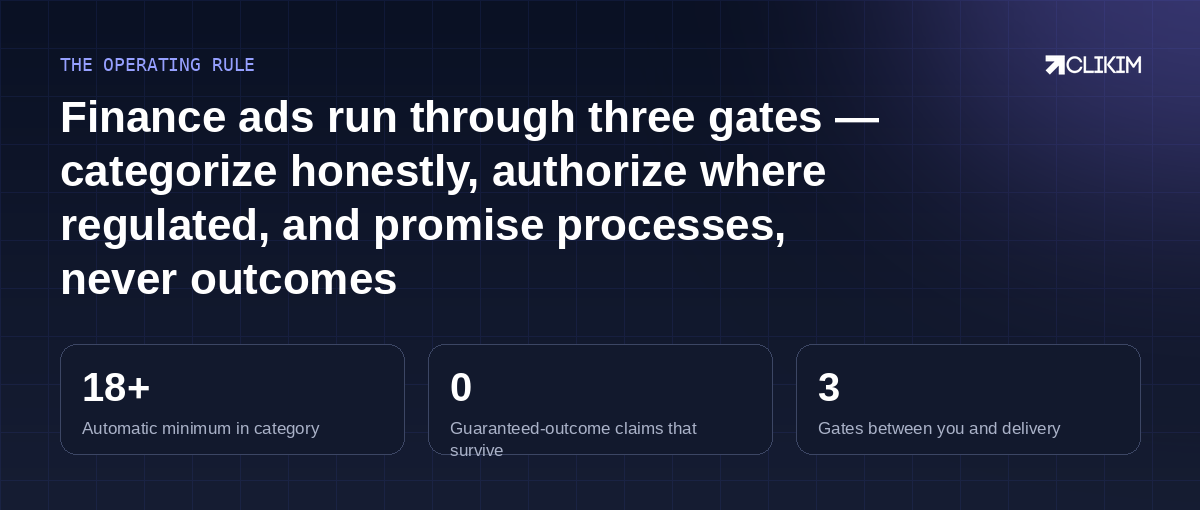
Three gates, honest categorization, process promises — finance on Meta is a licensed operator's game, and the lane is wide open for them.
Conversion Leads — optimize for qualified applicants, not form-fillers. leads-to-CRM failures — the pipe matters double in finance lead gen.
Frequently asked questions
Can you advertise financial services on Facebook in 2026?+
What is the financial products special ad category?+
What happens if I don't declare the special ad category?+
Do I need a license to advertise loans or insurance on Meta?+
Can fintech apps without credit products advertise normally?+
What financial ad claims are banned?+
How do I target the right customers without demographic targeting?+
Are trading signals or copy-trading services advertisable?+
Why was my compliant finance ad rejected anyway?+
Do outcome testimonials count as claims?+
How long does financial authorization take?+
Does the special category apply on Instagram and TikTok too?+
What account setup do finance advertisers need?+
How should finance advertisers measure lead quality, not just CPA?+
Which hook styles work inside the personal-attributes rules?+
Is BNPL treated like a loan product?+
Regulated products deserve unregulated headroom
Aged, whitelisted infrastructure on verified BMs — launch capacity for licensed operators, replacements for the false-positive days. Operated on BM2500 infrastructure.