
Facebook Ad Frequency: When Fatigue Actually Starts
Frequency is the most misread number on the dashboard — cold traffic strains at 3, retargeting is fine at 9, and the metric never testifies alone. Here's how to read it in pairs, what fatigue mechanically does in the auction, and the fixes matched to their causes.
Frequency = impressions ÷ reach in your selected window. There's no universal ceiling: broad cold prospecting gets uncomfortable around 3–4 (7-day), niche pools a bit higher, while retargeting runs healthily at 5–10+. Real fatigue is a pair — frequency rising while CTR falls 20–30% — which mechanically decays your auction value (CTR down → CPM up → delivery shrinks). Fix with creative rotation (new hooks especially) or broader audiences; hard caps only exist in Reach & Frequency buying.
• Frequency = impressions ÷ reach — average exposures per person in the window you're viewing. • There's no universal ceiling: cold prospecting strains at ~3–4; retargeting is healthy at 5–10+. • The real alarm is a pair: frequency rising while CTR falls 20–30% from its baseline. • Fatigue shows up in the auction as decaying action-rate estimates → pricier, weaker delivery. • The fix is rotation (new hooks especially) or breadth — not resignation or bid changes. • Always read frequency in a time window (7/30-day); lifetime frequency on an old ad is meaningless. • Broad audiences are the structural vaccine — big pools fatigue slower by construction.
What frequency actually measures
Frequency is the simplest metric on the dashboard — impressions divided by reach, the average number of times each reached person saw your ad in the selected window — and one of the most misread. Two clarifications fix most of the confusion. First, it's an average: a frequency of 3 usually means many people saw it once and a minority saw it eight times. Second, it's window-dependent: a lifetime frequency of 6 on an ad that's run for four months is unremarkable, while a 7-day frequency of 6 on cold traffic is a fire alarm. Always anchor the window before reacting to the number.
Why care at all? Because repetition has a performance curve. A second or third exposure often helps — recognition builds, consideration matures. Somewhere past that, returns flip: attention drops, engagement sags, and annoyance begins. That downslope is ad fatigue, and frequency is your leading indicator for it.
The comfort zones (by audience warmth)
There is no universal 'too high' — tolerance scales with audience warmth and pool size.
The table's logic: tolerance for repetition scales with relationship and intent. Strangers scrolling cold feeds resent seeing the same interruption four times; a cart abandoner seeing your reminder eight times in a week is being usefully pursued — that's the entire economics of retargeting, where small warm pools make high frequency structurally inevitable and commercially fine. Judging a retargeting ad set by prospecting frequency norms is the most common false alarm in the metric's repertoire.
What fatigue does under the hood
Fatigue isn't just users rolling their eyes — it's mechanical, and it happens in the auction. As repeated exposures depress engagement, the system's estimated action rate for your ad decays; its total value falls; it wins fewer auctions at worse prices. You experience this as the familiar death spiral: CTR softens first, then CPM creeps up, then delivery itself shrinks as the ad loses auctions it used to win. The dashboard says "frequency 4.8"; the auction says "this creative's predictive power is spent".
Negative feedback accelerates the ending: past a point, tired users start hiding the ad, and hides are a direct quality-ranking penalty. An ad pushed deep into burnout doesn't just stop working — it finishes its run actively taxed, which is why "ride it until zero" is a worse strategy than replacing it a week early.
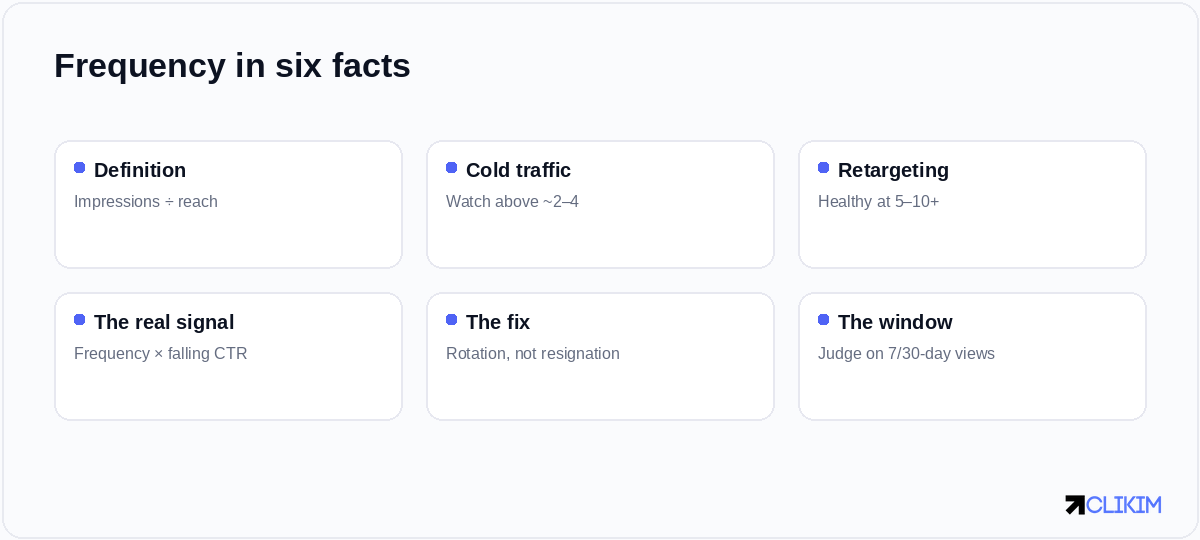
Impressions ÷ reach, read in a window, judged against warmth — and paired with CTR before any verdict.
Reading the signals (frequency never testifies alone)
Fatigue is a pattern across metrics, not a threshold on one — misreading it wastes healthy creative.
The pairs matter because frequency alone convicts innocent ads. A niche B2B pool might run at 4.5 for months with stable CTR — recycling, not fatiguing. Meanwhile an ad with flat frequency and collapsing CTR isn't fatigued at all; something else broke (a competitor's launch, seasonal mood shift, a landing page change). Per our kill-rules framework: diagnose where the chain fails before executing anything.
The fixes, matched to causes
Match the fix to the cause: rotation for tired creative, breadth for tired pools, rest for burned audiences.
Rotation deserves its asterisk: a new hook is a new ad; a new background color is not. The fatigue lives in the first 1.5 seconds users have memorized, so iterating openings on a proven body — per the UGC playbook — resets the clock at a fraction of full production cost. Brands with a weekly creative pipeline barely experience fatigue as an event; it's just Tuesday's rotation.
Prevention: structure beats vigilance
Accounts that rarely fight fatigue share two structural habits. Broad audiences: a 20-million-person pool simply takes longer to recycle than a 400k interest stack — the same broad-first logic that wins the auction also vaccinates against repetition. And pipeline over heroics: a steady flow of tested variants (3–5 weekly on TikTok-speed channels, biweekly on Meta for most budgets) means every winner has an understudy before it's needed. Fatigue management is inventory management.
Add the hygiene basics: exclude recent purchasers so you're not paying to annoy customers, and let your weekly review pull frequency-plus-CTR trends per ad, so rotation happens on schedule rather than after the cliff.
Fatigue speed varies by format
Not all creative ages at the same rate. High-concept video — a joke, a twist, a dramatic before/after — burns fastest, because its power is surprise and surprise doesn't repeat; expect steep decay after the second or third exposure per viewer. Demonstration and educational content ages slower: a clear product demo tolerates re-viewing because its value is informational. Carousels and catalogs age slowest of all — rotating products mean the "same ad" isn't literally the same experience twice. And static images sit in between: instantly parsed, quickly familiar, but cheap enough to rotate constantly.
Plan rotation calendars accordingly: a portfolio heavy on punchline-driven UGC needs understudies on a weekly cadence, while a demo-led account can run biweekly. When one format's winners keep dying young, the fix may be portfolio mix, not production speed.
A fatigue week, read in real time
Here's what the pattern looks like when it's actually happening. Monday: your 6-week-old winner shows 7-day frequency 3.9 (up from 3.1) and CTR 1.31% against a 1.72% baseline — the pair has spoken, so you queue the two pre-tested successors. Wednesday: successors go live at 30% of the ad set budget; the veteran keeps 70%. Weekend read: successor B's hook rate beats the veteran by 20%, CTR holds at 1.8%. Next Monday: budgets flip — B takes the lead, the veteran winds down to a remnant, and nothing dramatic happened at any point. No cliff, no dark week, no emergency brief.
Contrast with the panic version: ride the veteran until CPA doubles, then scramble a rush production, then launch untested creative into a cold restart. The difference between the two weeks isn't skill — it's whether the successor existed before the pair of signals demanded it.
A note on frequency caps
Auction campaigns don't offer per-ad frequency caps — the system self-regulates via the decaying action-rate mechanism above, which is usually enough. Hard caps live in Reach & Frequency buying (guaranteed-delivery campaigns for larger brand budgets), where you literally purchase "reach X people at frequency ≤2 per week". If your goal is performance, chase the fixes above; if your goal is controlled brand exposure at scale, R&F is the tool built for that promise.
What not to do: simulate a cap by strangling budgets. Underfunding an ad set to "keep frequency down" mostly starves its learning and delivery — you get the weak performance without the protection.
Frequency problems scale with account ceilings
One structural aggravator worth naming: capped accounts fatigue faster. When a spend-limited account can't afford broad-audience budgets, buyers compensate with narrow "efficient" pools — which recycle quickly and burn creative on an accelerated schedule. The account ceiling quietly becomes a creative-production tax: same ads, shorter lifespans, more replacements needed per month.
Room to run broad — the kind an uncapped agency ad account provides — is therefore also room to let creative live its full lifespan. Structure, again, doing the work vigilance otherwise would.
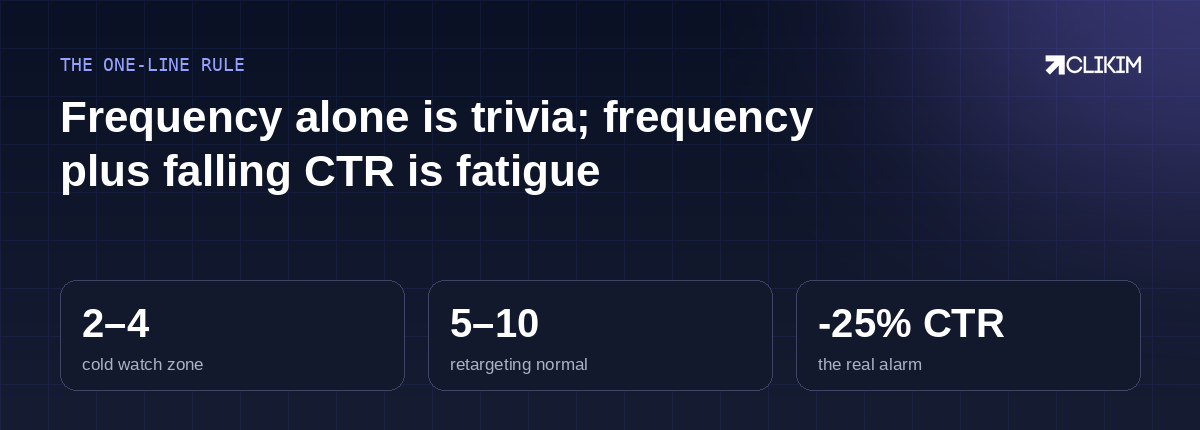
Watch the pair, not the number — and let rotation arrive on schedule, not after the cliff.
Frequently asked questions
What is frequency in Facebook ads?+
What is a good frequency for Facebook ads?+
When does ad fatigue actually start?+
Why does high frequency increase my costs?+
Is high frequency OK for retargeting?+
How do I fix ad fatigue?+
Can I set a frequency cap on Facebook ads?+
Should I lower my budget to reduce frequency?+
How often should I refresh Facebook ad creative?+
Does audience size affect how fast ads fatigue?+
What frequency window should I look at?+
My frequency is low but performance dropped — is it fatigue?+
Give creative room to live its full lifespan
Uncapped managed infrastructure makes broad audiences affordable — bigger pools, slower fatigue, fewer emergency rotations. Operated on BM2500 infrastructure.