
The Facebook Ads Optimization Checklist (Daily · Weekly · Monthly)
The closing piece of the series: everything the deep dives teach, compressed into an operating cadence. Five minutes daily (look, don't touch), forty-five minutes weekly (signal → creative → structure → budget, in that order), two hours monthly (question the architecture). Every line links to the guide that earns it.
Run optimization as three cadences. Daily (5 min): spend pacing, delivery flags, a 3-day CPA glance — look, don't edit; one-day windows lie and edits reset learning. Weekly (45 min), in strict order: signal first (Events Manager: volume, dedup, EMQ), then creative (kill criteria over full windows + queue replacements), then structure (Learning Limited = consolidate), then budget (scale winners ≤20–30%), then log every change. Monthly (2 hrs): MER vs platform ROAS, structure review, audience refresh, creative postmortem, and account health — caps, policy flags, 2FA. The account layer sets the ceiling the checklist can't raise.
• Optimization is a cadence, not an event: 5 minutes daily (look, don't touch), 45 minutes weekly (decide and act), 2 hours monthly (re-architect). • The weekly order is non-negotiable: signal → creative → structure → budget. Every step assumes the one before it is true. • Daily editing is the most expensive habit in Facebook ads — one-day windows lie, and edits reset learning. • Scale winners in ≤20–30% budget steps; bigger jumps re-enter learning and torch the very stability you're scaling. • Judge the program monthly on MER and margin-true CPA, not on platform-attributed ROAS alone. • Log every change — one line: what, why, expected effect. Accounts with logs learn; accounts without repeat themselves. • This checklist closes the Clikim decisions series — every line links back to the deep dive that justifies it.
The premise: three cadences, three jobs
Every underperforming account we audit shares one habit: optimization as a mood — a burst of panicked edits when a bad day lands, then weeks of neglect. The machine underneath punishes exactly that rhythm: learning resets on every significant edit, one-day metrics are statistical noise, and real problems (a tracking break, creative fatigue, an approaching cap) develop on timescales of weeks. So this closing piece of the series is an operating system, not a tip list: a daily glance that deliberately does nothing, a weekly session where every real decision happens, and a monthly pass that questions the architecture itself. Each checklist line links to the guide that earns it.
Daily — five minutes, hands off
The daily job is surveillance, not surgery. One-day windows lie, and daily edits reset learning — look, note, close the tab.
The daily discipline is mostly a discipline of not acting. You're checking for catastrophes — spend stuck at zero, a rejection wave, a genuinely broken number — not performance. A CPA that looks ugly over one day is noise in a system that needs full attribution windows to be judged; touching it resets learning and converts noise into real damage. Look, note anything suspicious in your log, close the tab.
Weekly — the 45-minute session where everything happens
Order matters: signal before judgment, judgment before structure, structure before budget. Optimizing creative on top of broken tracking is polishing a mirage.
Signal first, always. Ten minutes in Events Manager: event volume trends, deduplication, EMQ on the money events, one live test conversion. Every later judgment assumes this data is true — creative decisions made on top of a half-broken pixel are decisions about a mirage.
Creative second. Apply the kill criteria mechanically over full windows: flag what's dead, keep what's compounding, and — the half most people skip — queue replacements from your testing lane so the account never depends on yesterday's winner. Frequency climbing while CTR sags is fatigue announcing itself a week early.
Structure third. Learning status per ad set: anything Learning Limited is a consolidation signal, not a creative problem. Check auction overlap if you run multiple ad sets against similar pools. Resist restructuring more than once in this block — structure changes are the most expensive edits in the account.
Budget last. Winners scale in ≤20–30% steps so they stay out of re-learning; verify the 50-events-a-week math still holds at the new number. Then the two logging minutes: one line per change — what, why, expected effect. Four weeks later this log is the difference between a program that learns and one that rediscovers its own mistakes.
Monthly — the two-hour strategic pass
The monthly pass is where strategy lives — and where account infrastructure gets audited before it becomes an emergency.
Monthly is where you stop asking "is this ad working" and start asking "is this machine built right." Reconcile platform ROAS against blended MER from your books — attribution drift compounds quietly, and scaling decisions made on flattered numbers scale the flattery. Re-run the structure question against current signal volume (ABO vs CBO, ASC vs manual) — the right architecture at 20 purchases a week is wrong at 200. Refresh custom audiences and exclusion hygiene. Run the creative postmortem by angle, not by ad. And audit the unglamorous layer: spending-cap headroom against next month's plan, policy flags in Account Quality, 2FA on every user per the hacked-account playbook.
One week inside the cadence (a worked example)
Here's how it plays out for a store spending $400/day. Monday, weekly session: Events Manager shows Purchase volume normal but EMQ slipped from 7.1 to 5.8 — the dev's checkout update dropped the hashed phone parameter; ticket filed, ten minutes. Creative pass flags one of five ads: $118 spent since Wednesday, zero conversions over a full window, frequency 3.4 — killed, and a queued test-lane variant promoted in its place. Learning status clean, no structural edits. The Saturday winner earned a raise: $120 → $150/day (25%, inside the ladder). Three lines in the log.
Tuesday–Friday, daily glances: Wednesday looks scary — CPA 1.9× band on the 3-day view. The old habit says pause something; the cadence says note it and wait, because Wednesday's conversions haven't finished attributing. By Friday the window fills in and CPA is back inside the band — the "crisis" was attribution lag, and the account kept its learning intact by doing nothing. The following Monday: the EMQ fix is live and verified with one test event; the promoted variant beat the ad it replaced by 22%. Nothing here is heroic — that's the point. The cadence turns optimization from adrenaline into compounding.
The five habits this cadence exists to kill
Daily editing — the most expensive habit in Facebook ads: noise-driven changes that reset learning, made worse by one-day attribution windows that systematically under-report. Scaling by doubling — 2× budget jumps re-enter learning at exactly the moment you needed stability; the 20–30% ladder exists for a reason. Optimizing creative on broken tracking — killing ads whose conversions the pixel simply stopped seeing. Trusting platform ROAS alone — every dashboard over-credits itself; only MER can't be flattered. Ignoring the account layer — the cleanest optimization cadence in the world ends the same way if the account hits its invisible cap mid-scale or dies in a ban wave with no backup.
The series, as a map
This checklist is the index to everything the series covers in depth. The machine: the auction, the learning phase, objectives. The structure decisions: account structure, one campaign or many, ABO vs CBO, bid strategies. The judgment calls: when to kill an ad, benchmarks, CVR. The signal layer: CAPI, Events Manager, custom audiences. And the survival layer: delivery problems, account security, the glossary. If a weekly-session decision ever feels underjustified, its long answer is one click away.
The line the checklist can't fix
One honest caveat to close the series. Every item above optimizes within the account you have — and the account itself sets the ceiling. A new, low-trust account runs this cadence perfectly and still hits the wall: capped daily spend that breaks the 50-event math, review friction that delays every creative refresh, and ban-wave exposure that no checklist line prevents. That's the layer managed whitelisted infrastructure exists for — aged, uncapped, high-trust rails (Facebook and TikTok both) so the cadence above is the only thing deciding your growth rate.
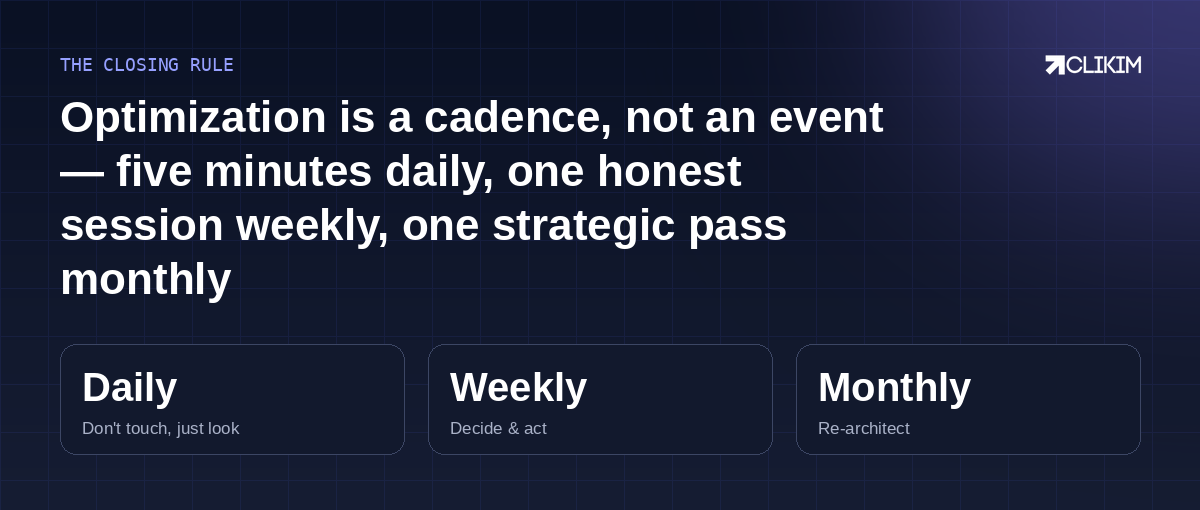
Five minutes daily, one honest weekly session, one monthly re-architecture — the whole series, operationalized.
attribution-settings comparison — make sure you're optimizing against the right numbers. incremental attribution — the setting that tries to count only added conversions.
Frequently asked questions
How often should I optimize my Facebook ads?+
What should I check daily on my Facebook ads?+
What's the right order for a weekly optimization session?+
How fast can I scale a winning ad set's budget?+
When should I kill an underperforming ad?+
Why is my perfectly optimized account still not scaling?+
Should I trust ROAS in Ads Manager?+
What is Learning Limited and what do I do about it?+
How many new creatives do I need per month?+
What belongs in the monthly review that weekly misses?+
What should a change log for ad accounts look like?+
Does this checklist work for TikTok ads too?+
What if I miss a weekly session?+
Run the cadence on an account without a ceiling
The checklist optimizes what the account allows. Whitelisted Facebook & TikTok infrastructure — aged, uncapped, under a BM2500 — makes the cadence the only limit.