
One Campaign or Many? Consolidation vs Segmentation in 2026
Structure is signal budgeting: every ad set is a mouth that needs ~50 conversion events a week. Here's the formula that sizes your account, the three-container default, the five splits that genuinely earn their cost — and the segmentation smells to merge today.
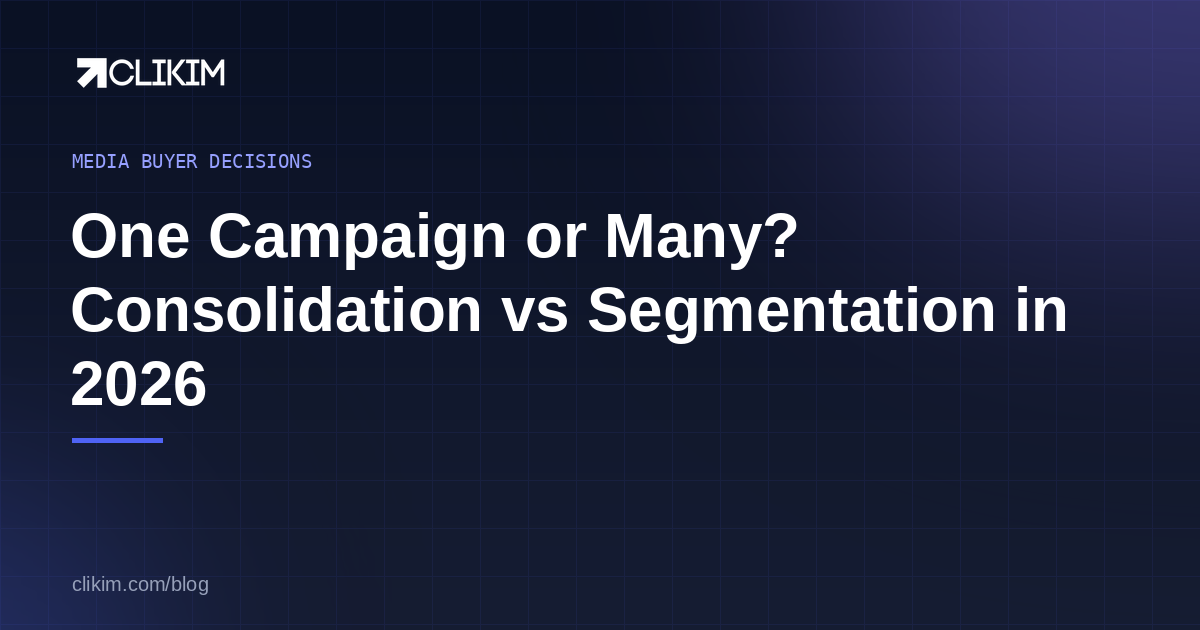
Run the formula first: weekly spend ÷ CPA ÷ 50 = the ad sets you can actually feed — most accounts run more mouths than their events can fill. Default to three containers: an ABO test bench, a scaling container (CBO/ASC), and at most one scalpel campaign for surgical jobs. Split only when the job differs (testing vs scaling, strict exclusions, real geo/offer differences, special ad categories) — never for hunches like interests, age brackets or placements. Re-run the math quarterly; structure grows behind spend, not ahead of it.
• Structure is signal budgeting: every ad set needs ~50 conversion events/week to learn. • Compute your ceiling: weekly spend ÷ CPA ÷ 50 = max healthy ad sets. Most accounts exceed it. • Default to as few containers as possible: test bench, scaler, and (maybe) one scalpel. • Split only for different jobs — testing vs scaling, strict exclusions, real geo/offer differences. • Never split by hunch: interests, age brackets, placements and product-curiosity all fragment signal. • Consolidation compounds: fatter ad sets learn faster, fatigue slower, and win cheaper auctions. • Re-run the math quarterly — structure should grow with spend, not ahead of it.
The question behind the question
"Should I split this into its own campaign?" is really asking: can I afford another mouth to feed? Every ad set is a learner that needs roughly 50 conversion events a week to stabilize — signal it can only get from your spend. Structure, properly understood, is the budgeting of that signal. One campaign or many isn't a philosophy debate; it's arithmetic most accounts have never run.
The signal-budget formula: spend ÷ CPA ÷ 50. Most accounts run more ad sets than their events can feed.
Run your own row before reading further: weekly spend, divided by CPA, divided by 50. A $500/day account at a $30 CPA generates ~117 events a week — enough to feed two ad sets properly. If that account runs nine, nothing learns, everything wobbles, and the "Facebook is inconsistent" complaint writes itself. The learning phase isn't a hazing ritual; it's the constraint the whole structure question orbits.
The consolidated default
Start from the minimum viable structure and make additions justify themselves: an ABO test bench (fair budgets for new angles, per the testing framework), a scaling container (CBO or ASC holding proven winners), and — only when a surgical job demands it — one scalpel campaign for strict exclusions or special offers. Three containers cover the vast majority of accounts under $50k/month, and the burden of proof sits on container number four.
Why the miser's posture pays: concentrated events exit learning faster, fatter audiences fatigue slower, consolidated history feeds stronger action-rate estimates (cheaper auctions), and every merged container is one less thing resetting itself every time you breathe on it. Consolidation isn't tidiness — it's compounding.
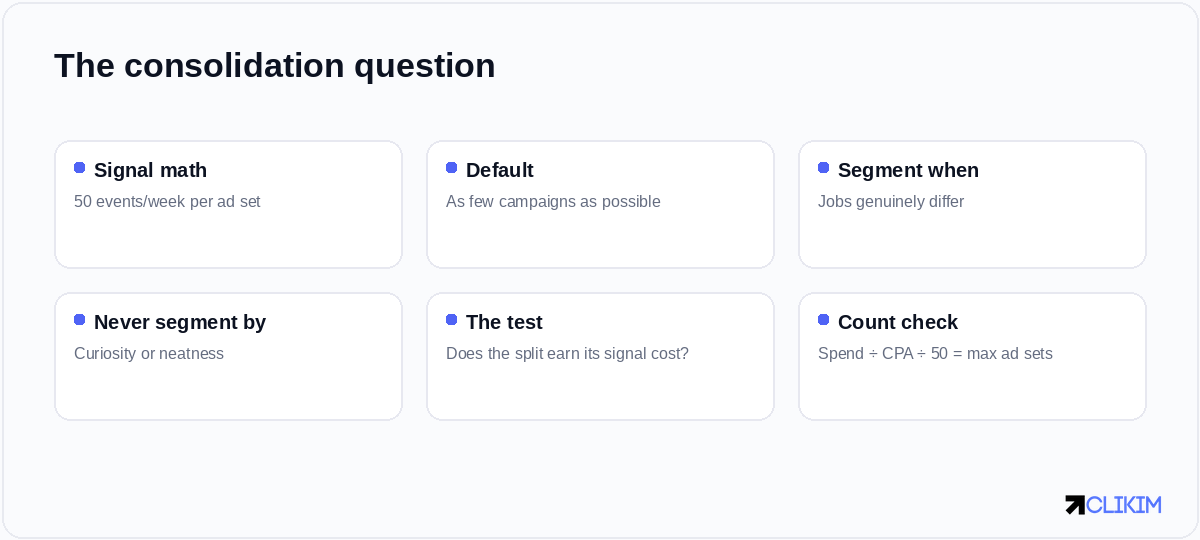
Structure is signal budgeting: compute the event budget, assign jobs, merge until it hurts.
When splitting genuinely earns its cost
Every legitimate split is a different JOB — not a different hunch about audiences.
The unifying test: a split earns its signal cost when the containers have different jobs, not different hunches. Testing and scaling want opposite budget philosophies — that's a job difference (the ABO/CBO split). Prospecting versus strictly-excluded remarketing addresses different humans by definition. A DE offer priced in euros with German creative is a different business from your US line. And special ad categories don't ask your opinion. Everything else on your structure chart should have to argue for its life.
Segmentation smells (merge these today)
If the only difference between two containers is a hunch, the structure is paying signal for astrology.
Each row is a 2019 habit surviving on inertia. The interest-per-ad-set museum fragments signal and overlaps audiences — the double tax we dismantled in broad vs interests. Age and placement splits duplicate work the delivery model does better internally. Product-per-campaign on a twelve-SKU store starves every container; one campaign with catalog dynamic ads pools the purchase signal instead. And winner-farms — five clones of the champion — are the duplication myth wearing a structure costume.
How to read a struggling structure
The symptoms of over-segmentation are consistent: multiple ad sets stuck in Learning or Learning Limited, blended CPA noticeably worse than your best ad set's CPA (fragmentation tax made visible), high audience-overlap percentages in the comparison tool, and a dashboard where every container's numbers are too small to mean anything on any given day. If your account diagnosis keeps ending in "not enough data" — per the delivery troubleshooting guide — the structure usually created that scarcity itself.
The merge protocol: consolidate the overlapping/starved sets into the broadest sensible container, keep the proven creative, expect one honest learning phase as the merged set consolidates its history, and resist re-splitting for at least a month. Accounts almost always exit the merge with better blended numbers than the fragments ever produced — usually within two weeks.
A merge, before and after
The numbers from a real-shaped example make the tax visible. Before: a $700/day apparel account running fourteen ad sets across five campaigns — interests, age splits, two winner-clones, a per-product campaign for each of four hero SKUs. Eleven of fourteen sets flagged Learning or Learning Limited; audience overlap between the interest sets ran 40–60%; blended CPA sat at $52 while the single best ad set — the only one clearing 50 weekly events — ran $31. The structure was paying a 68% fragmentation premium over its own proven capability.
The merge: three containers. One broad prospecting CBO holding the four best creatives; the ABO test bench; one catalog campaign pooling all SKUs. Week one: the consolidated sets re-learned (blended CPA briefly $44 — expected, per the honest learning phase). Week two: everything exited learning for the first time in the account's history. Week three onward: blended CPA settled at $33–35 on identical creative and spend. Nothing was optimized except the arithmetic.
Structure that grows with spend
Consolidation isn't forever-minimalism; it's sequencing. As spend grows, your event budget grows, and structure can responsibly expand: the $35k/week account genuinely can feed geo splits, funnel stages and offer lines that would starve a $3k account. The discipline is ordering — grow spend first, add structure second, re-running the ÷50 math at each step. Accounts that build the org chart before the signal budget end up with impressive architecture diagrams and unstable delivery.
Quarterly structure review, three questions: does every container still have a distinct job? does every ad set still clear ~50 events? did any split added last quarter actually beat the consolidated baseline it replaced? Kill what fails the questions — structure earns its complexity or loses it.
The ceiling on the whole equation
One variable silently caps the math: weekly spend is bounded by what the account allows. A $250/day-capped account generates a fixed, small event budget no structure can stretch — its consolidation isn't optional, it's forced, and even the minimum viable structure runs starved. Restrictions compound it: every interruption resets the learning that consolidation exists to protect.
Which makes infrastructure the upstream structural decision: an uncapped agency ad account raises the event budget itself — funding real testing, properly-fed scaling, and the structural room to grow when the economics say grow. The best campaign architecture is downstream of an account that can afford one.
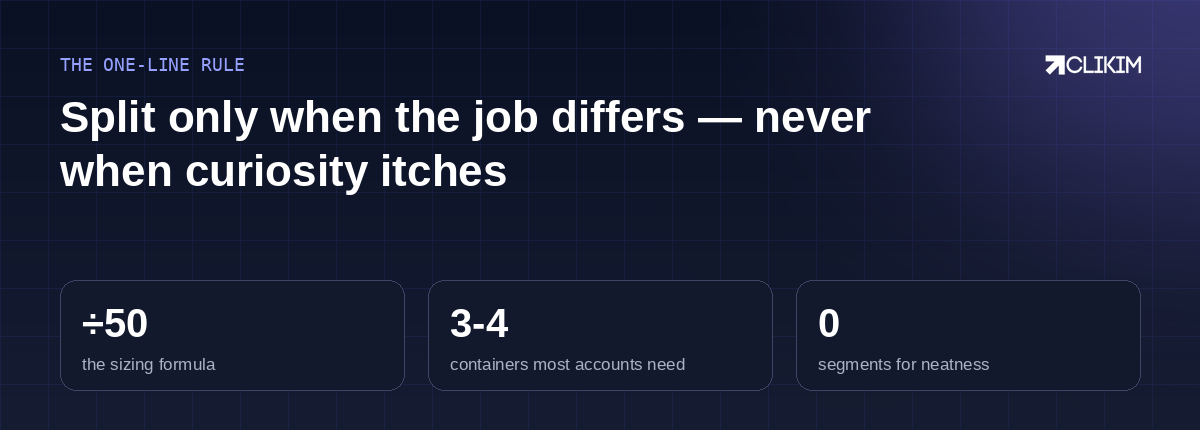
Compute the event budget, assign real jobs, merge the hunches — and grow structure behind spend, not ahead of it.
Frequently asked questions
How many Facebook campaigns should I run?+
Why is consolidation better than segmentation on Facebook?+
When should I split into a separate campaign?+
Is one ad set per interest still a good idea?+
Should each product get its own campaign?+
What are the signs my account is over-segmented?+
How do I merge over-segmented ad sets safely?+
Does the 50-events rule really matter?+
When can I add more structure?+
How does Advantage+ change the consolidation question?+
Do more campaigns give the algorithm more chances to win?+
What if my spending limit forces tiny budgets?+
Fund the structure, not just the chart
Event budgets come from spend, and spend comes from headroom. Managed whitelisted infrastructure with no preset cap keeps every container fed. Operated on BM2500 infrastructure.