
Google Ads in 2026: The Complete Operator’s Guide
Google Ads is the largest intent machine ever built — and in 2026 it’s also an AI-run auction wearing the interface of a keyword tool. This guide is the operator’s map: how the system actually decides who pays what, the campaign types worth your money, the billing and verification gates that quietly kill accounts, and how serious spenders structure for scale.
Google Ads in 2026 is an AI auction you steer with objectives, budgets and creative — not a keyword-bidding tool.
The order of operations that works: nail conversion tracking first, start with Search on exact-intent queries, feed Smart Bidding enough conversions to learn, then expand into Performance Max and Demand Gen once your signal is clean.
The unglamorous parts decide survival: billing thresholds, advertiser verification, and a suspension system that acts first and explains later. Every subsystem has its own deep guide in the hub below.
How Google Ads actually works
Strip the interface away and Google Ads is one mechanism: an auction for attention, held in the milliseconds after someone expresses intent. On Search that intent is a query; on YouTube and Display it’s inferred from behavior; on Shopping it’s a product hunt. You bring three inputs — money, targeting and creative — and Google’s models decide when you enter the auction and what you pay.
What most advertisers underestimate is how much of the outcome is decided by signal quality rather than settings. Smart Bidding optimizes toward the conversions you report. Feed it garbage — duplicate events, missing purchases, lead events that never become customers — and it optimizes toward garbage with industrial efficiency. The single highest-leverage hour you’ll spend on this platform is the hour you spend making conversion tracking truthful.
The second thing to internalize: Ad Rank still runs the auction. Your bid × predicted quality (expected CTR, relevance, landing-page experience) decides position and price. Quality is why a disciplined small account regularly beats a sloppy large one — the auction subsidizes ads people actually want to click.
The campaign types in 2026
| Type | Where it runs | Best for | Watch out for |
|---|---|---|---|
| Search | Google results | Capturing existing demand; highest intent | Broad match + weak negatives = budget leak |
| Performance Max | All surfaces at once | Ecommerce with clean feed + conversion data | Opaque by default — use channel reporting |
| Shopping | Shopping tab, results | Product catalogs with competitive pricing | Feed quality decides everything |
| Demand Gen | YouTube, Discover, Gmail | Demand creation with social-style creative | Judge on incremental lift, not last click |
| Video | YouTube | Awareness and action campaigns | Creative carries the whole load |
| Display | 3M+ sites and apps | Retargeting, cheap reach | Placement hygiene or MFA-site waste |
The 2026 lineup. Discovery campaigns became Demand Gen; PMax absorbed most of what Smart campaigns did for serious spenders.
The sequencing that keeps money safe: Search first on your provable-intent queries, because it converts on demand that already exists. Layer Shopping/PMax once the feed and purchase tracking are clean. Add Demand Gen and Video when you can afford to create demand, not just harvest it — and measure them on lift, not on the last-click column, or you’ll conclude they “don’t work” exactly when they do. The full argument for how these budgets split against Meta lives in our Google vs Meta comparison.
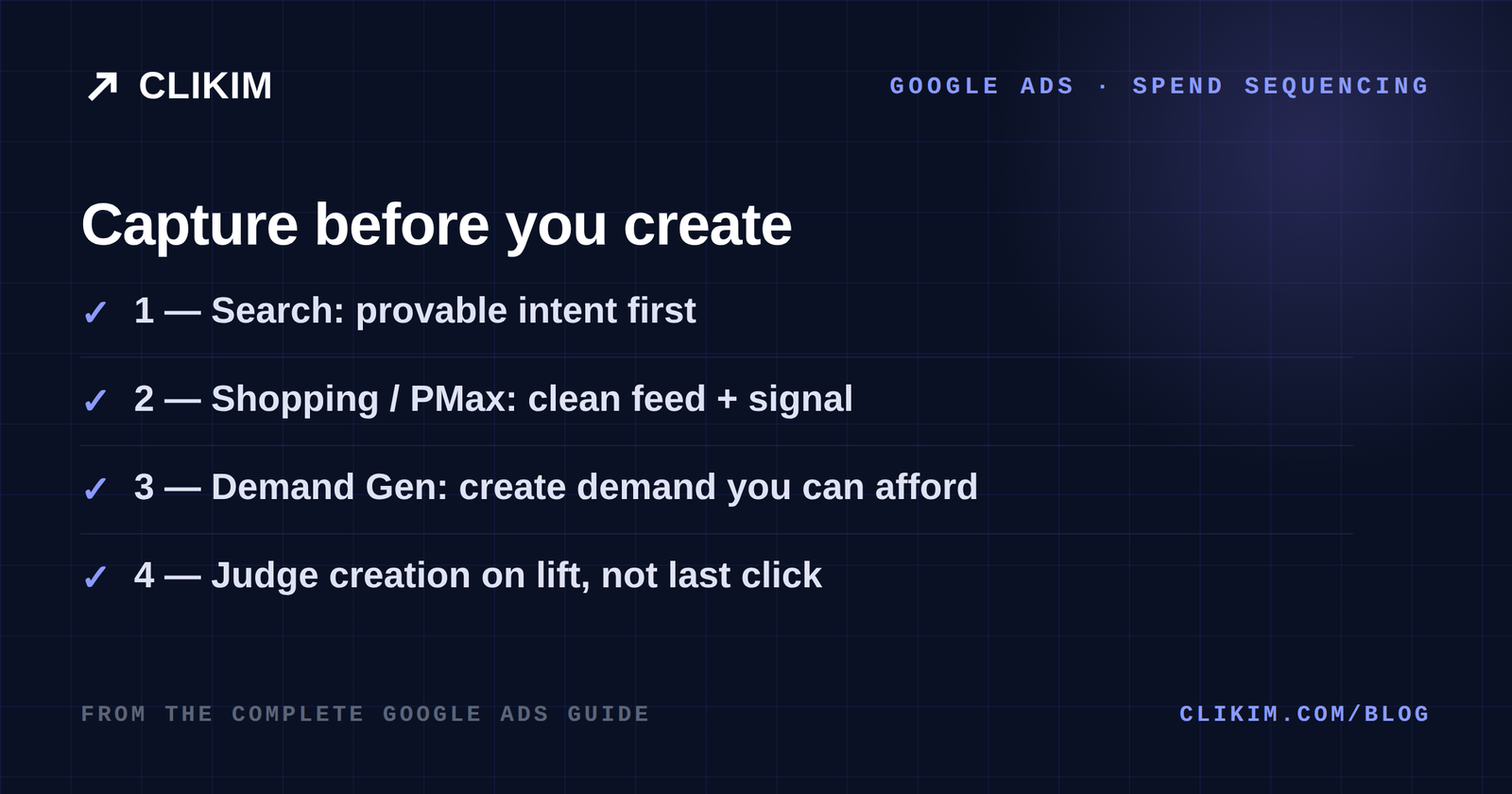
Sequence spend from provable intent outward — capture before you create.
Setting up an account properly
Account setup is where future suspensions are prevented or scheduled. The checklist that matters:
- One real business, one account — matching legal name, domain, and payment profile. Mismatches between who advertises, who gets paid, and whose site it is are the root of most “circumventing systems” flags.
- Conversion tracking before the first dollar — the Google tag or GA4 import, with the money events (purchase, qualified lead) marked primary and everything else secondary.
- Consent Mode v2 if you touch the EU — without it, measurement and remarketing degrade to nothing.
- Complete advertiser verification early — identity and, for some, business-operations checks arrive eventually; doing them on your schedule beats doing them during a suspension. The verification guide covers documents and the two-strike traps.
- Payment hygiene — a business card that matches the business, kept current; payment declines are a suspension vector, not just an inconvenience (see suspicious payment activity).
Billing, thresholds and payments
Google bills most accounts on automatic payments: you accrue spend, and you’re charged when you hit a billing threshold or your 30-day cycle — whichever comes first. Thresholds start small and climb with clean payment history. Two operational consequences follow.
First, a card decline at threshold pauses every campaign — mid-scale, mid-promotion, whenever the threshold happens to trip. Second, the threshold system spawned a grey market of “threshold accounts” — farmed accounts spent hard against a threshold that’s never paid. Understand them so you recognize why Google’s payment enforcement is so twitchy.
The mechanics of the legitimate system are in the billing thresholds guide. If your operation needs invoicing, monthly invoicing exists at scale, and managed infrastructure through Google Ads agency accounts carries funded-balance billing without threshold roulette.
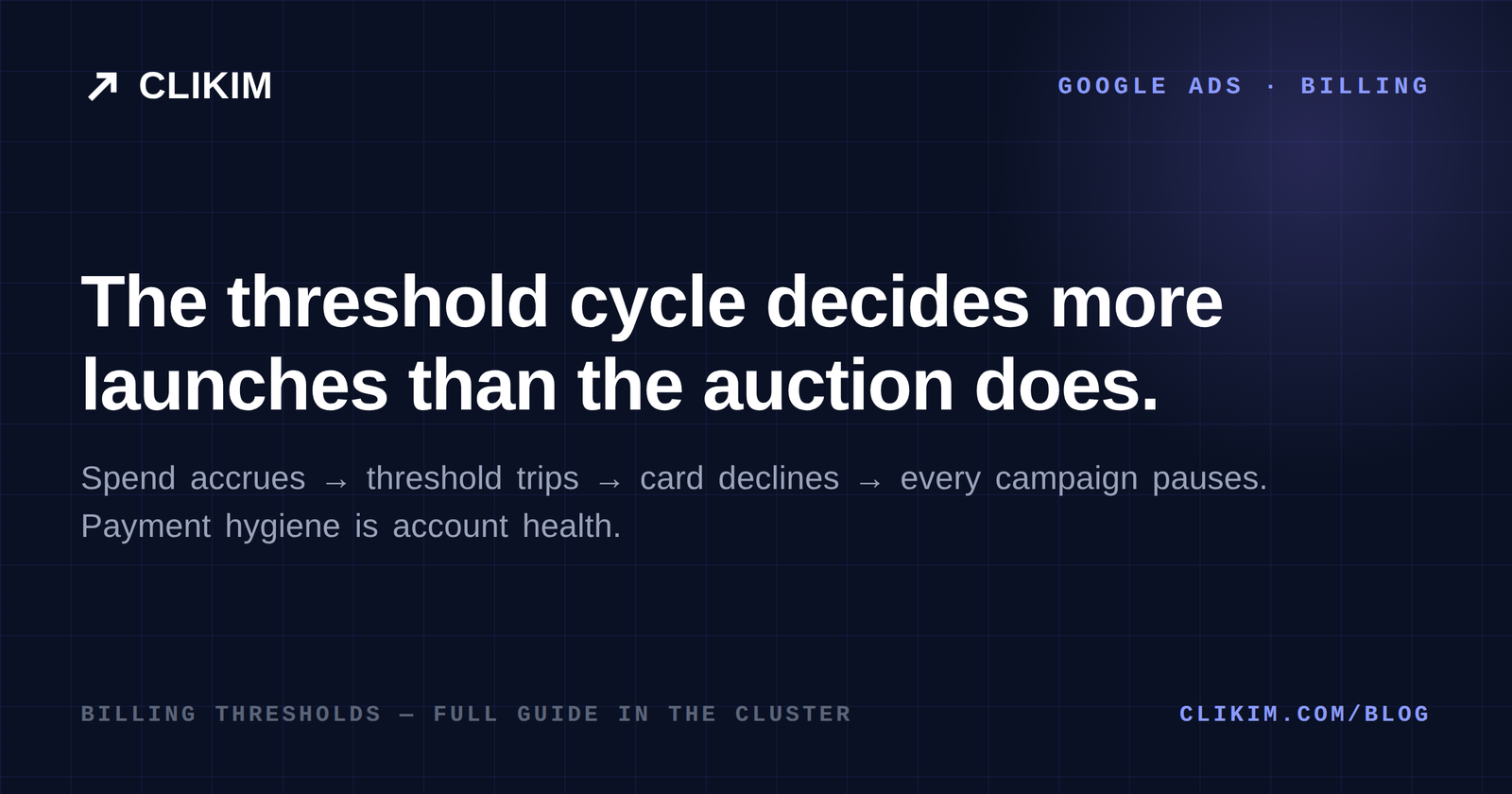
The threshold cycle: spend accrues, the charge trips, and a declined card pauses everything.
Smart Bidding without the mysticism
Manual CPC still exists, but the platform’s center of gravity is Smart Bidding: Target CPA, Target ROAS, Maximize Conversions, Maximize Conversion Value. The practical rules:
- Feed it volume. The models calibrate on conversions. Under ~30–50 conversions/month per bid strategy, expect volatility; consolidate campaigns until the math works.
- Targets are steering wheels, not wishes. A Target CPA far below what your account has ever achieved doesn’t produce cheap conversions — it produces no impressions. Move targets 10–20% at a time.
- Broad match is now a bidding feature. Paired with Smart Bidding and real conversion data it finds queries exact match can’t; paired with weak signal it sprays budget. Earn the right to use it.
- Respect learning periods. Every major edit re-calibrates. Batch changes, then leave the system alone for days, not hours.
Performance Max and Demand Gen
PMax is Google’s everything-campaign: one budget, all surfaces, AI allocation. It works genuinely well for ecommerce accounts with a clean product feed and truthful purchase values — and it has earned its reputation for opacity everywhere else. Run it with guardrails: channel-level reporting (now available) reviewed weekly, brand exclusions so it doesn’t claim your navigational traffic as wins, negative keywords applied, and asset groups organized by product economics rather than aesthetics.
Demand Gen is the social-style side: visually-led placements across YouTube, Discover and Gmail. Treat it like you’d treat Meta prospecting — creative-first, judged on incremental customers over a window, not same-day ROAS. It’s the natural second act once Search and Shopping have proven the funnel.
Suspensions, verification and account health
Google’s enforcement is automated-first and act-then-explain. Accounts get suspended before a human reads anything; appeals are how you reach the human. Three subsystems matter:
Suspension reasons cluster into billing (payment problems, suspicious payment activity), policy (what you advertise and how), and identity (who you appear to be vs who you verified as). The suspension guide decodes every reason string; the pattern across all of them is that Google suspends the account relationship, not the ad — fixing the ad without fixing the underlying mismatch gets the appeal templated away.
Appeals are a writing problem: one clear claim, evidence attached, zero indignation. The appeal playbook covers the formats that get read. Appeal once, properly — rapid-fire resubmissions queue you behind your own noise.
Verification is the quiet gate: identity checks, and business-operations questionnaires for advertisers in scrutinized flows. Treat every verification request as a same-week priority; expired requests suspend accounts that did nothing else wrong.
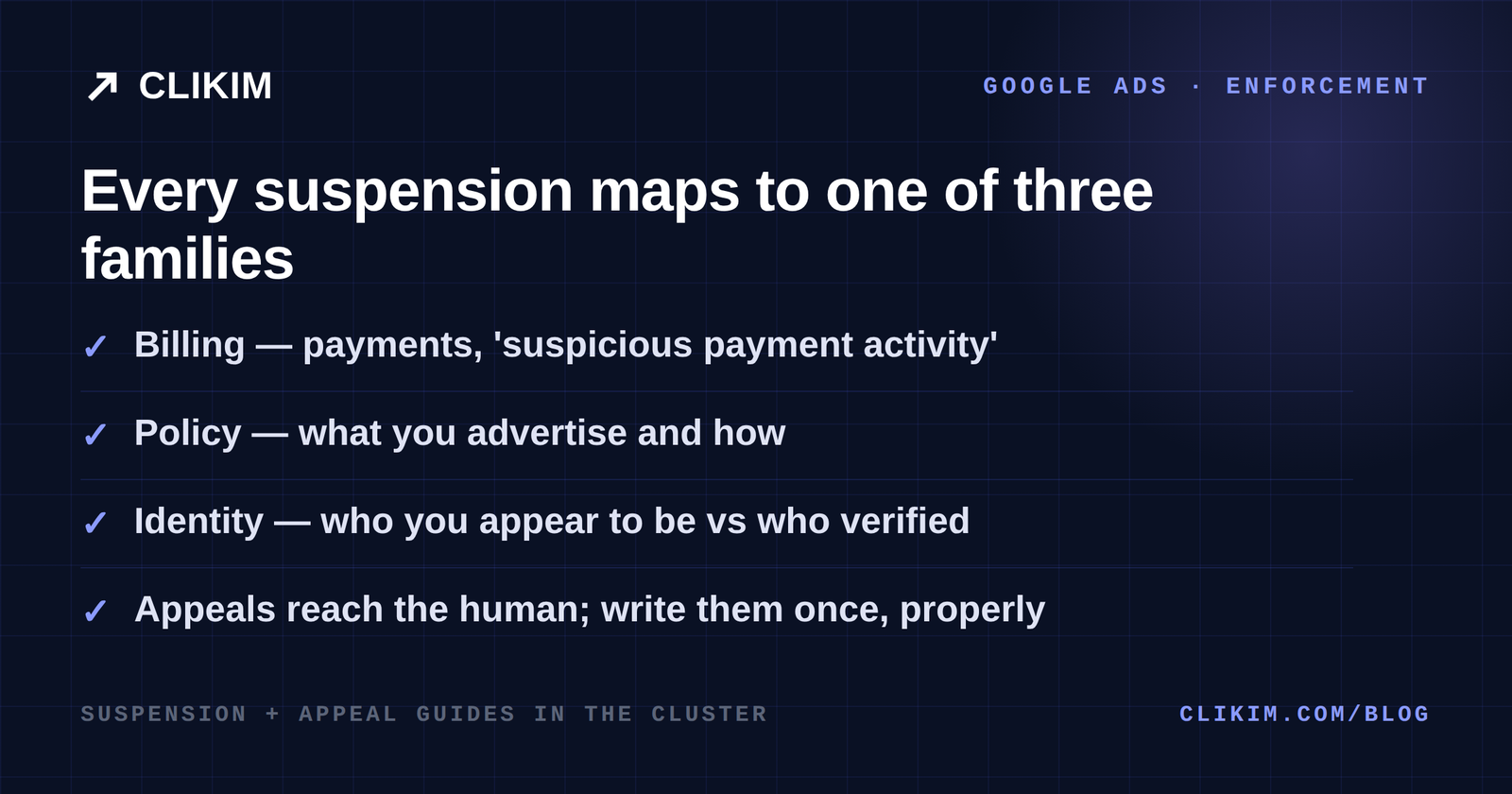
Three enforcement families — billing, policy, identity. Every suspension string maps to one.
Structure and scaling
Past a few thousand a month, structure is what scales — not hero campaigns. The operator pattern: consolidated campaigns per economic unit (not per keyword whim) so Smart Bidding gets volume; an MCC manager account as the umbrella once multiple accounts exist; documented conversion definitions so nobody “optimizes” the tracking into fiction; and payment capacity that won’t flinch at scale.
That last one is where serious spenders hit the platform’s quiet ceiling: new accounts with low thresholds, verification friction mid-scale, and billing pauses at exactly the wrong moment. It’s the problem managed infrastructure exists to absorb — established structures, invoiced billing, and support that answers.
The market for that access runs from legitimate operators to landing-page-only resellers. The provider landscape guide maps how to tell them apart, and our own managed Google Ads access is documented plainly if the fit is right.
The Google Ads library: every guide in this cluster
This pillar is the map; the cluster goes deep on each subsystem. Everything below is written for operators, kept current, and linked back here.
Frequently asked questions
Is Google Ads worth it in 2026?+
How much does Google Ads cost?+
How long does Google Ads take to work?+
Should I start with Performance Max or Search?+
Why did my Google Ads account get suspended?+
What’s the difference between Google Ads and an MCC?+
Do I need advertiser verification?+
Serious Google spend needs serious rails
Managed Google Ads infrastructure through Clikim — established structures, invoiced billing instead of threshold roulette, and a rep who answers before small problems become suspensions.